
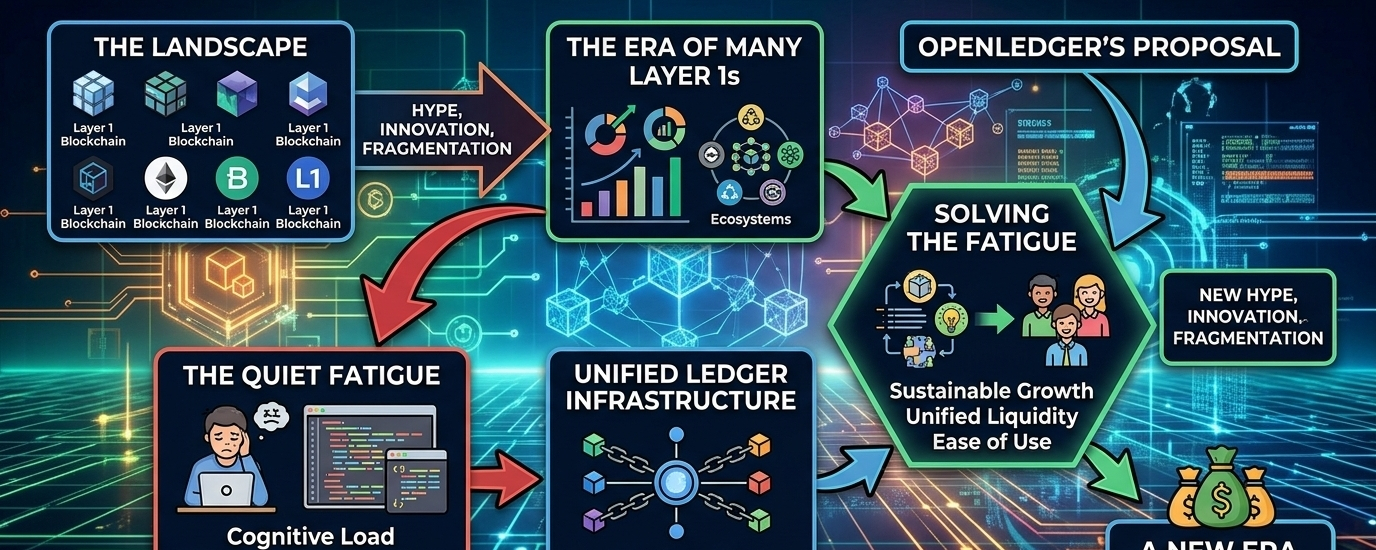
The first time I looked at OpenLedger, I didn’t really have a strong reaction. Which, honestly, might be a better sign than excitement at this point. Crypto has trained people to react instantly to keywords. AI. Modular. Layer 1. Coordination layer. Agent economy. Everyone already knows the script before the whitepaper even loads. Usually within ten minutes you can predict the entire community timeline too. A few big accounts posting diagrams. Some venture names floating around. A roadmap full of abstractions that somehow always ends with “mass adoption.”
OpenLedger feels aware of that fatigue, at least a little.
Not in the sense that it avoids ambitious language completely. It still sits inside the same ecosystem of promises every newer chain enters. But the framing around data, models, and AI agents feels slightly different from the usual “faster blockchain” conversation. Less obsessed with throughput benchmarks and more focused on the uncomfortable reality that AI systems are becoming economic actors before the infrastructure around them is remotely mature enough to handle it.
That part is interesting to me.
Because after years in crypto, you start realizing most chains are not actually built around real pressure. They’re built around hypothetical pressure. Testnet traffic. Carefully staged stress demos. Synthetic numbers. Real systems break in uglier ways. Congestion doesn’t arrive politely. Users don’t coordinate their behavior just because a validator architecture looked elegant in a technical diagram.
The real test starts when people stop behaving predictably.
And honestly, crypto already has examples of this. Solana is probably the clearest one. When conditions are normal, it feels incredibly smooth. Fast enough that people stop thinking about the chain itself. Which is probably the goal. But then periods of heavy activity hit and suddenly the conversation changes from user experience to survivability. Spam. Failed transactions. Congestion debates. Validator pressure. None of that means Solana failed. I think people flatten those discussions too much. It just means scale is messy in practice. Real usage introduces weird behavior that architecture alone can’t fully anticipate.
That’s the thing newer Layer 1 discussions often avoid. Systems don’t collapse because the founders lacked intelligence. They collapse because live environments are irrational.
OpenLedger seems to quietly orbit around that realization. Not directly, maybe. But indirectly through this idea that AI coordination itself becomes infrastructure. That liquidity isn’t only financial anymore. Data becomes liquid. Models become liquid. Agents interact with each other economically instead of sitting inside isolated applications.
Now whether that actually becomes reality is another question entirely.
Crypto has a long history of describing future behaviors that never materialize outside conference panels. Interoperability was supposed to solve fragmentation. Then bridges became security liabilities. App-chains were supposed to solve congestion. Then liquidity scattered everywhere and users got tired of moving assets across ecosystems. Modular architecture was supposed to simplify scaling but mostly made the average user feel like they needed a map just to understand where they were.
So when people talk about AI agents transacting across decentralized systems, part of me immediately assumes we’re still early in the imagination phase. The conceptual phase always sounds cleaner than the operational one.
Still, OpenLedger does seem to notice something important that many AI-related crypto projects ignore.
Most current AI infrastructure conversations focus heavily on model outputs while treating the underlying contributors almost like invisible machinery. Data providers disappear into the background. Attribution becomes vague. Economic value pools at the application layer while the lower layers become interchangeable commodities.
OpenLedger appears to push against that a bit by making contribution tracking part of the system design itself. At least philosophically. The idea that data, models, and agents can all be accounted for economically instead of existing as detached components.
I don’t think people fully appreciate how difficult that becomes once actual scale enters the picture though.
Tracking contribution sounds simple until multiple models train recursively on outputs generated by other models trained on partially synthetic data originating from unknown sources. Attribution starts dissolving quickly. Ownership becomes blurry. Incentive systems become gameable. Every economic layer attracts extraction behavior eventually.
And that’s where I become cautious again.
Because crypto loves clean incentive diagrams. Reality produces strange loops instead.
At the same time, I understand why projects like this keep emerging. There’s a growing sense that existing internet infrastructure wasn’t really designed for machine-native economies. Most systems still assume humans are the primary actors coordinating value exchange. But AI changes interaction patterns completely. Machines generating content. Machines consuming APIs. Machines optimizing capital allocation. Machines negotiating with other machines eventually. It sounds absurd until you realize parts of it are already happening in fragmented ways.
Maybe OpenLedger is trying to position itself for that transition before it fully arrives.
Maybe too early.
Maybe exactly early enough.
Hard to tell from here.
What I find more interesting than the branding itself is the trade-off profile underneath it. OpenLedger doesn’t appear obsessed with becoming the universal chain for everything. That alone is refreshing. A lot of Layer 1s die trying to become entire civilizations instead of infrastructure. OpenLedger feels narrower in focus. More willing to simplify around a specific assumption: that coordination around AI-generated value becomes increasingly important.
But narrowing scope creates its own risks.
Specialized ecosystems often struggle to attract general liquidity. Users rarely migrate because architecture improved slightly. They move when there’s opportunity, incentives, or cultural gravity. Sometimes not even then. Most people stay where their assets already live. Habits matter more than whitepapers.
This is where nearly every new chain runs into the same wall eventually.
Not technology. Inertia.
Ethereum still dominates partly because everyone already built their lives around it. Solana retains energy because its ecosystem actually feels alive during active periods. Users tolerate imperfections when activity exists. Liquidity clusters socially before it clusters technically.
So the real question for OpenLedger probably isn’t whether the design makes sense. Parts of it genuinely do. The harder question is whether an AI-centered economic layer can attract sustained participation before the market moves on to the next narrative cycle pretending to reinvent intelligence again.
Because AI discourse inside crypto already feels overheated sometimes. Every second project suddenly becomes an “AI protocol” the moment funding conditions shift. You can almost watch teams rewriting descriptions in real time to fit investor appetite. That atmosphere makes it harder to evaluate projects fairly because everything starts sounding contaminated by trend exposure.
OpenLedger sits inside that environment whether it wants to or not.
But beneath the buzzwords, there is a real underlying tension being explored here. If machine-generated activity becomes economically meaningful, existing infrastructure probably does become insufficient eventually. Attribution matters. Coordination matters. Resource allocation matters. Even identity starts becoming strange once autonomous systems participate economically.
The project seems aware of that future pressure.
I just don’t know if awareness alone is enough anymore.
Execution decides everything eventually. Community quality matters. Developer retention matters. Whether builders stay after incentives fade matters. Whether the chain behaves predictably during chaotic conditions matters. Most infrastructure looks convincing before stress arrives.
And honestly, after enough cycles, I’ve stopped assuming any chain automatically earns permanence just because the narrative sounds intelligent.
Still, I can’t fully dismiss OpenLedger either.
There’s at least an attempt here to think one layer deeper than the usual throughput race. Less obsession with raw speed. More attention toward how value itself moves between contributors in AI systems. That doesn’t guarantee success. But it feels more grounded than pretending another slightly faster chain alone changes everything.
Maybe the future really does become a network of specialized systems sharing load instead of one dominant settlement layer swallowing the internet. Or maybe fragmentation simply becomes too exhausting and users retreat toward whichever ecosystem already feels familiar.
Both outcomes seem plausible right now.
That uncertainty is probably the most honest part of the entire conversation.
It might work. Or nobody shows up.
