
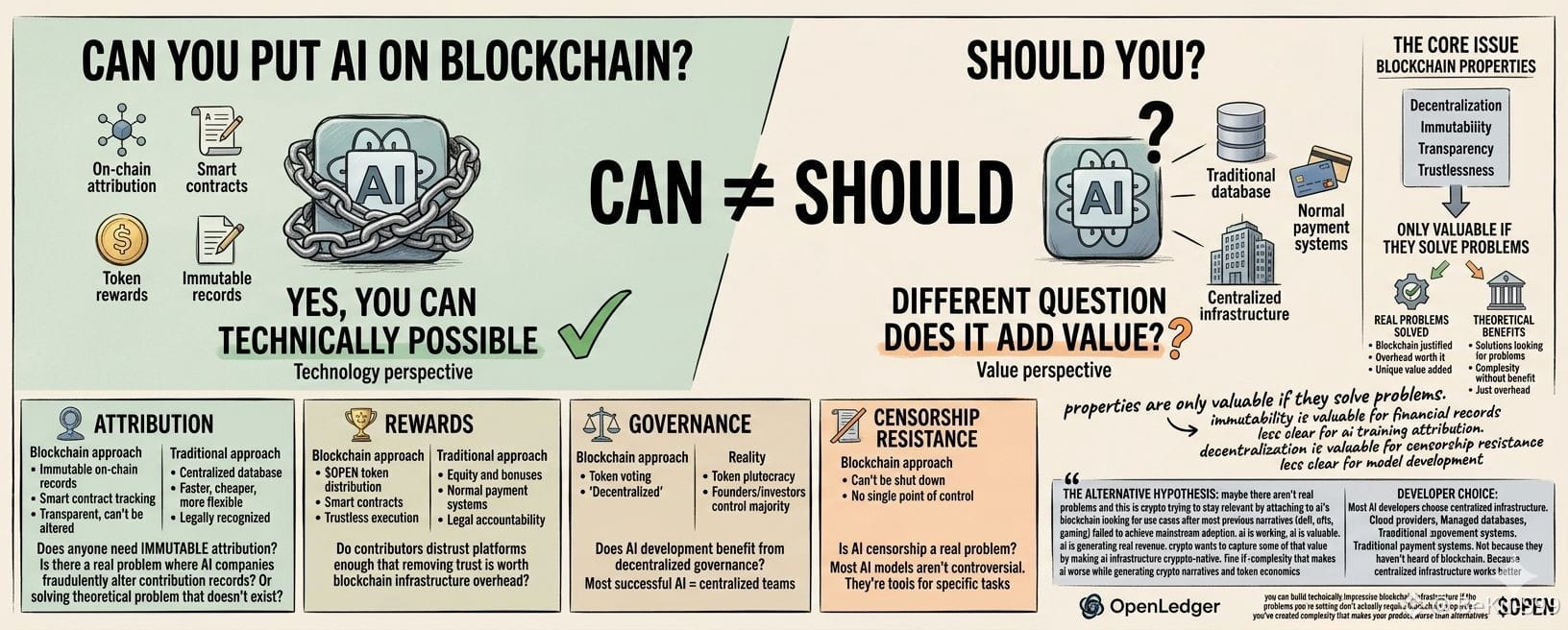
I keep watching @OpenLedger and trying to figure out whether AI training and inference genuinely benefit from being on blockchain or whether this is crypto finding new narratives after most others failed.
What I'm watching isn't whether the technology works. You can put AI attribution on-chain, track contributions with tokens, and manage rewards through smart contracts. What I'm watching is whether doing those things on blockchain creates value that couldn't be achieved more simply off-chain.
The blockchain necessity question for AI infrastructure.
Not whether you can put AI on blockchain. The fundamental question of whether you should. Whether the specific properties blockchain provides—decentralization, immutability, transparency—actually improve AI development or whether they're solutions looking for problems.
That distinction matters because complexity without corresponding benefit is just overhead.
OpenLedger puts data attribution, model training records, and reward distribution on-chain. Every contribution gets verified and recorded immutably. Smart contracts manage compensation.
What I can't tell is which of those things actually requires blockchain versus which could work better with traditional infrastructure.
The challenge is that most blockchain-AI pitches assume blockchain adds value without proving it.
Take attribution. OpenLedger tracks who contributed what data. But does it need blockchain? Centralized databases can track contributions. They're faster, cheaper, more flexible.
The blockchain argument: centralized databases can be altered. Blockchain provides immutability.
But does anyone need immutable attribution? Is there a real problem where AI companies fraudulently alter contribution records?
Same with rewards. @OpenLedger distributes $OPEN tokens based on contributions. Those distributions happen through smart contracts. Transparent, automated, trustless.
But companies distribute equity and bonuses without blockchain. They use traditional systems. Those systems work. They're legally recognized.
What does blockchain add? Trustlessness. You don't need to trust the platform to execute payments correctly.
Is that valuable for AI development? Do data contributors actually distrust platforms enough that removing trust is worth blockchain infrastructure overhead?
Most likely, no. People trust traditional platforms because there's legal accountability. OpenAI doesn't need blockchain to pay contractors.
Maybe OpenLedger argues decentralization is the value.
But token voting isn't decentralization. It's plutocracy.
And even if it were, does AI development benefit from decentralized governance?
Probably not. Most successful AI happens in centralized organizations. OpenAI, Anthropic, Google.
Maybe the argument is censorship resistance. Decentralized AI can't be shut down.
That's potentially valuable. But is AI censorship a real problem? Most AI models aren't controversial. They're tools for specific tasks.
I'd prefer seeing OpenLedger articulate specific problems that blockchain solves for AI development. Not theoretical benefits. Actual problems that exist today.
Most blockchain-AI projects can't do this. They assume blockchain is obviously valuable.
But properties are only valuable if they solve problems.
The stakes for adoption depend on whether blockchain adds value or just adds complexity. If blockchain solves real problems better than alternatives, developers choose it despite overhead. If it doesn't, they choose simpler centralized infrastructure.
Most AI developers choose centralized infrastructure. They use cloud providers, managed databases, traditional payment systems. Because centralized infrastructure works better.
Maybe OpenLedger has identified specific problems where blockchain genuinely helps.
Maybe there aren't and this is crypto trying to stay relevant by attaching to AI's success. Blockchain looking for use cases after most previous narratives failed to achieve mainstream adoption.
AI is working. AI is valuable. AI is generating real revenue. Crypto wants to capture some of that value by making AI infrastructure crypto-native.
That's fine if blockchain actually improves AI. It's not fine if blockchain is parasitic complexity that makes AI development worse while generating crypto narratives and token economics.
I'm watching to see which one OpenLedger becomes.
The blockchain necessity question's fundamental. You can build technically impressive blockchain infrastructure. If the problems you're solving don't actually require blockchain properties, you've created complexity that makes your product worse than alternatives.
And honestly, I trust platforms that question whether their use case needs blockchain over platforms that assume blockchain is obviously valuable and work backwards from that assumption.
