
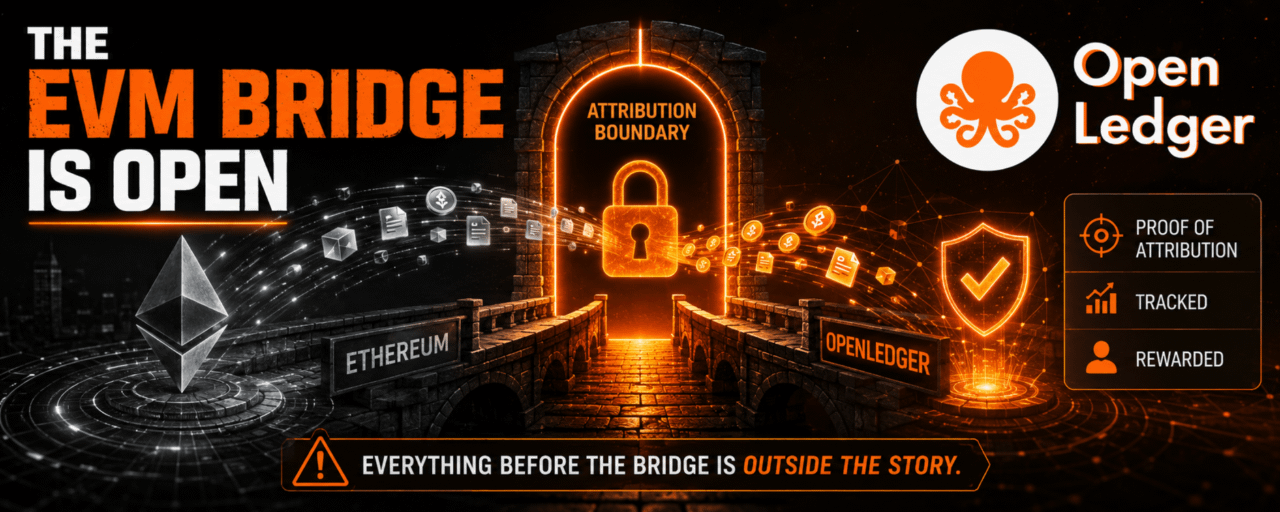
OpenLedger runs as an EVM-compatible OP Stack rollup, which means builders can move assets across from Ethereum without rewriting their entire stack. That compatibility is genuinely useful, most serious Web3 infrastructure already lives on or around Ethereum, and a bridge that preserves familiar tooling lowers the barrier to adoption significantly.
What I keep thinking about is what happens at the crossing point itself, and it turns out to be more structurally interesting than the bridge narrative usually suggests.
Proof of Attribution is built around a specific assumption: that the economic history of a data contribution, model interaction, or agent decision can be traced on-chain from origin to inference output. The system is only as reliable as its ability to see the full picture. A partial attribution trace, one that captures some of the history but not all, doesn't just leave gaps. It creates something potentially more dangerous than obvious opacity: a record that looks complete but isn't.
The EVM Bridge introduces that problem structurally.
When assets or data move from Ethereum into OpenLedger, they cross what I'd call an attribution boundary, the point at which PoA gains visibility. Everything that happens after the crossing gets tracked, scored, and linked to contributor rewards. Everything before the crossing sits outside the attribution graph entirely. The source chain's history doesn't travel with the asset. OpenLedger sees an arrival, not a journey.
This matters more as the network matures than it does at launch.
In the early stages, most activity originates natively within OpenLedger - DataNets built from scratch, agents deployed locally, inference requests generated on-chain. Attribution traces are clean because everything started inside the visibility boundary. But EVM compatibility is explicitly designed to change that. The bridge exists to pull Ethereum-ecosystem capital, data, and agents into OpenLedger. As adoption grows, a larger fraction of what enters the system will carry pre-crossing history that PoA is structurally blind to.
The analogy that keeps coming back to me is supply chain certification. An audit can track every step of production inside a certified facility with high accuracy. But when raw materials arrive from outside the certification boundary, the audit's integrity depends on documentation it didn't generate and can't independently verify. The final product carries a certificate that's technically accurate for every step the auditor could see, and silent about the steps it couldn't. Enterprise procurement teams that care about AI provenance, increasingly they do, for regulatory reasons, will eventually ask the same question about OpenLedger's attribution records: what exactly does this trace cover, and where did visibility begin?
Here's what I can't dismiss cleanly. EVM compatibility isn't a design compromise. It's a strategic necessity. A blockchain that required builders to abandon Ethereum tooling and build attribution history from zero would have a fraction of OpenLedger's addressable market. The bridge is what makes the network viable at scale, which means the attribution boundary it creates isn't accidental, it's load-bearing infrastructure inside the growth model.
That creates a tension worth naming precisely. The faster OpenLedger grows through EVM integration, the larger the fraction of on-chain activity carrying pre-crossing history outside the attribution graph. Growth and attribution completeness pull in opposite directions, at least until cross-chain provenance standards exist and those standards don't exist anywhere in the industry yet.
What I watch for is specific. Whether bridge contracts include attribution metadata in their event logs alongside asset transfers. Whether there's a provenance import standard being developed for cross-chain contribution history. Whether enterprise deployments that use the bridge include any contractual treatment of what happens to attribution claims that predate the crossing. None of that is publicly visible yet. The bridge ships. The provenance question gets handled later, if at all.
That sequencing might be acceptable, infrastructure rarely ships with all its accountability mechanisms fully formed. But it means attribution completeness on OpenLedger is currently a function of where assets originated. And as the bridge becomes the primary growth channel, that dependency doesn't shrink. It compounds.