
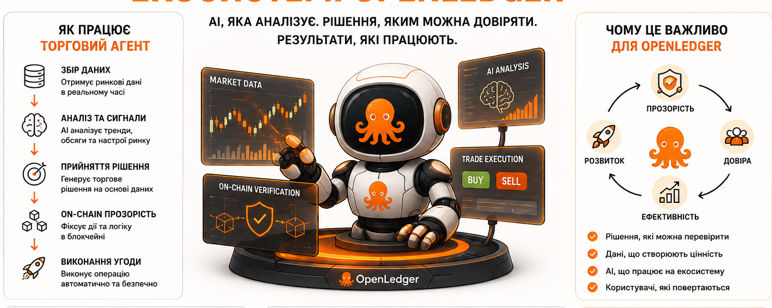
Yesterday, I was once again stuck pondering about a trading agent in the ecosystem.@OpenLedger And honestly, the longer you look at this whole story, the more you start to realize — it’s not just about another AI tool or a shiny idea around automation. It’s fundamentally a question of whether these agents can actually change the way we interact with the market, rather than just being another trendy addition to Web3. If you strip away all the noise surrounding AI narratives, lately the market has been flooded with stories about smart agents, trading bots, and systems that 'analyze everything better than a human'. Sounds great. But all too often behind the flashy words lies a familiar script: more hype, more promises, more attention. And that's where it gets really interesting. In#OpenLedger The history potentially looks deeper. Here, the trading agent is perceived not just as a mere automation mechanic, but as a potential intersection between AI, data, and real action within the ecosystem. When decisions start being made not only by humans but by a system constantly interacting with data, the whole structure begins to move a bit differently. But the main question that really triggers me is: is the mere existence of an agent enough for all this to work smoothly and sustainably? In my opinion, the problem with many projects is that smart systems sometimes only create the illusion of depth. People come to check out the new tech, test its capabilities, catch the initial hype — and then the usual reality check comes, smashing the entire illusion of success against a concrete wall. And when the initial novelty wears off, the real value becomes visible. OpenLedger$OPEN looks a bit different for now, because here the trading agent can potentially work not just as a short-term tool or an informational trigger, but as part of a larger interaction model. More data, more activity, more use cases. But let's be honest: that might not be enough either. Any system starts to change only when a habit of interaction arises between the user and the mechanics. If the agent merely creates a short spike of interest — the ecosystem will feel it sooner or later. Math, as always, wins. That's why it's critically important for OpenLedger that the trading agent isn't just a new AI layer over the ecosystem, but a part of a larger logic. It should be connected not just to the tech wow-factor, but to utility, transparency, and long-term motivation. Because as soon as the mechanics exist solely for the moment — they become fragile. And here, in my opinion, lies the most crucial point. The true strength of the trading agent is not in its ability to make decisions automatically, but in whether it fosters trust in those decisions. And that's a whole different level. The difference between a strong AI tool and a weak one is defined not by the noise around its launch, but by user behavior. If they return because they see real value in the system — that's growth. If they come only due to the hype around AI — that's just deferred risk. And perhaps this is what currently determines the role of the trading agent in the future of OpenLedger. Because it's not about 'is there AI there.' It's about whether it can maintain balance where many other models have already started to crumble. After all, a Trading agent is not about the 'Start' button. It's about the psychology of trust multiplied by math.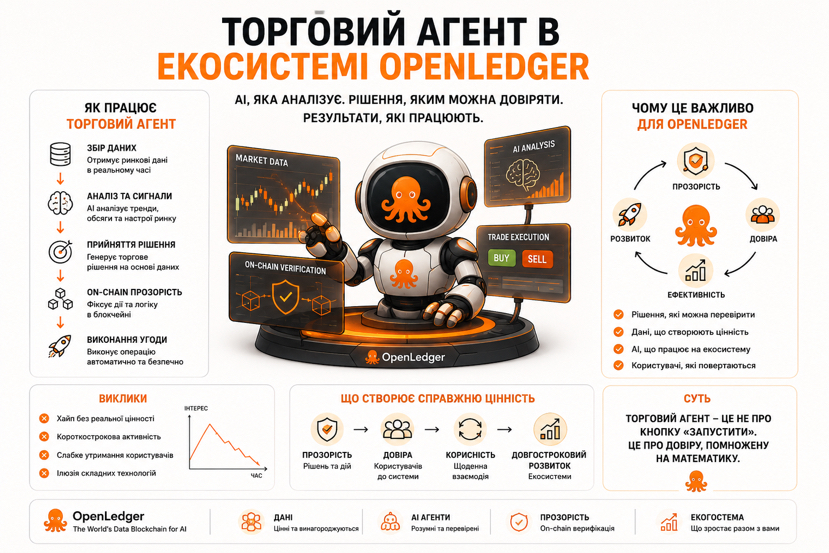
Let's see if this is enough. After all, this is where it's decided whether the trading agent will become the foundation for a new level of interaction for OpenLedger… or just another bubble, an incomprehensible and useless story that the market once crushed and didn't even notice. 😏
