
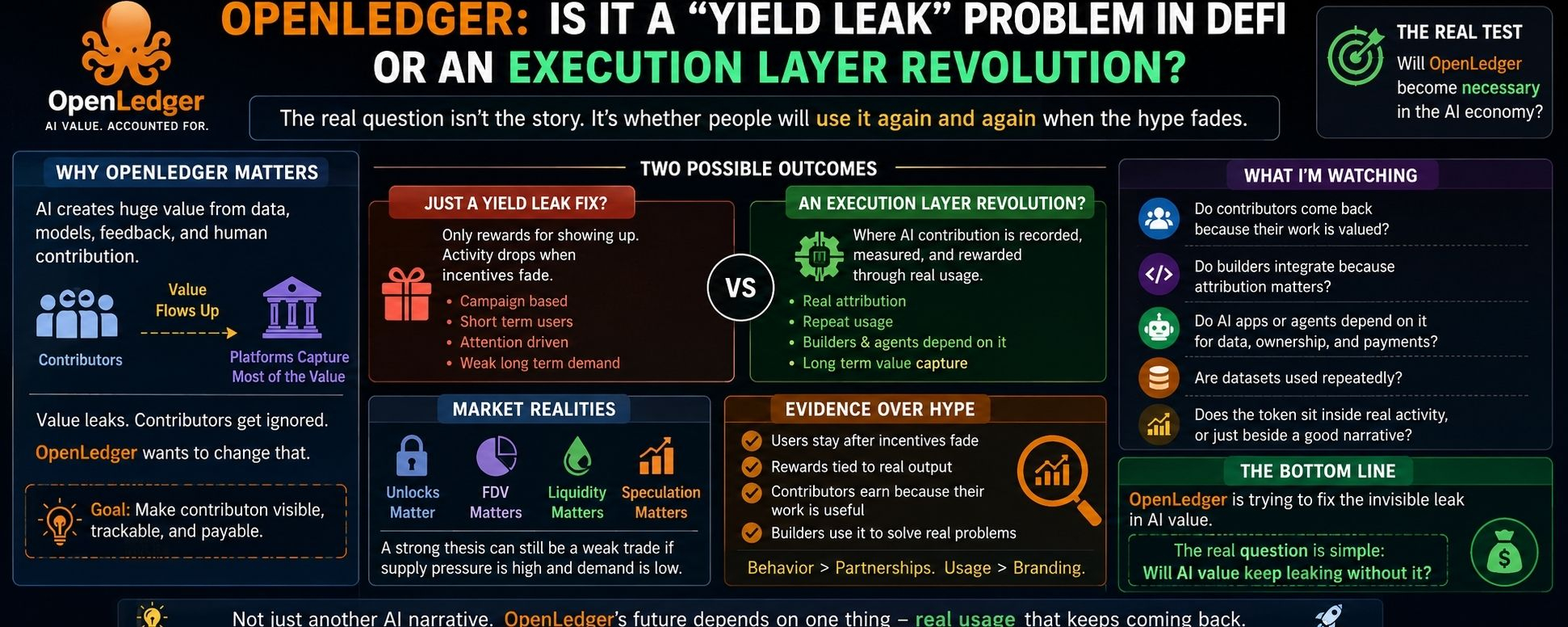

I’m looking at OpenLedger as more than another AI crypto name passing through the market. At first, it is easy to place it inside the same bucket as every other AI token: data, agents, incentives, infrastructure, big future, big story. But the more I look at it, the more I think the real question is simpler and harder at the same time.
Can OpenLedger become useful after the excitement cools down?
That is what I care about as a trader. Not only the branding. Not only the partnerships. Not only the AI label. Those things can bring attention, but attention is not the same as demand.
OpenLedger is trying to solve a problem that most people ignore. AI does not create value from nothing. It depends on data, human input, feedback, corrections, models, and community contribution. The issue is that many of the people who help create that value never stay connected to the money later.
That is where the “yield leak” idea makes sense to me.
In DeFi, yield can leak through bad systems, weak routing, idle liquidity, or incentive games. In AI, value leaks when contributors help build something useful, but the reward flows somewhere else. OpenLedger seems to be focused on making that contribution visible, trackable, and possibly payable.
That sounds strong, but I still do not want to treat it like a guaranteed win.
Crypto has seen many projects with beautiful problems and weak token demand. A project can be important, but the token can still struggle. A network can have users, but if those users only come for rewards, the activity may not last. That is why OpenLedger needs to prove more than a good idea.
I’m watching whether people use OpenLedger repeatedly.
Do contributors return because their work has real value? Do builders use it because attribution matters to them? Do AI apps or agents need it to track data, ownership, or payments? Do datasets get used again and again? These questions matter more than a loud campaign.
This is where OpenLedger could become bigger than just a fix for leaked value.
If the project only rewards people for showing up, then it is just another incentive machine. But if it becomes a place where AI contribution is recorded, usage is measured, and rewards move based on real activity, then it starts looking more like an execution layer for AI value.
That difference is important.
An execution layer is not just a story. It is where things actually happen. It is where users, builders, contributors, and applications come back because the system gives them something they cannot easily get elsewhere. For OpenLedger, that would mean becoming part of the actual AI workflow, not just part of the AI narrative.
Still, the market side cannot be ignored.
Liquidity matters. Unlocks matter. FDV matters. Speculation matters. Even if OpenLedger has a strong thesis, traders still need to ask whether real demand can handle future supply. A good project can still become a difficult trade if the token has too much pressure and not enough repeated use.
That is why I am not judging OpenLedger only by announcements.
I want to see behavior. I want to see users staying after incentives fade. I want to see contributors earning because their work is useful, not just because they are early. I want to see builders using OpenLedger because it solves a real problem, not because it sounds good in a tweet.
OpenLedger’s strongest idea is that AI value should not stay invisible. If people contribute data, improve models, support agents, or help build useful intelligence, there should be a way to track that value. There should be a way to connect contribution with reward.
That is a real market problem.
But the token only becomes interesting if that problem creates repeated demand. Not one-time hype. Not temporary farming. Not empty activity. Real demand means someone has to use the system because it makes the AI economy work better.
That is the line I keep coming back to with OpenLedger.
If it becomes another AI narrative, the market will trade it like a narrative. Fast attention, fast rotation, fast doubt. But if it becomes infrastructure that AI builders and contributors actually depend on, then the market may be underestimating what it is trying to build.
So I am not asking whether OpenLedger has a good story.
I am asking whether OpenLedger becomes necessary when AI value needs to be tracked, paid, and proven.