
A couple of nights ago, I had dinner with a friend who's into quant trading, and he casually mentioned something that stuck with me. He said that in their current strategies, they’re using several Agents that operate with each other. One Agent gathers on-chain data, another generates trading signals, and a third executes the orders—pretty much no human intervention is needed. His daily grind is just making sure those Agents aren’t throwing shade at each other. This really hit me; the so-called Agent-to-Agent collaboration isn’t just a story—it’s a reality that’s already unfolding.
But right now, there's a huge issue with this Agent collaboration: there’s no common settlement and trust mechanism among them. When one Agent calls another Agent's service, how does the payment work? Who ensures that the call records can’t be tampered with? Is the data source compliant? These questions are usually handled in traditional Web2 API systems through pre-signing contracts and manual reconciliations, but once the number of Agents increases, that method just can't hold up. What @OpenLedger is doing happens to be the solution to this problem.
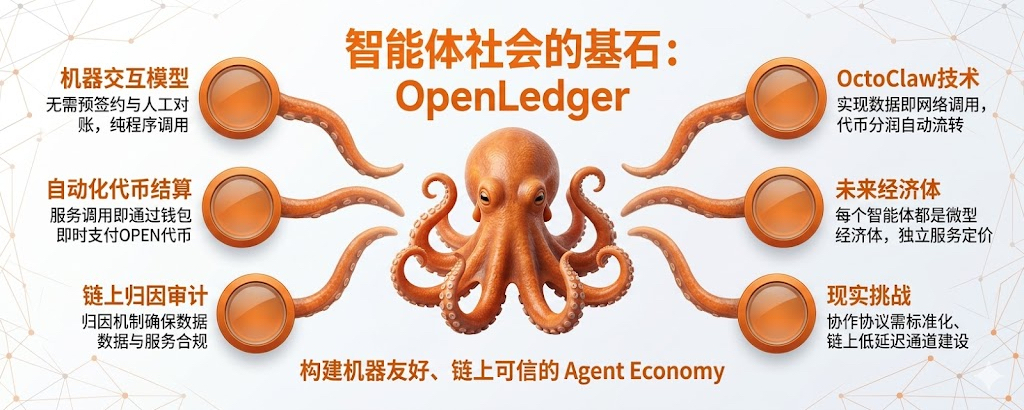
Why do I say this? Back in May, I seriously reviewed the technical documentation for #OpenLedger and the related design of OctoClaw and found that it has a pretty interesting characteristic: the whole on-chain design is inherently meant for programmatic use, not for humans. An Agent can access OpenLedger data with just a wallet address; each call deducts a certain amount of $OPEN tokens, and profit-sharing flows to data contributors automatically according to Proof of Attribution. The entire process requires no account registration, no credit card binding, and no manual approval. This purely machine-friendly trading model is exactly the infrastructure that the Agent economy needs.
Looking deeper, the premise for the Agent economy to take off is that a trustworthy collaborative network can form among Agents. One Agent wanting to utilize another Agent’s capabilities involves more than just payment; it also needs to confirm the quality of the other’s service, trace responsibility in case of issues, and have a way to accumulate reputation over long-term cooperation. OpenLedger's on-chain attribution mechanism essentially provides this infrastructure, with every Agent call having an on-chain record, every service quality being traceable, and every profit-sharing being auditable.
Last week, I ran a small experiment where a local Agent used OctoClaw to pull data from a financial Datanet on OpenLedger, then handed that data over to another Agent for market analysis. The whole process completed without manual intervention, with the two Agents executing a full service exchange through wallet addresses and contract calls, and the OPEN tokens were automatically settled to the data contributor as per the preset rules.
If this Agent collaboration network can truly scale, what does that mean? It means that in the future, many services won't need humans as the smallest trading unit. A user issues a request, and behind that could be a dozen Agents calling each other across different chains and services to give you a result. Each Agent is a mini-economy, with its own wallet, service pricing, and reputation record. OpenLedger's on-chain infrastructure is essentially the foundational settlement layer of this mini-economic society.
However, there are several real constraints to this Agent society narrative that are important to clarify. The collaboration protocols between Agents haven't been standardized; each company creating Agents has its own interface design. Anthropic has Claude's Computer Use, OpenAI has its own Function Calling specs, and the open-source community has frameworks like LangChain and AutoGen. Whether these Agents can call each other is a question. OpenLedger provides the underlying settlement capability, but the upper-level Agent communication protocols need to be pushed by the entire industry; OpenLedger can't do it unilaterally. The on-chain call latency of OpenLedger is still relatively high for many Agent scenarios; an Agent's decision might need to be completed in milliseconds. Currently, OpenLedger's OP Stack L2 combined with EigenDA returns data with a latency in seconds. This speed may be enough for slow decision-making Agents, but it falls short for scenarios that require quick responses; specialized fast channels must be developed to expand into these use cases. Another point is the maturity of the Agent industry itself; my friends have few real-world Agent-to-Agent case studies, and the Agent networks that are truly operating in production environments are quite limited. OpenLedger, as an infrastructure provider, finds itself in the awkward position of being ready while the clients have yet to appear.
My take on OpenLedger building the Agent social infrastructure is that they've chosen a great direction, which could be way bigger than the token price discussions happening now. If the Agent economy really becomes the mainstream of the next era, then the on-chain facilities that support settlements and trust between Agents will definitely become foundational protocols. However, the return cycle for this is long; you won't see results in six months or a year. OpenLedger has to endure the entire transition period of the Agent industry from experimental to production phases, and during this gap, the token price will likely fluctuate because there won't be enough on-chain calling volume to support the token demand.