
#OpenLedger Recently, the narrative around Datanets, PoA proof of attribution, and Payable AI has been on fire. The logic sounds solid: AI needs high-quality data, data contributors need returns, and blockchain quantifies contributions, using $OPEN for automatic revenue sharing.
On the surface, the model looks like a perfect closed loop. But after digging deep into the industry’s foundational logic, I've uncovered a fundamental paradox—the high-value private data that AI craves is precisely what’s least likely to be shared publicly.
The core resource driving the iteration of top-tier AI models has never been just random public text scraped from the web. It’s medical imaging, internal enterprise workflows, real financial trading records, and detailed user behavior trajectories—these assets hold value based on scarcity, privacy, and exclusivity.
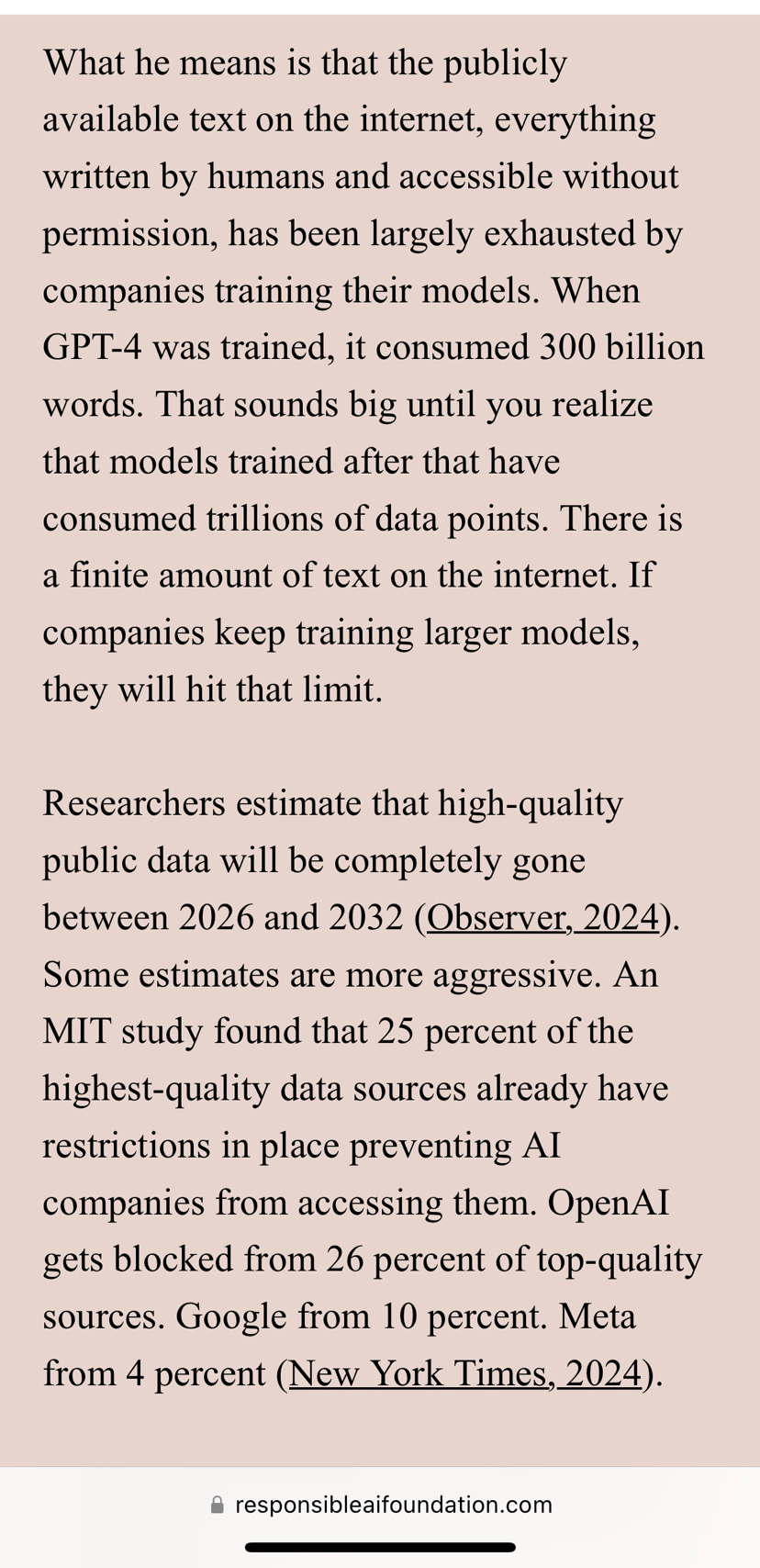
MIT's research makes it crystal clear: 25% of top-quality data sources have already completely locked down public scraping. OpenAI, Google, Meta—all shut out. Goldman Sachs' chief data officer put it bluntly: 'The public quality data usable by the industry has already been fully mined.'
I don't think this is some future trend; it's happening right now. Epoch AI has calculated precisely: from 2026 to 2032, all high-quality public text data on the internet will be completely depleted. The AI industry has already moved past the public data bonanza and entered the 'race for private data' phase.
OpenLedger's breakthrough approach is quite simple: use tokens as incentives to attract users to bring private data onto Datanets.
But let me ask you: if a piece of data can continuously generate high commercial value for its holder, why would they share it publicly? How would you respond?
Once private data is integrated into a public network, anyone can access, train, and reuse it, directly nullifying its scarcity and instantly dismantling the holder's exclusive barrier. Future quality data holders will just become licensed copyright holders—meticulously controlling access permissions, and they will never make it publicly available for free.
This creates the most awkward deadlock: scarce quality data is watching from the outside, and all that's left on-chain is low-value public data and garbage data generated by retail traders.
What frustrates me even more is that OpenLedger only addresses the technical issues of 'contribution tracing' and 'revenue settlement' while completely dodging the core contradictions of 'data ownership' and 'commercial barriers'. The incentive mechanism can optimize 'how to split the profits', but it can never answer: why should I hand over my core data and trade secrets?
Even if their PoA attribution tech and OP Stack architecture have some exploratory value, it doesn't change the underlying logical flaws. I predict a rather ironic situation: in the future, the cost of AI inference will keep rising while the quality of on-chain data remains stagnant, because the real core data will always be floating outside the ecosystem @OpenLedger .
I'm currently focused on one key indicator: whether Datanets will attract genuine high-value private data sources (like healthcare institutions, financial firms, and large enterprises) that are willing to onboard and continuously contribute core data. If all we're left with is public data being farmed by retail traders, then this whole 'data sharing – AI utilization – revenue sharing' loop won't even get off the ground. At that point, the narrative will be completely over. I'm putting this out there, and I'll wait for time to validate it.