
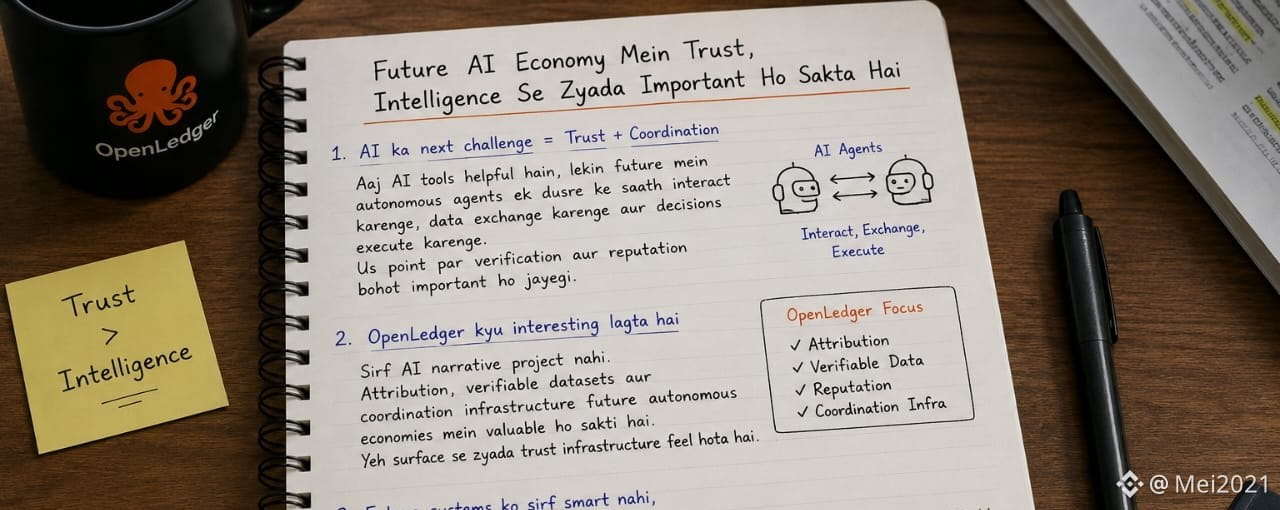
The more I observe AI and crypto markets, the more I feel that people mostly focus on visible things.
New models. Fast automation. Impressive demos. Viral AI tools.
And honestly, that's natural.
Tech markets often reward what’s immediately visible.
But if you look at history, long-term value is often built in the invisible infrastructure layers.
Take the Internet as an example.
In the early internet phase, people found websites and apps exciting.
Later, it became clear that the actual foundation was: servers, protocols, cloud systems, and coordination infrastructure.
I think AI is also gradually moving in that direction.
Today's AI ecosystem mostly seems like a capability race.
Which model is smarter? Which trains on more data? Which gives more human-like outputs?
But as the concept of autonomous agents matures, I feel the main challenge of the future might not be intelligence… but coordination.
And coordination without trust doesn't work.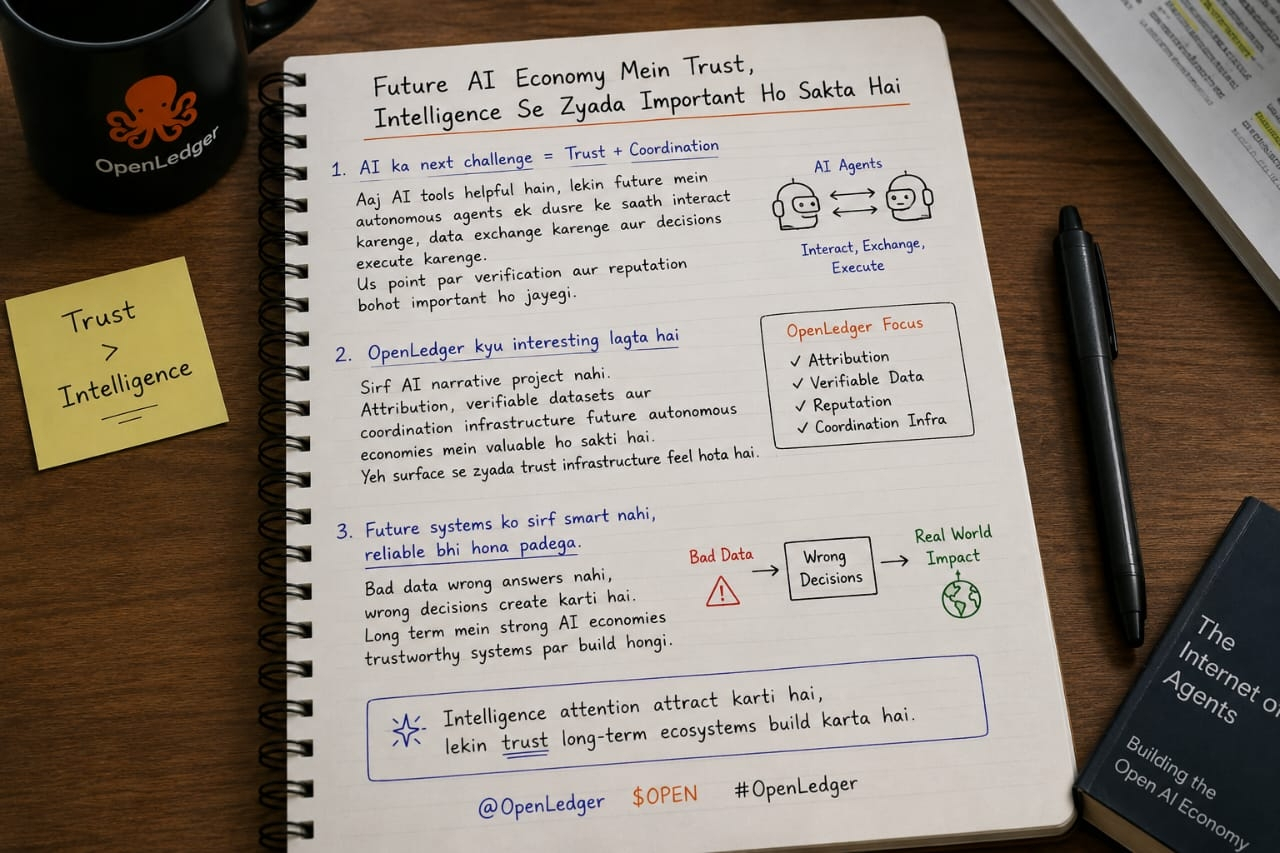
This point I find very interesting.
Today, we mostly use AI as tools.
Chatbots. Content generators. Research assistants.
But in the future, AI agents could perform transactions, consume services, execute financial actions, or even collaborate with other agents.
At that point, systems will need to be not just smart.
It must also be reliable.
And honestly, I feel the market hasn't deeply appreciated this problem yet.
If an AI agent relies on some external dataset, then verification becomes crucial.
Is the data genuine? Is it manipulated? Is the source reliable? What was the contributor's historical behavior like?
All these questions gradually become infrastructure-level problems.
And I think OpenLedger feels interesting at this layer.
On a surface level, people can only understand this as just an AI + blockchain project.
But the more I look at the attribution and data coordination side, the more it seems that the deeper angle of the project could be trust infrastructure.
Especially in the context of autonomous economies.
Another thing that seems important to me is that AI-generated content is rapidly flooding the internet.
Today already: synthetic media, AI-written articles, fake images, and manipulated information are becoming very common.
This problem could become even more intense in the future.
And when AI systems start training on AI-generated information, the reliability issue will become even more serious.
Personally, I believe the biggest problem of the future internet may be not 'information abundance'… but 'information credibility.'
And honestly, this is where attribution systems can become important.
Which data is verified? Which contributor has historically been accurate? Which source is trustworthy?
These systems do not just distribute rewards… they help create trust layers.
And long-term autonomous economies will need trust layers.
History shows the same.
Financial systems operate on trust. Markets operate on trust. Institutions operate on trust.
AI economies will eventually demand trust as well.
But the difference will be that here the interaction speed and scale will be much higher.
Humans won't be able to manually verify every decision.
Systems will have to evaluate themselves: reputation, accuracy, history, and reliability.
And honestly, I think this could be the next major infrastructure challenge for the AI industry.
Another interesting thing is that decentralized systems naturally create coordination problems.
Open ecosystems innovation allows for… but at the same time attracts spam, manipulation, and low-quality behavior.
So if future AI ecosystems are open and autonomous, filtering and verification will become even more critical.
That's why I think projects that are trying to solve data attribution, verification, reputation, and coordination… could be more important in the long term compared to projects that just sell the 'smarter AI' narrative.
I personally still view AI narratives cautiously.
Not every project will survive. Not every token will achieve meaningful adoption.
But I genuinely believe the market will eventually realize that in a world of autonomous systems, intelligence alone is not enough.
Trust is equally important.
And maybe that's why it feels worth closely observing infrastructure-focused projects like OpenLedger.
Because sometimes the most important technologies of the future are the ones that initially seem like 'boring backend infrastructure'...
until the whole ecosystem starts to depend on them.