
I've been thinking about something lately that I just can't shake off.
In the end, what are we really building in crypto when every cycle feels the same?
Every time I check the market, I see a recurring pattern. A new blockchain pops up. A new narrative gets pushed. This time it’s 'AI', last time it was something else. The language changes, but the vibe stays the same. The hype ramps up quickly, the community expands, and then everything starts to cool down. Liquidity dries up, attention fades, and people move on to the next story.
That makes me wonder: are we building a real system or just creating short-term attention loops?
Meanwhile, outside of crypto, something is changing really fast. AI is no longer just a trend. It's gradually becoming a part of how the internet operates. And for AI to function, it needs something very basic: real human data. Not fake interactions. Not bots talking to bots. But the real behaviors, thoughts, and actions of humans.
But this is where things get uncomfortable.@OpenLedger
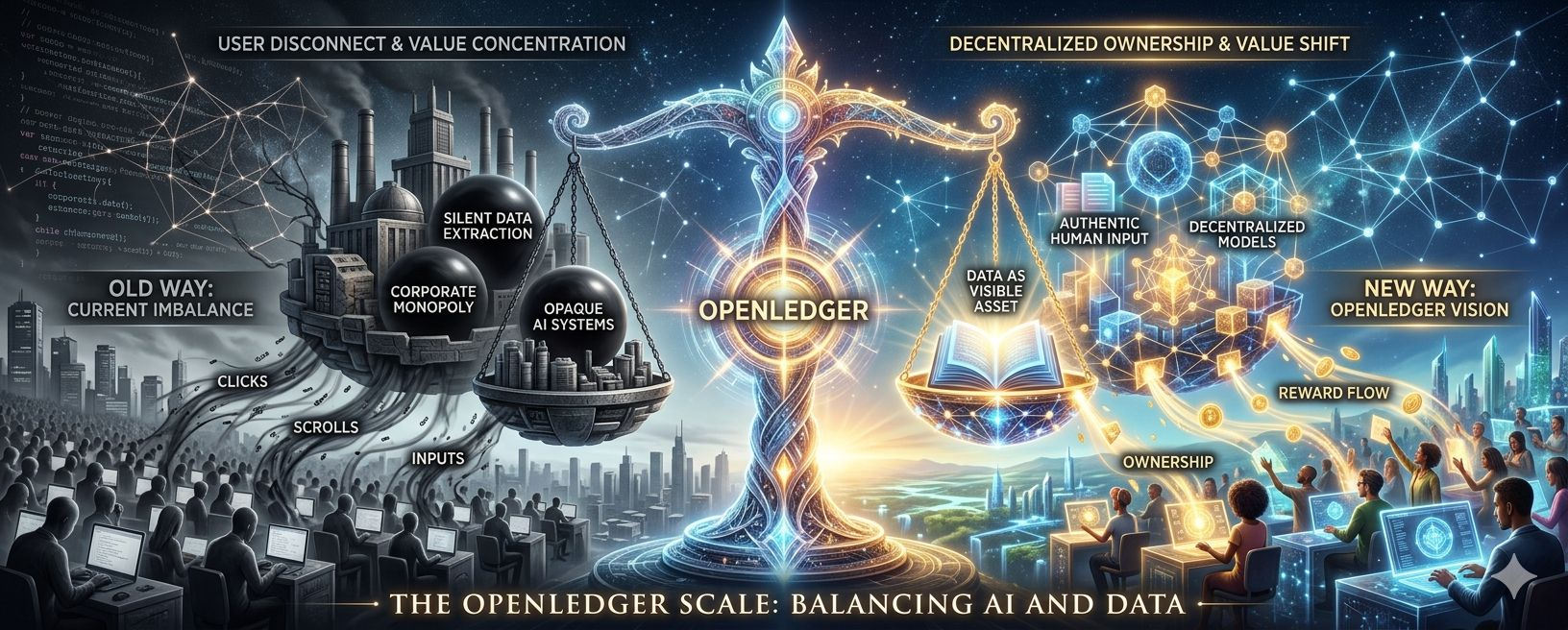
The current internet has been data-mined to a very deep level. Every click, every scroll, every post becomes data. Big companies collect them, train their systems, and turn it into enormous value. Meanwhile, the creators of that data get almost nothing in return.
This imbalance happens very quietly, so many people don’t notice it.
Worse yet, the internet is gradually losing its 'real human layer'. I see it every day. Empty comments, content lacking real emotion, accounts operating like humans but not necessarily being human. And now, with AI generating content en masse, the line between real and fake is becoming even blurrier.
This is when I started paying attention to ideas like OpenLedger.
Not because it promises to solve everything, but because it’s tapping into a very specific issue: data is no longer just a byproduct of the internet; it’s becoming a core resource for AI.
The basic idea is quite simple. Data, AI models, and agents all hold value. Instead of letting that value lie within the closed systems of big companies, it could be recognized, shared, and owned in a more open way. Those who contribute data or build models could receive corresponding value.
When I first heard it, my initial reaction wasn’t excitement but caution. Because crypto has had too many ideas that sound good in theory but hard to implement in practice.#OpenLedger
But the more I think, the more I see the problem it addresses is real, even though the solution is still uncertain.
AI systems are not static. They’re not built once and done. They need continuous new data, new human behaviors, and new contexts to avoid becoming obsolete. And from that arises the important question: who owns the data stream feeding AI?
Right now, the answer still mainly lies with centralized companies.
OpenLedger seeks to view data as a flow that can be tracked and moved between systems, rather than being locked in one single place. Simply put, it turns data and AI outcomes into a form of assets that can be recognized and shared.
But of course, it's easier said than done.
Blockchain has already faced major issues with user experience. Wallets, seed phrases, bridges, gas fees… all these are barriers. Meanwhile, AI requires absolute simplicity. If a person has to jump through too many complex hoops to use an AI tool, they’ll just walk away.
Here lies a clear contradiction: on one side, the ideal of transparency and ownership; on the other, the reality of convenience.
Another layer is control. Currently, a handful of companies hold most of the most powerful AI. They control the models, the data, and how users access them. This concentration is strong and directly affects how the digital world operates.
Decentralized systems try to reduce this concentration, but in return, they bring complexity and scalability issues. So, this is not just a technical problem, but a choice between two things: fairness and convenience.
What makes this story more urgent is that AI is becoming increasingly hard to distinguish real from fake. Text, images, voice… everything is advancing to a level that’s almost unrecognizable. In that environment, the concepts of data origin and authenticity become extremely important.
If we don’t know where something comes from, trust will gradually fade away.
This is where projects like OpenLedger are betting: that the future of AI will need an open infrastructure layer to track data and ownership, otherwise a few companies will control nearly all the 'intelligence' of the internet.
But I’m still not sure if this will succeed or not. Crypto has failed many times due to good ideas but poor execution or because users just didn’t care enough. And most users really don’t prioritize decentralization — they prioritize convenience.
If a centralized application is easier to use, they will choose it.
That’s the biggest challenge. It’s not about technology, but human behavior.
So, the real question isn’t whether this idea is good or not, but whether it’s simple enough for users to adopt.
I wonder:
Are we really accepting a future where a few companies control most of the intelligence of the world?
Will data ever really belong to the creators in practice, not just in theory?
And if AI is built from human data, shouldn’t that data be recognized more clearly?
My conclusion is quite calm: we are still very early in the debate about ownership in the AI age. Crypto is trying to fill that gap, but most experiments will still have to go through many bumps before a truly stable model emerges.
