
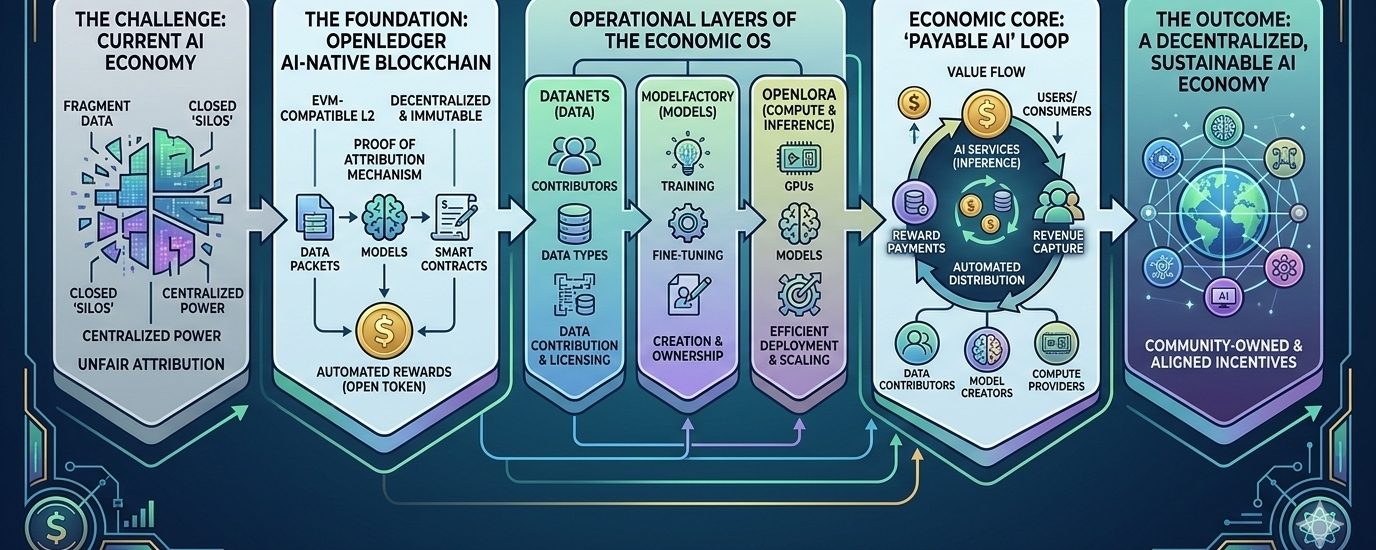
I have been looking into OpenLedger for the better part of several evenings, and the strange thing is that the deeper I went, the less it felt like an AI project and the more it felt like a debate about economics. Most conversations around artificial intelligence focus on capabilities. Bigger models, faster inference, better reasoning, more impressive demonstrations. OpenLedger starts from a different place. It asks a question that sits underneath all of those achievements: who actually owns the value created by intelligence? That sounds philosophical until money enters the picture. Then it becomes very practical.
The modern AI industry runs on an enormous amount of human contribution. Data is collected, organized, labeled, cleaned, refined, and transformed before a model ever produces a useful response. Yet there is a curious disconnect between the people creating the raw material and the organizations capturing the majority of the economic upside. OpenLedger's core thesis is that this disconnect is not a side effect of the industry but one of its central structural flaws. The project describes itself as an AI blockchain designed to monetize data, models, and agents while recording contributions throughout the entire AI lifecycle. The idea is that intelligence should not exist as a black box. It should exist inside a transparent economic system where contribution can be measured, verified, and rewarded.
What strikes me about this approach is that OpenLedger is not trying to compete directly with the largest AI companies on model quality. Instead, it is attempting to build the accounting layer underneath AI. That may sound less exciting, but history has a habit of rewarding infrastructure that solves coordination problems. The internet did not become valuable simply because information could move. It became valuable because protocols emerged that standardized how information moved. Financial markets did not scale because people trusted each other. They scaled because systems emerged that tracked ownership, transactions, and obligations. OpenLedger appears to be asking whether artificial intelligence now requires a similar layer of economic infrastructure.
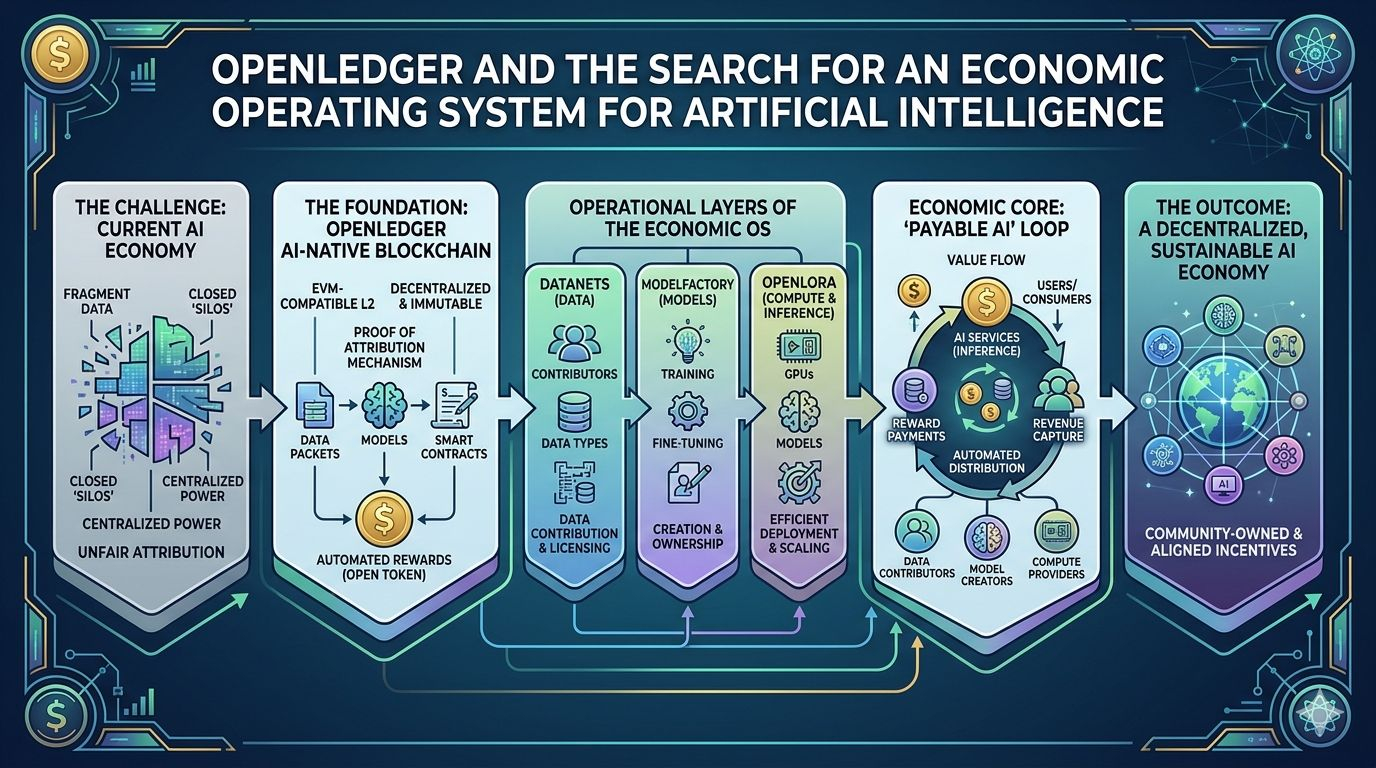
At the center of the architecture is something called Proof of Attribution. After reading through technical documents, I kept returning to this concept because almost everything else in the project appears to depend on it. Proof of Attribution is designed to track how data influences models and how models generate outputs. Rather than allowing contributions to disappear into a training process forever, the system attempts to maintain a verifiable record linking outcomes back to the data and participants that helped create them. In theory, this enables contributors to receive rewards based on measurable impact rather than arbitrary allocation. The project frames this as a way to make AI both explainable and payable.
The idea becomes easier to understand when viewed through OpenLedger's Datanets. These are community-owned, domain-specific datasets where contributors can upload, curate, and manage information that may later be used for model development. Most AI systems today operate with limited visibility into where their knowledge originates. Datanets attempt to create an environment where data provenance remains visible throughout the process. Instead of treating data as a disposable input, OpenLedger treats it as a productive asset with persistent ownership records and economic rights attached to it.
I find this particularly interesting because the AI industry often talks about data as if it were a naturally occurring resource. More data. Better data. Larger datasets. The language sometimes obscures the reality that data is usually generated by people. Expertise, research, creativity, and labor sit behind much of the information that powers machine intelligence. OpenLedger's entire model seems built around the belief that those contributions should remain economically visible long after they enter the training pipeline. Whether the market ultimately agrees is another question, but it is difficult to argue that the current system has fully solved the problem.
The project's infrastructure extends beyond attribution. OpenLedger includes ModelFactory, a framework intended to simplify the creation and fine-tuning of AI models using permissioned datasets. It also includes OpenLoRA, a deployment layer designed to serve large numbers of specialized models efficiently. This caught my attention because the future of AI may look very different from the present narrative. Much of today's attention is concentrated on giant general-purpose models. Yet many industries increasingly require specialized systems trained on narrow, high-quality datasets. OpenLedger appears to be positioning itself around that possibility, creating tools that allow communities to build and monetize specialized intelligence rather than relying entirely on centralized providers.
The OPEN token functions as the connective tissue holding the economic model together. It serves as gas for network operations, supports governance participation, powers inference payments, and distributes rewards to data contributors and model developers. When users interact with models, value can theoretically flow through the attribution system toward the participants whose contributions influenced the result. It is an ambitious attempt to align incentives across an ecosystem that traditionally separates creators from outcomes.
Still, skepticism feels necessary here. The history of both crypto and AI is littered with elegant theories that struggled against real-world adoption. OpenLedger's vision depends on participation. Contributors must provide valuable data. Developers must build models. Users must find those models useful. The attribution system must function accurately enough to create trust. Network effects are notoriously difficult to manufacture. A transparent economy is only valuable if enough people decide to operate inside it.
That uncertainty is probably what keeps the project interesting. OpenLedger is not simply making a technical argument. It is making an economic one. It assumes that as artificial intelligence becomes more important, ownership, attribution, and compensation will become more important as well. The project may succeed, or it may become one of many experiments exploring the intersection of AI and blockchain. Yet the question it raises feels increasingly difficult to dismiss. Intelligence is becoming one of the most valuable products in the world. The mechanisms determining who gets credit for creating that intelligence remain surprisingly immature. OpenLedger is, at its core, an attempt to build those mechanisms before the rest of the industry decides it needs them.
