
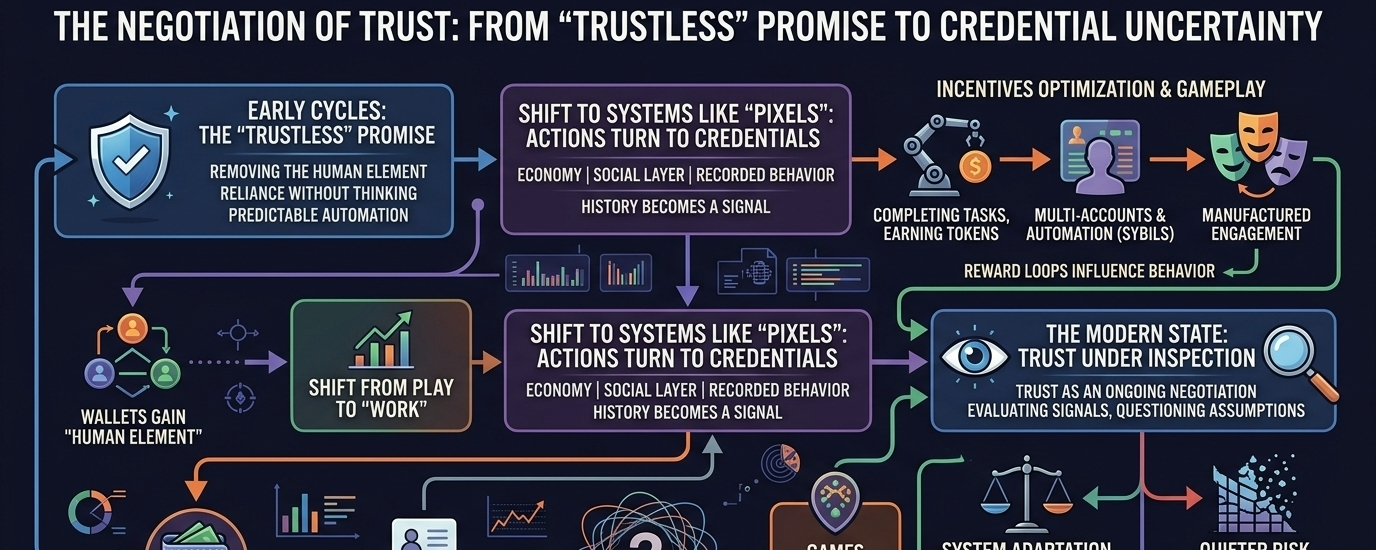
I’ve been around long enough to remember when “trustless” was the loudest word in the room. It sounded clean. Final. Like something you could rely on without thinking too much about the people behind it.
That idea didn’t age as well as many expected.
Now we’re looking at systems like Pixels — not just a game, but a small economy, a social layer, and more importantly, a place where behavior gets recorded, rewarded, and remembered. On the surface, it’s simple: farm, explore, earn, trade. Underneath, though, it starts to resemble something else entirely — a network where actions slowly turn into credentials.
And credentials… they don’t stay simple for long.
At first, they feel harmless. You complete tasks, you earn tokens, maybe your wallet starts to carry a bit of history. That history becomes a signal. Someone who’s played longer, contributed more, or held assets through volatility starts to look more “credible.” Not officially, not in a stamped way — but socially, it begins to matter.
This is where things shift.
Because the moment credentials start influencing access, rewards, or status, they stop being passive records. They become targets.
I’ve seen this pattern before. Incentives change behavior faster than technology ever does. When tokens are involved, people don’t just participate — they optimize. They create multiple accounts, automate interactions, simulate engagement. Not because they believe in the system, but because the system pays them to behave a certain way.
So now you have a question: what exactly is being verified?
Is it genuine participation, or just well-executed strategy?
Pixels, like many Web3 environments, sits right in the middle of that tension. It wants to reward engagement, but it also has to deal with the fact that engagement can be manufactured. It wants to build a sense of progression, but progression can be gamed. And over time, those small distortions start to accumulate.
Credentials begin to lose clarity.
Not all at once. It’s gradual. A wallet that looks experienced might just be efficient. A player with status might simply understand the reward loops better than others. The system doesn’t break — it just becomes harder to read.
And that’s where trust gets interesting.
Because trust here isn’t something you grant upfront. It’s something you keep revisiting. You look at signals, you question them, you adjust your assumptions. The system isn’t asking you to blindly believe — it’s forcing you to stay aware.
That’s a very different model from what we were promised in earlier cycles.
Back then, the idea was to remove trust entirely. Now it feels more like we’re building environments where trust is constantly under inspection. Where nothing is fully settled. Where every credential carries a bit of doubt along with it.
There’s something honest about that, even if it’s uncomfortable.
Of course, this also introduces a quieter risk. If users start to feel that everything can be manipulated, they may stop trusting the system altogether. Not because it failed outright, but because it became too complex to interpret. Too many layers. Too many incentives pulling in different directions.
And games like Pixels amplify this effect. They’re not just financial systems — they’re social spaces. People aren’t only earning; they’re interacting, forming habits, building identities. When rewards enter that mix, behavior shifts in subtle ways. People play differently when something is at stake. Sometimes they stop playing altogether and start “working” the system instead.
That’s not necessarily a flaw. It’s just a reality.
What matters is whether the system can adapt. Whether it can recognize when its own signals are being distorted. Whether it allows room for reevaluation — for old credentials to lose weight, for new behavior to matter again.
In that sense, the most interesting part of Pixels isn’t the token or the gameplay loop. It’s the ongoing negotiation between action and interpretation. Between what the system records and what those records actually mean over time.
I don’t see it as a finished model. It feels more like an experiment that hasn’t decided what it wants to become yet.
And maybe that’s the point.
Trust here isn’t instant. It isn’t fixed. It moves, it erodes, it rebuilds in small ways. You don’t fully rely on it, but you don’t ignore it either. You just keep watching — how people behave, how incentives shift, how the system responds when it’s pushed a little too far.
I wouldn’t say I trust it.
But I’m not ready to dismiss it either.
For now, I’m just paying attention.