

I’ll be honest I stopped taking most blockchain games seriously a while ago.
After watching wave after wave of “play-to-earn” projects explode with Hype and then quietly collapse, I got tired of the same pattern. Big promises, Flashy token models, loud communities shouting about the future of gaming… and then six months later, nobody’s there except bots farming scraps.
That’s exactly why Pixels Surprised me.
The first time I looked into it, I wasn’t expecting much. I thought it would be another crypto game trying to force financial systems into gameplay and calling it innovation. But Pixels felt different almost immediately. Instead of throwing token economics in my face, it reminded me of those peaceful farming games I used to lose hours in without realizing it. Plant crops, gather materials, explore slowly, chat with people simple stuff, but weirdly comforting.
and Honestly, that calm feeling is probably its biggest strength.
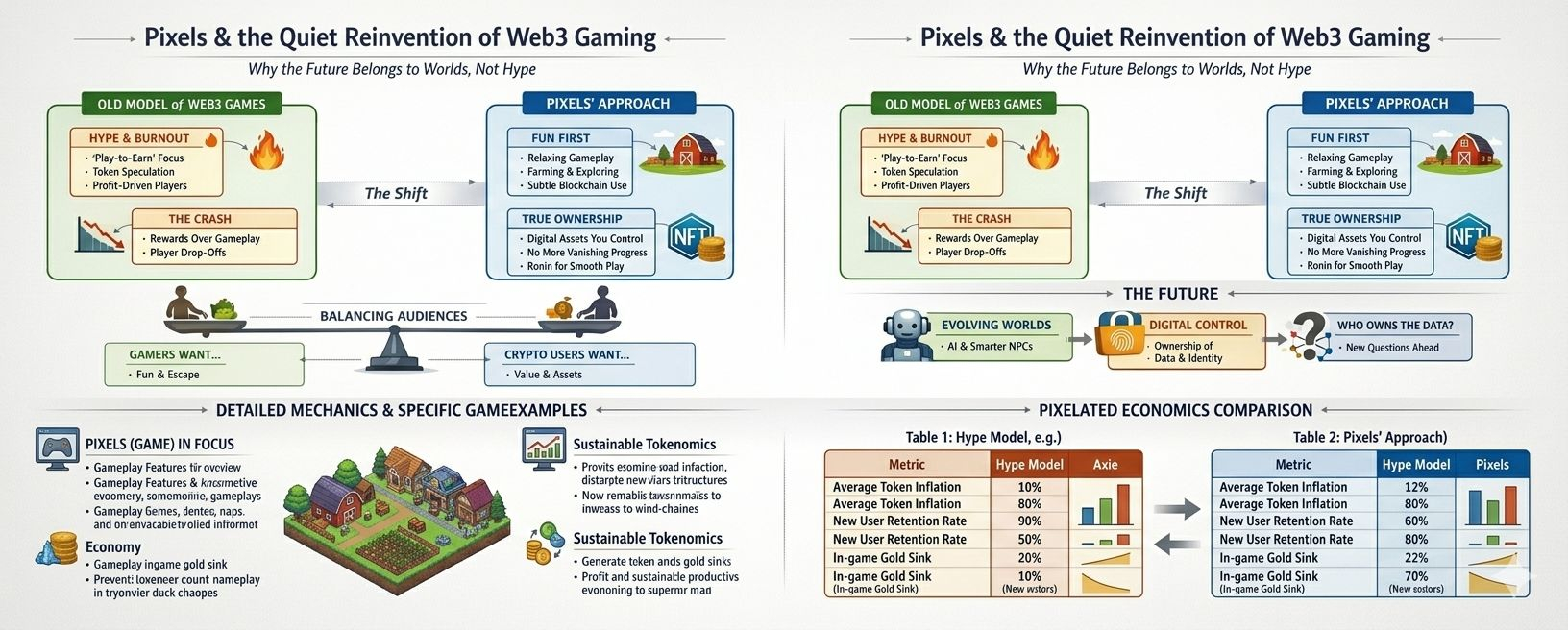
What Pixels seems to understand better than a lot of Web3 games is something the industry forgot during the hype years: if the game itself isn’t enjoyable, nothing else matters.
That sounds obvious, but crypto gaming ignored this lesson for too long. Too many projects treated gameplay like decoration and rewards like the real product. The result? Players came for profits, not because they loved being there. Once token prices dropped, so did the entire ecosystem.
Pixels feels like it’s trying to reverse that damage.
When I’m looking at Pixels, I don’t feel like I’m looking at a financial machine disguised as a game. I feel like I’m seeing an actual world first — one where blockchain is present, but quiet. That difference matters more than people think.
Because the real interesting part isn’t “earning.” It’s ownership.
In traditional games, I’ve spent months grinding for items or building progress that never truly belonged to me. If the publisher shuts the servers down, changes the rules, or kills Support, everything disappears. That always felt wrong, even before I understood blockchain.
Pixels challenges that old setup by making digital ownership part of the Game without making it overwhelming. That’s smart. It doesn’t constantly interrupt the experience to remind me there’s blockchain underneath. And running on Ronin helps too Smoother transactions, less friction, fewer moments where I feel like I’m dealing with crypto infrastructure instead of just playing.
But let me say this too: ownership can ruin games if it’s handled badly.
I have seen it happen. The second players start thinking more about Efficiency than enjoyment, the mood changes. Farming stops feeling relaxing and starts feeling like unpaid labor. Instead of asking, “What do I feel like doing today?” people start asking, “What’s the most profitable move?”
That shift kills Magic fast.
and that’s where Pixels is Walking a tightrope.
It has to serve two completely different audiences at once. on one side, there are regular gamers who just want a peaceful world to enjoy. On the other side, there are Crypto-native users already thinking in terms of scarcity, token value, and market opportunity. Those two mindsets don’t naturally align.
If Pixels leans too hard into speculation, it becomes transactional. If it ignores the economic layer completely, it loses part of its Web3 identity.
That balance is everything.
What makes this even Bigger, in my opinion, is that Pixels isn’t only testing ideas about gaming. It’s quietly testing ideas about how we might live in digital spaces in general. Ownership in games could eventually connect to bigger questions personal data, digital identity, online assets, creative rights.
And with AI starting to reshape games too, that future gets more complicated.
I actually think the next leap for games like Pixels will Happen when worlds begin reacting intelligently smarter NPCs, adaptive ecosystems, personalized environments. That could make these spaces feel genuinely alive. But then another issue comes up: if a game learns from how I behave, who owns that data? Me? The developers? The network?
Nobody really has a Clean answer yet.
That uncertainty is real, but so is the opportunity.
For me, the true success test for Pixels is simple: If I ever reach the point where I stop noticing the blockchain entirely while I’m Playing, then it has succeeded.
Because the best technology disappears into the background.
And maybe that’s why Pixels stands out right now. Not because it’s louder than other Web3 games — but because it’s quieter, more careful, and actually seems to understand that people stay for worlds they enjoy, not systems they’re forced to calculate.
That’s a lesson this Industry needed badly.