
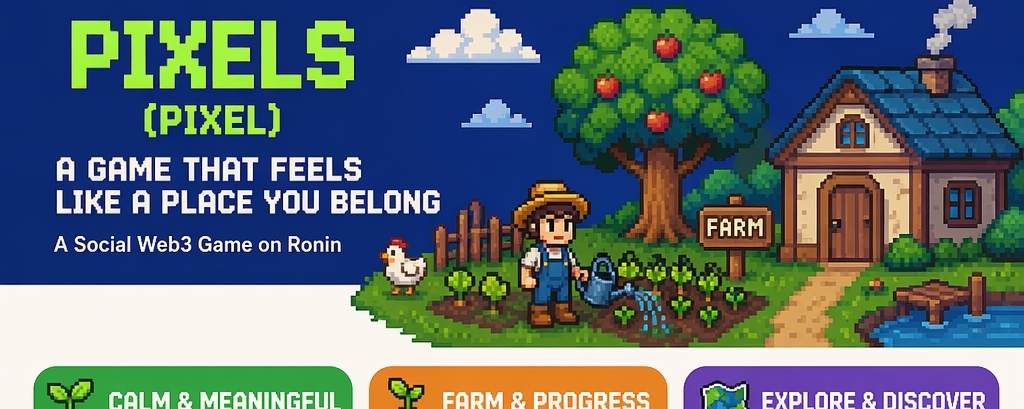
Most games today are built to keep you moving—faster goals, louder rewards, constant action. Pixels takes a different path. It slows things down in a way that feels almost unfamiliar at first, like stepping into a quiet village after spending too long in a noisy city. Nothing is demanding your attention every second. Instead, it gently invites you to stay.
At its core, Pixels is a social Web3 game built on the Ronin Network, but describing it that way doesn’t really capture what it feels like to play. When you first enter its world, you’re not thinking about blockchain or tokens. You’re thinking about where to start—maybe planting your first crops, maybe wandering off to see what’s beyond the trees. It feels simple, but not empty. There’s a calm sense that everything you do, no matter how small, is part of something that builds over time.
Farming in Pixels isn’t just a mechanic—it’s more like a rhythm you fall into. You plant, you wait, you return, and slowly you begin to see progress. It’s not rushed, and that’s the point. The game doesn’t try to overwhelm you with pressure. Instead, it creates a space where progress feels earned in a natural way. The same goes for exploration. You’re not just chasing objectives—you’re following curiosity. You might set out to gather resources and end up discovering a new area or crossing paths with another player doing the same thing.
That human element is what makes Pixels stand out. You’re not alone in this world. Other players are there, building their own farms, chasing their own goals, and shaping the environment in their own way. It creates a quiet sense of community. Even if you’re not directly interacting, you can feel that the world is shared. It’s not static—it’s alive.
What’s interesting is how Pixels handles ownership without making it feel complicated. In many games, everything you achieve stays locked inside the system. Here, there’s a different feeling. The time you spend, the resources you collect, and the things you create carry a sense of permanence. It doesn’t shout about it, but you can feel it. Your progress feels like it actually belongs to you in a meaningful way.
At the same time, Pixels doesn’t fall into the trap that many early Web3 games did—where everything revolved around earning. Yes, there are in-game currencies and rewards, including the PIXEL token, but they don’t take over the experience. You’re not constantly being pushed to think about value in a financial sense. Instead, the game keeps your focus on playing, exploring, and building. The rewards come naturally as a result of that, not as the only reason for it.
This balance is probably one of the biggest reasons Pixels has managed to grow so quickly. It appeals to both casual players who just want to relax and more dedicated players who enjoy deeper systems and progression. You can log in for a short session and still feel like you’ve done something meaningful, or you can spend hours building and optimizing your space. The game adjusts to your pace rather than forcing you into one.
There’s also a creative side to Pixels that feels refreshing. You’re not just following a fixed path—you’re shaping your own experience. Your farm, your choices, your way of playing—it all adds up to something that feels personal. Over time, you start to recognize your own space in the world. It becomes familiar, almost like returning to a place you’ve built yourself.
Looking ahead, Pixels feels like it’s just getting started. Its connection to the Ronin ecosystem suggests a future where games are more connected, where what you do in one place might carry over into another. That idea is still evolving, but Pixels already gives a glimpse of what that kind of future could feel like—less fragmented, more continuous.
What really makes Pixels special, though, isn’t just its systems or its technology. It’s the feeling it leaves you with. It doesn’t try to impress you with complexity or intensity. Instead, it gives you space. Space to play, to explore, to build, and to return whenever you feel like it.
And maybe that’s why it works so well. Because in the end, Pixels doesn’t feel like something you have to keep up with. It feels like somewhere you can simply show up—and that’s a rare thing in gaming today.
