
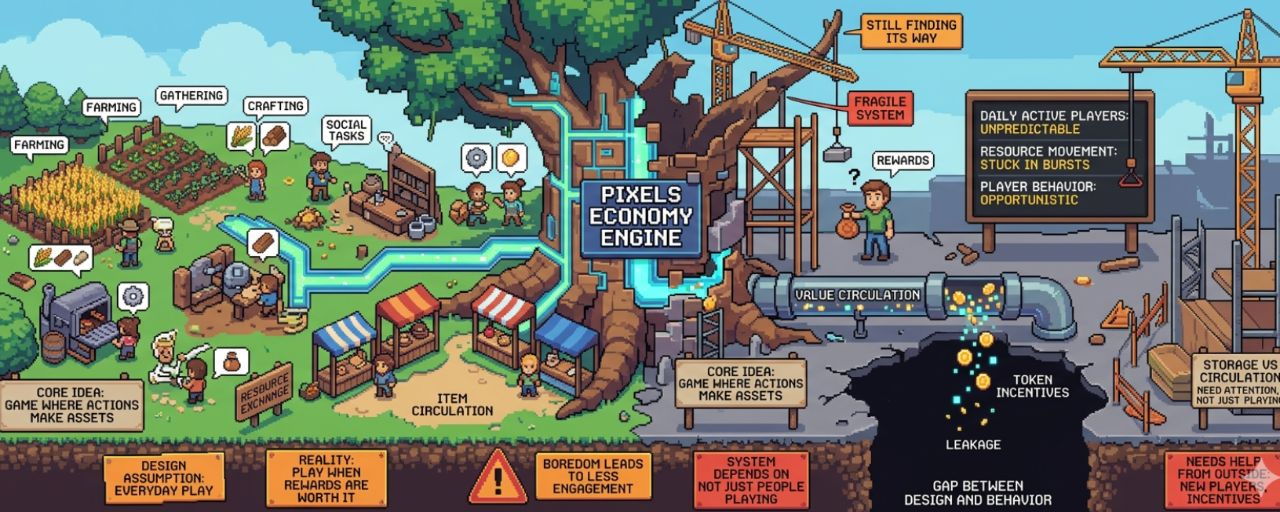
When I look at PIXEL I do not see a story about a token. I see a game system that tries to act like an economy. Its not fully there yet. It feels half-finished like its still finding its way.
The game loop from Pixels is still the focus. Players move between farming, gathering, crafting and small social tasks.
On paper this looks like an economy where effort turns into resources and resources turn into progress.. In reality it feels fragile. It needs attention, not people playing.
The value inside the system doesn't move smoothly. It moves in bursts. Players play for a while then stop. Assets and rewards change hands. Often without being used much. This creates a kind of economy that leaks. Value comes in through incentives. It doesn't always circulate before leaving.
This shows a gap between design and behavior. The design assumes people will play every day.. Players are more opportunistic. They play when rewards seem worth their time. They slow down when it feels like much work.
I think about how the ecosystem depends on players being active. Without players the crafting and resource exchanges slow down. This isn't about how many players there are. It's about how items and resources move. If they don't move often the economy feels stuck.
Something interesting is how the game tries to turn actions into economic meaning. Farming becomes making things. Crafting becomes changing things. Trading becomes sharing. It sounds good. In practice not every action feels important. Some actions only feel important because of rewards.
This shows a difference between incentives and real usage. Incentives can get people to play. They can't always make actions feel meaningful. If incentives weaken the behavior can collapse quickly. This tells me the system is still sensitive not stable.
There's also the question of how assets move. Items and tokens should circulate like blood.. Sometimes it feels like storage, not circulation. Players accumulate more than they spend.. They convert out of the system instead of reinvesting. This reduces how fast the economy moves.
One thing I notice is how much the system relies on doing the things over and over. Same actions, loops, same rewards. This can be powerful if it builds habit.. If its not rewarding it becomes boring.. Boredom leads to less engagement.
So the system is in a state. Its not broken,. Its not fully working either. It's in that zone where the structure exists but behavior hasn't fully locked in. That's usually the part for any game economy.
I also think about how people see things versus how they are. From outside it looks like a working ecosystem.. Inside it might feel like too much grind and not enough economic activity. That difference matters because long-term success depends on how players feel about what they get versus what they put in.
There's something though. With these weaknesses the core idea still works. A game where actions make assets and those assets circulate in a shared economy is still an idea. The question is whether enough players will stay enough for the system to become self-sustaining.
Now it feels like it still needs help from outside. New players, incentives, new bursts of activity. Without that the internal loops might slow down more than intended.. Slow systems, in crypto gaming tend to struggle.
So I keep coming to one thought. The design isn't the risk. The behavior is. Whether players treat the system like something they live in or just something they pass through. That difference decides everything.
At this stage it's still not clear which direction it will go.