
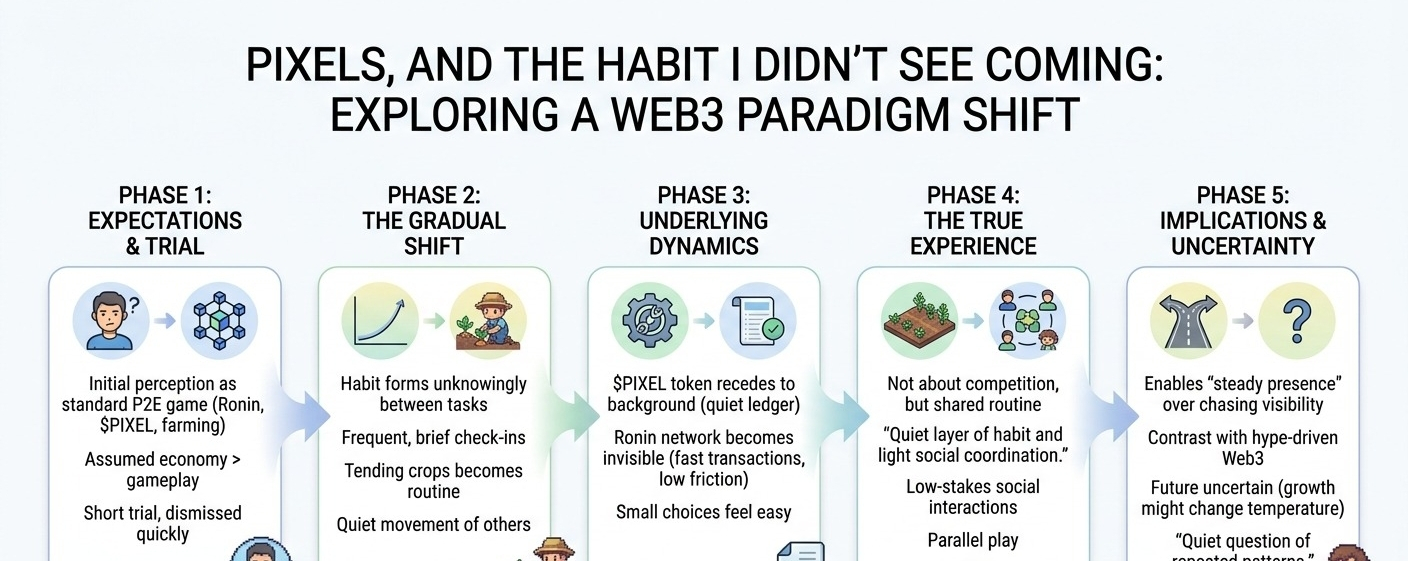
When I first encountered Pixels, it registered as the standard offering in this space. A social casual game on the Ronin network, built around farming plots, wandering an open world, and occasional creation. The token, $PIXEL, sat there like an expected feature, something that would likely steer the experience toward familiar incentives. I thought I understood the shape of it immediately. Pleasant visuals, light mechanics, probably another project where the economy eventually overshadowed the activity. I gave it a short trial and assumed that would be enough.
The shift happened gradually, almost without me noticing. I found myself opening the game between other tasks, not out of any particular goal but because it felt easy to step back in. A few minutes of tending crops turned into watching the quiet movement of other players across the map. Someone would pause near my plot and offer a spare resource. Another would mention a path they liked for no clear reason. The interactions stayed small. There was little talk of prices or optimization. Instead the chat carried the kind of remarks people make when they are simply occupying the same space over time.
That persistence surprised me. I had expected the token to dominate my attention, yet $PIXEL mostly remained in the background. It appeared when trades happened or when crafting required balance, but it felt more like a quiet ledger keeping count than a force pulling every decision. Ronin contributed to this by staying nearly invisible. Actions resolved quickly enough that I stopped thinking about the network at all. The barrier between wanting to do something and doing it had been lowered so far that small choices no longer carried weight. What remained was rhythm.
Beneath the surface of farming, exploration, and creation, Pixels seems to be about the slow construction of shared routine. The open world supplies gentle reasons to cross paths without turning every encounter into a contest. Your plot becomes both personal anchor and public statement. The activities give structure to time spent near others, turning repetition into something that starts to resemble belonging. It is not dramatic. It is simply there, waiting for the next visit.
This matters because it runs counter to how most visibility in Web3 tends to work. Projects often build around narrative peaks and moments that can be announced or measured right away. Pixels, from what I have seen, leans into infrastructure that supports ongoing use instead. When the chain and the token recede, attention can settle on the quieter layer of habit and light social coordination. The difference between chasing visibility and enabling steady presence becomes tangible. One demands attention. The other allows it to arrive naturally.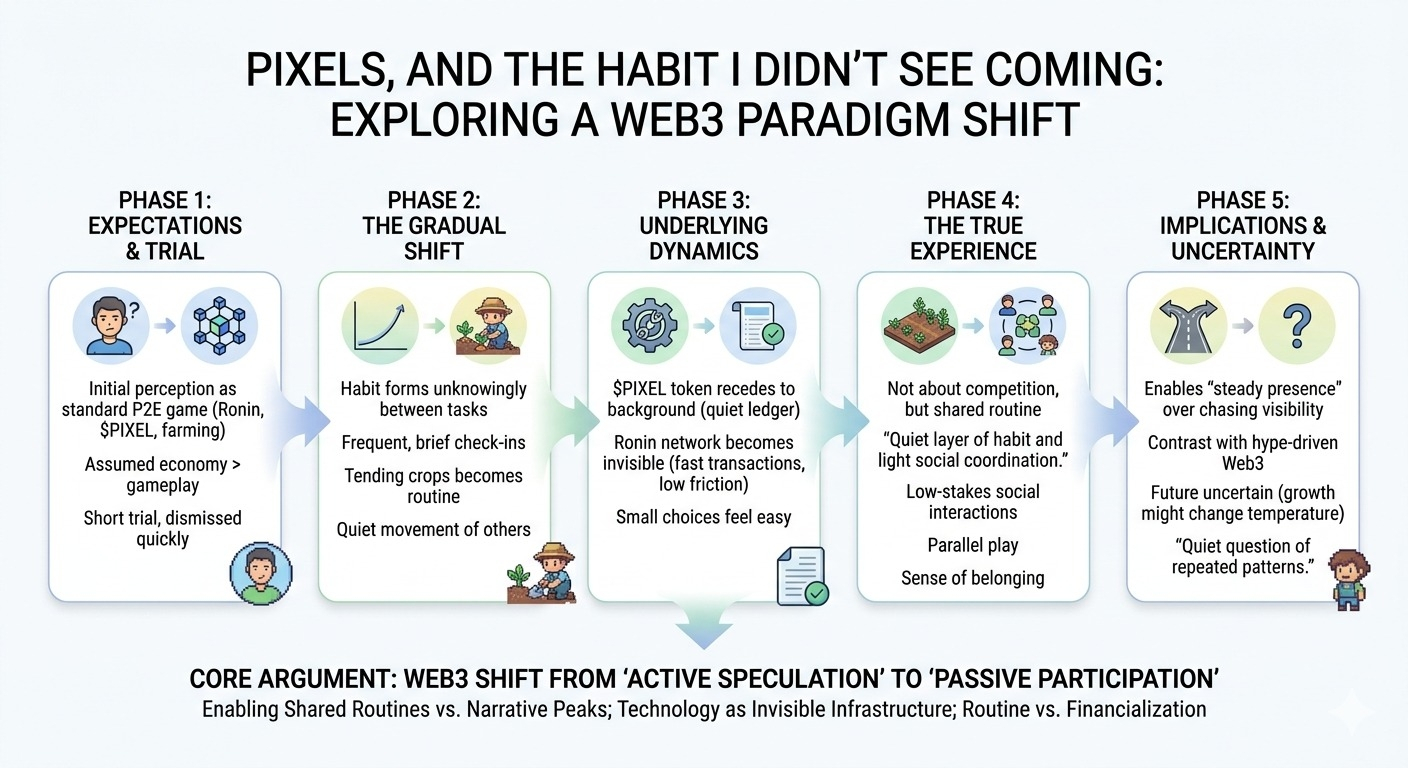
I still have no firm sense of where this leads or how long the calm can last. Growth might change the temperature. Yet I keep returning to the same small observation. The game has become part of certain days without asking for that role. I log in, water the same crops, notice the same names, and leave again. There is no conclusion in that pattern, only the quiet question of whether many such patterns, repeated across enough people, might be what actually holds a world together.
