
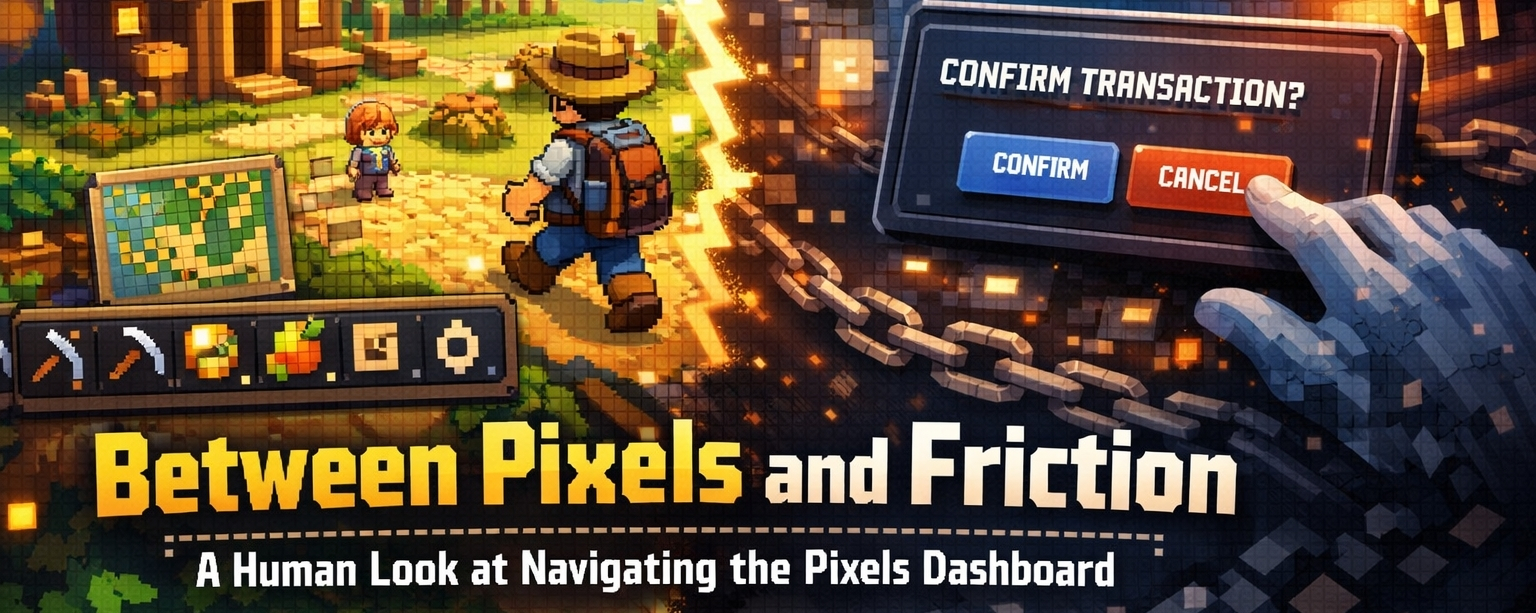
I’ve spent enough time opening Web3 game dashboards to develop a kind of quiet skepticism before anything even loads. There’s a pattern you start to recognize—interfaces that feel like they were designed by people who already understand every moving part, rather than someone encountering it for the first time. You click around and nothing quite explains itself. Buttons feel ambiguous, menus assume context you don’t have yet, and wallet interactions appear suddenly without enough clarity to guide you through what’s actually happening. When something fails, there’s rarely a clear explanation, just a lingering uncertainty that leaves you wondering if you made a mistake or the system did. That expectation followed me when I first opened Pixels, but what stood out almost immediately was that it didn’t overwhelm me in the same way. It runs directly in the browser, which already removes one layer of friction, and once inside, the experience feels intentionally simple in a way that works in its favor. The pixelated style isn’t just aesthetic—it softens the density of the interface. Even when there’s a lot happening, it doesn’t feel visually heavy, and that subtle design decision carries more weight than it seems at first.
Moving through the game feels natural in a way that’s easy to overlook because it should be the standard, yet often isn’t in this space. The bottom hotbar holds most of what you need—inventory, quests, map, settings—and it’s arranged in a way that doesn’t require much thought to understand. Within a few minutes, I found myself navigating without needing to pause or look anything up, which is surprisingly rare. The quest tracker sits where it’s visible but not distracting, and the map does its job without making you fight to interpret it. It’s the kind of flow where you don’t feel like you’re learning an interface—you’re just playing. But that smoothness doesn’t fully carry over once the blockchain layer enters the picture. The moment an action requires an on-chain transaction, the experience shifts. You’re pulled out of the world and into a wallet confirmation, waiting for something invisible to complete before you can continue. That break in momentum feels sharper than it should, not because it’s unexpected, but because it interrupts a flow that was otherwise working well. There were moments where I wasn’t completely sure if something had gone through or not, and that small uncertainty lingers longer than it should in a game environment.
As time goes on, smaller points of friction start to surface. The inventory system works, but it begins to feel crowded once you’re carrying a variety of resources. There’s a limit to how easily you can sort or locate specific items, and over a longer session, that extra scrolling becomes noticeable. It’s not enough to push you away, but it’s the kind of thing that quietly adds weight to the experience. The same feeling shows up more clearly in the land management side of the interface. Owning land introduces a different set of menus that don’t feel as refined as the rest of the game. The options are there, but they aren’t always presented in a way that feels intuitive, especially if you’re still figuring things out. It gives the impression that you’re expected to already understand the system rather than being guided through it, which creates a steeper learning curve than necessary. Still, when you return to the core loop—walking through the world, interacting with characters, tending to tasks—the game settles back into something that feels considered and accessible. That contrast becomes the defining part of the experience. The gameplay itself is smooth enough to keep you engaged, while the blockchain interactions remain the moments where friction creeps in. It’s not seamless, but it’s functional, and in a space where even basic usability can feel inconsistent, that balance is enough to keep you exploring a little longer. I found myself staying in the game, even while keeping a separate tab open to fill in the gaps, which says more about the current state of things than any feature list ever could.