
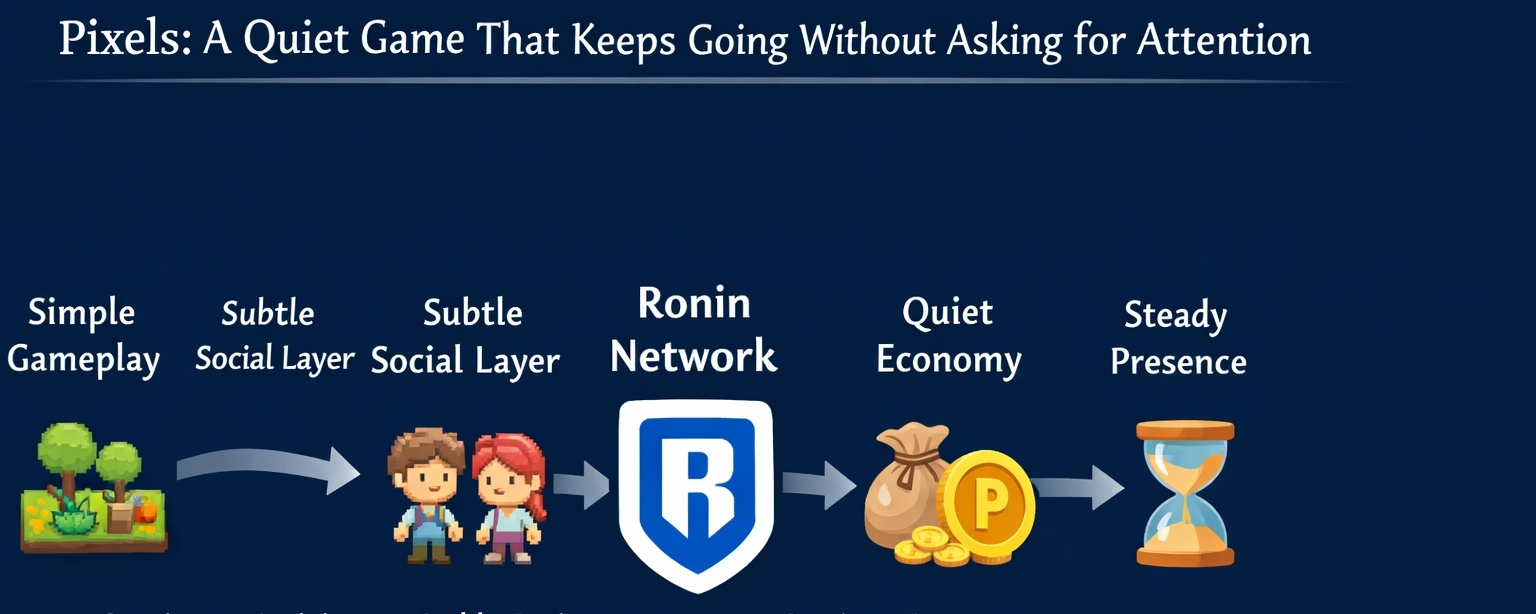

I didn’t really pay attention to Pixels at first. It looked like something I had already seen too many times. A simple farming game, a social layer, a token somewhere in the background trying to give it weight. Nothing about that combination feels new anymore, at least not on the surface.
Most projects that start this way follow a predictable rhythm. They get noticed quickly, people rush in, activity spikes, and then slowly, almost quietly, things start to thin out. Not because the idea was bad, but because it couldn’t hold itself together once the initial excitement wore off.
So I didn’t feel any urgency to look deeper.
But Pixels didn’t disappear the way I expected it to. It stayed around, not loudly, not in a way that demanded attention, but in a way that was difficult to ignore over time. People were still playing it. Not chasing hype, not constantly talking about it, just… there. Logging in, doing small things, continuing the loop.
That kind of consistency is easy to overlook, but it usually means something.
It made me look at it differently. Not as a concept, not as a pitch, but as something that had to function day after day without relying on momentum. Because that’s where most projects struggle. When there’s nothing new to point to, no announcement to lean on, no sudden reason for people to come back.
That’s when the structure gets tested.
Pixels feels aware of that, even if it doesn’t say it directly. It’s built on Ronin Network, and that choice matters more than it might seem. Ronin has already gone through cycles of growth and failure. It has seen what happens when game economies move too fast or become too dependent on incentives. That kind of experience tends to shape decisions in quieter ways.
You can feel a bit of that in how Pixels is put together.
It doesn’t try to overwhelm you. The gameplay loop is simple—farming, gathering, moving around, repeating. Normally, that kind of simplicity would raise concerns. It would suggest there isn’t enough depth to keep people engaged. But here, it feels more like a boundary than a weakness. Like it’s staying within limits it understands.
Still, it’s hard to tell whether that comes from confidence or constraint.
Sometimes projects stay small because they know their limits. Other times, they stay small because they don’t have a choice. From the outside, those two things look almost identical.
What I find more interesting is how the world feels when you’re inside it. Not in terms of features, but in terms of presence. Other players are there, moving around, doing their own things. You notice them, but you’re not forced to interact. It doesn’t feel empty, but it doesn’t feel demanding either.
That balance is subtle, and it matters more than most people think. It’s often the difference between something that feels alive and something that just feels occupied.
At the same time, the economic layer never really disappears. Even if it stays in the background, it’s always shaping behavior. Time spent in the game, resources collected, rewards earned—these things slowly influence how people approach the experience.
And that’s usually where problems begin to show up, not all at once, but gradually.
People start focusing more on efficiency than enjoyment. Small imbalances start to matter more than they should. The system shifts, quietly, until it feels different from what it was at the start. By the time it becomes obvious, it’s already part of the structure.
I don’t think Pixels has reached that point yet, or if it has, it hasn’t made it obvious.
What stands out is that it keeps going without needing constant attention. It doesn’t rely on big updates or sudden bursts of excitement to stay relevant. It just continues, in a way that feels steady, almost understated.
That doesn’t mean it’s strong. It just means it hasn’t given a clear reason to fall apart.
I’m still unsure about it. There are still questions that haven’t been answered, especially around how it holds up under pressure over a longer period of time. But I can’t dismiss it as easily as I did in the beginning.
For now, it feels like something in progress. Not fully proven, not clearly flawed. Just something that’s still holding together, quietly, without trying too hard to prove that it deserves to.