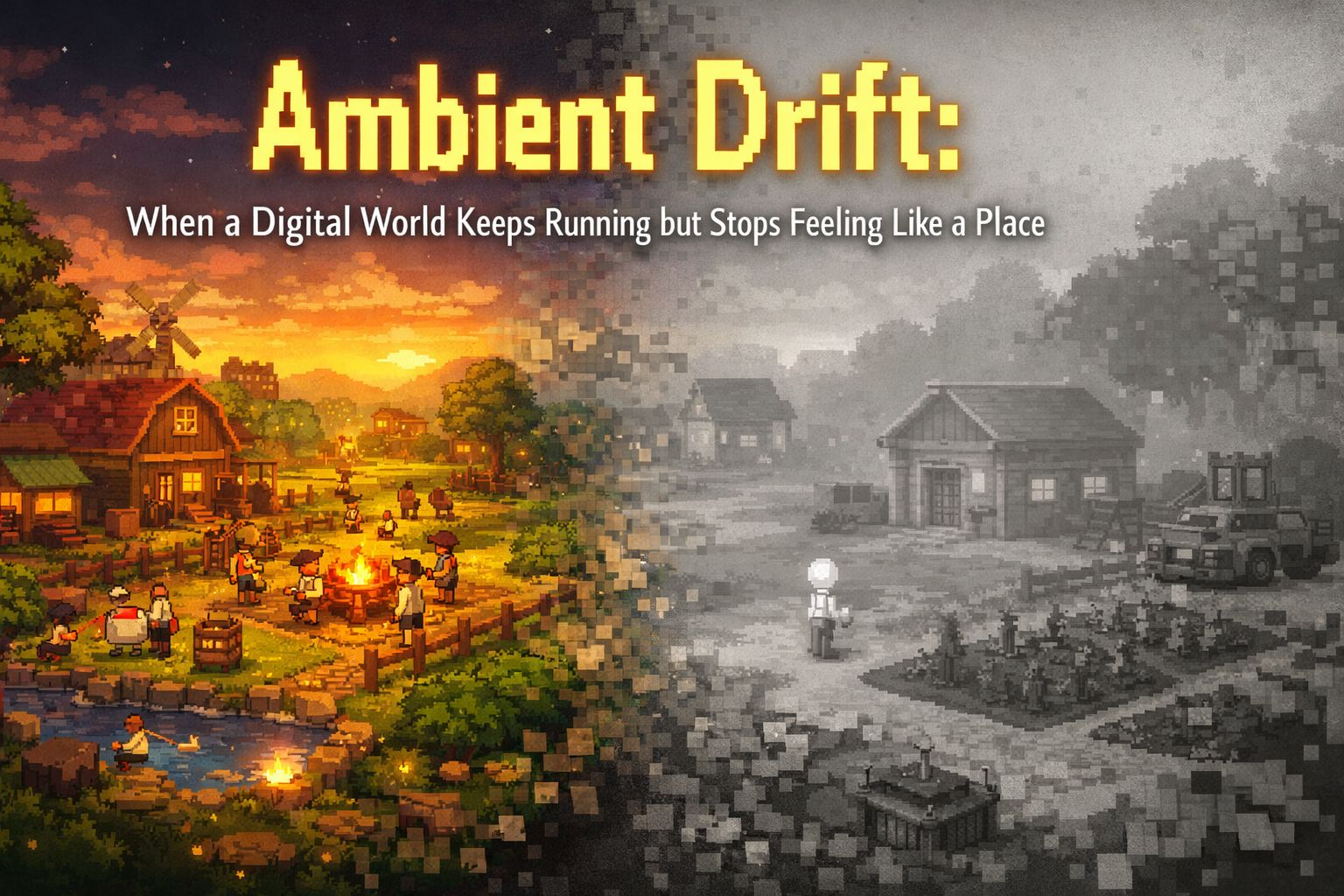
Ambient Drift is the slow moment when an online world is still active, still functioning, still full of movement, but starts losing the everyday patterns that made it feel like a real place. That is the most interesting way to think about Pixels. Most people explain the game through the obvious features first: farming, progression, social play, digital ownership, on-chain systems. Those things are all part of it, but they are not the deepest layer. The more important question is whether a world like this can keep its sense of place once players begin approaching it mainly through optimization.
This problem shows up more clearly in autonomous systems and decentralized environments because no single person is fully directing how the world is experienced. The shape of the place is created by many forces at once: regular players, highly efficient grinders, coordinated groups, automated behavior, and the outside logic of markets. None of those forces are strange on their own. In fact, each one makes sense. But when they all start pulling at the same world, they can gradually change its character. In a tightly controlled game, designers can step in more directly when something starts feeling off. In decentralized systems, that is harder. Change happens through accumulated behavior, and by the time the shift becomes obvious, a lot of the atmosphere may already be gone.
That is what makes this kind of risk easy to miss. Nothing dramatic has to happen. The world does not need to collapse. It can still look healthy from the outside. Players are active. Tasks are getting done. Value is moving through the system. On a dashboard, things may even look strong. But under the surface, something quieter can start slipping away. The world stops creating familiarity. Players still repeat actions, but the repetition becomes purely functional. Routes are chosen because they are efficient, not because they have become part of someone’s habit. Presence becomes more useful than social. The world still works, but it starts to feel thinner.
That difference matters because people do not become attached to a world only through rewards. They become attached through recognition. They start noticing where others tend to gather. They take the same path often enough that it begins to feel natural. Certain names become familiar. Certain areas begin to carry a mood at certain times of day. These things sound small, but they are usually what make a world stay with people. The attachment does not always come from major events. More often, it comes from repeated contact with ordinary things. Once every repeated action gets reduced to output, that softer layer begins to weaken.
That is why Ambient Drift is more serious than obvious instability. Instability gets attention immediately. People react to it. Drift is quieter. It can live comfortably inside decent metrics for a long time. A game can still have activity, transactions, and returning users while slowly becoming less meaningful as a place. That is the mistake many operators make. They treat visible activity as proof that the world is healthy. But a world can be busy without feeling alive. It can be heavily used without being deeply known.
Pixels makes this especially interesting because part of its appeal comes from something harder to measure. It has a gentle continuity to it. It can feel less like a product demanding constant attention and more like a place that keeps moving with or without you. That quality gives it a different kind of strength. But it also means the risk cuts deeper. When a world gets much of its charm from rhythm, atmosphere, and repeated coexistence, over-optimization does not just affect balance or progression. It affects the emotional structure of the space. It starts wearing down the very thing that made the world feel worth returning to.
One useful way to think about this is to separate throughput density from presence density. Throughput density is about how much value, progression, or output players can generate in a given amount of time. Presence density is about how often people still cross paths in familiar places, repeat recognizable routines, and share space in ways that are not fully explained by maximum efficiency. Many decentralized systems become very good at increasing throughput density. Far fewer know how to protect presence density once players understand how to optimize the system properly. That is usually where Ambient Drift begins. The world becomes better at producing results while becoming worse at producing attachment.
A lot of systems miss this because they look at return, but not the quality of return. It is not enough to know that players came back. The real question is why they came back, and what kind of behavior still exists once the most efficient paths are widely known. If players only log in to complete a narrow objective and leave the moment it is done, then the world is no longer behaving like a place. It is behaving like a terminal. A healthier sign is when people still return without a fully defined goal, spend time in familiar zones longer than strict efficiency would justify, and continue doing some things that are slightly redundant from a systems perspective. In social worlds, that redundancy is not waste. It is often where attachment begins.
This can be uncomfortable for modern digital design because so much of it is built around removing friction, shortening loops, and making behavior cleaner. But places do not become memorable by becoming perfectly smooth. They become memorable by having shape. Shape comes from unevenness, repetition, and the small habits that survive beyond pure utility. Once everything becomes streamlined, a world may become easier to use, but it often becomes harder to remember. The map still exists, but its social geography starts to fade.
So the real test is not whether the system is active. It is whether the world still creates forms of shared life that cannot be fully explained by efficiency alone. In production, that would mean a meaningful share of players still return to the same places at roughly the same times, repeat some behaviors that are not strictly necessary, and do so without feeling punished for it. If that is still true, then the world still has rhythm. If it stops being true, then no matter how healthy the numbers look, Ambient Drift has already begun.