I’ll be honest. When I first heard “rewarded LiveOps engine,” it sounded like another polished idea trying to repackage something we’ve already seen. Rewards, tasks, incentives… none of that is new.
But the longer I sat with it, the more it stopped feeling like a feature and started looking like a correction.
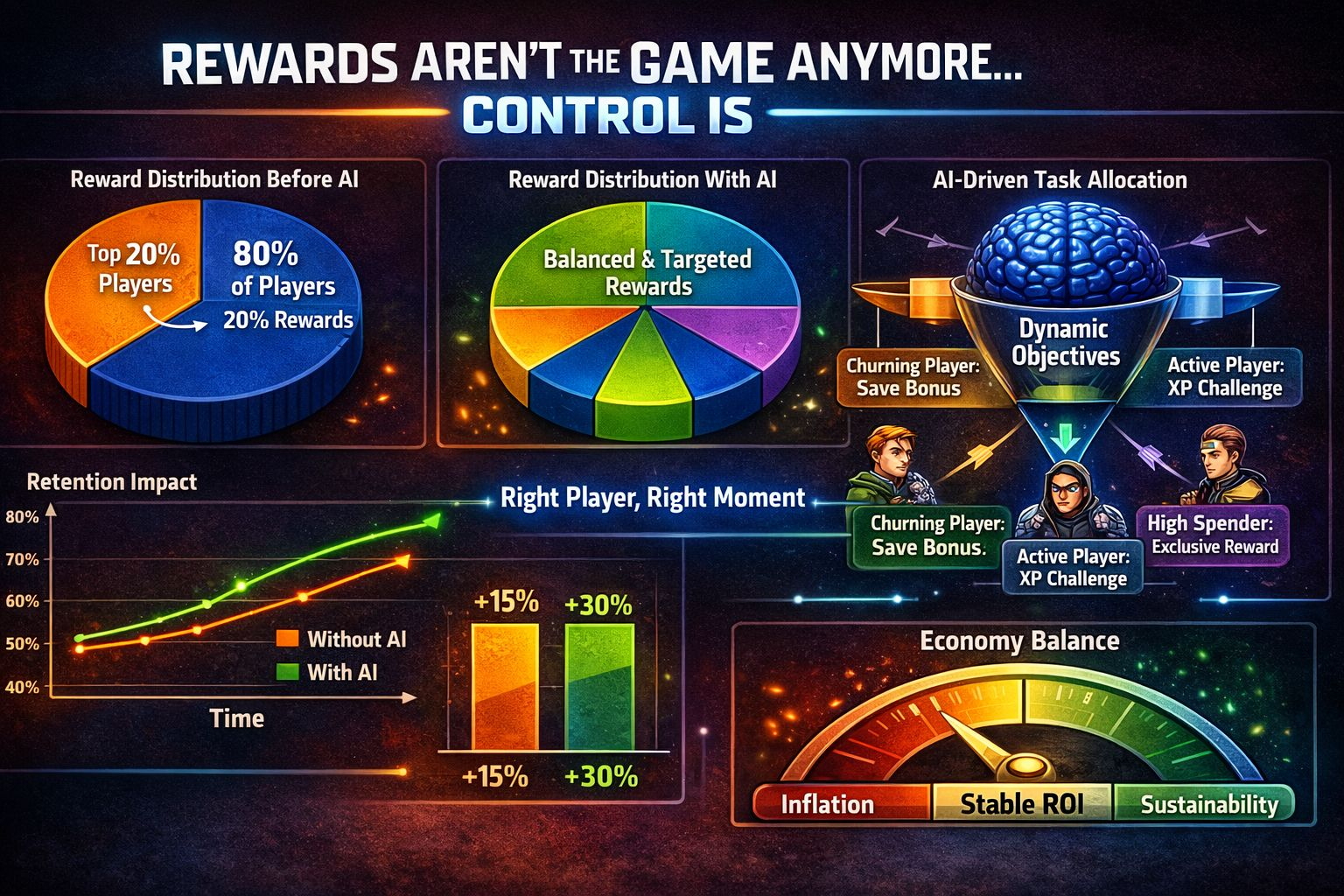
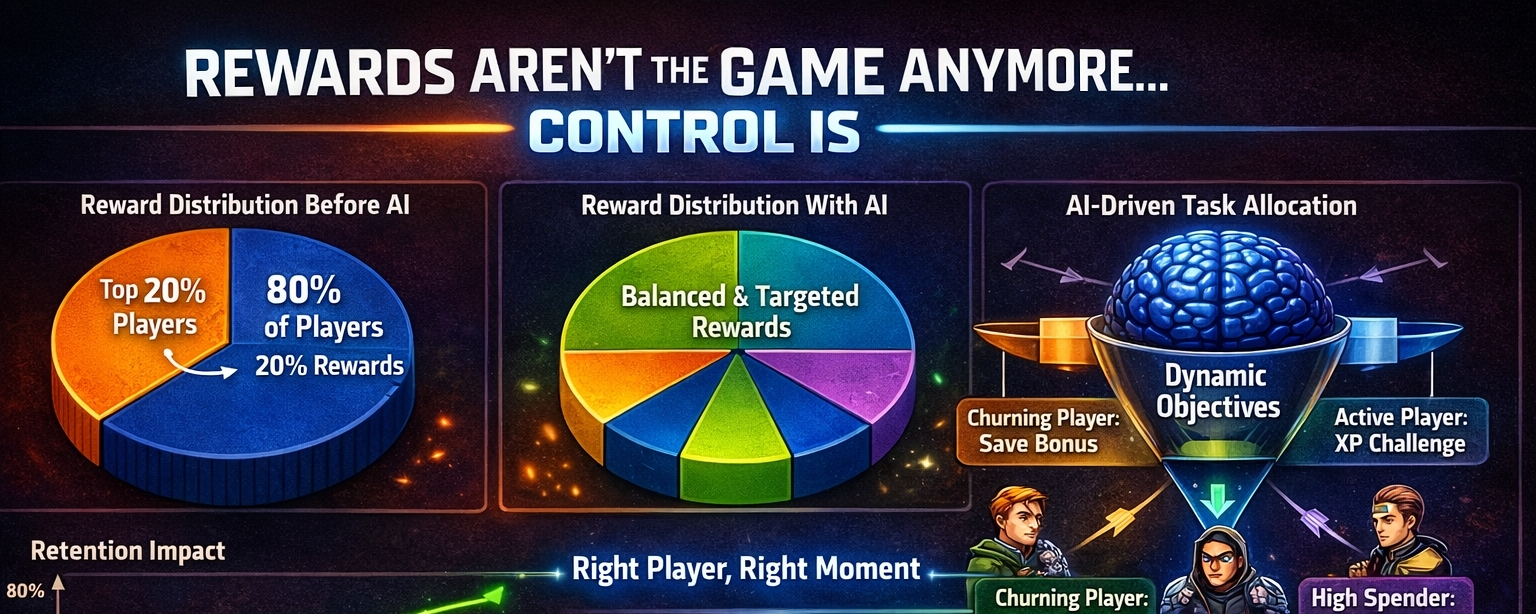
Because if you strip everything back, most play-to-earn systems didn’t fail because of bad tokens or weak gameplay loops. They failed because distribution was broken. Rewards were treated like an open tap. Always flowing, barely filtered. And over time, the same pattern repeated. A small group captured most of the value, usually the fastest, the most optimized, or the most automated. Everyone else slowly lost interest.
That wasn’t random. That was design.
What Stacked is doing inside Pixels is shifting that design from “open faucet” to controlled allocation. And the difference is bigger than it sounds.
On the surface, nothing looks complicated. You complete tasks, you earn rewards. Simple loop. But underneath, there’s an intelligence layer deciding how that loop is shaped for each player.
Not just what tasks exist, but when they appear, who sees them, and how often they repeat.
That timing piece is where everything changes.
Because a reward is not just a reward anymore. It becomes a signal.
If a player is about to drop off, a well-timed task can pull them back in. If a player is already deeply engaged, over-rewarding them doesn’t help, it actually reduces long-term value. So instead of pushing incentives equally across everyone, the system starts narrowing its focus.
Right player. Right moment.
Sounds simple. But what it really means is constant recalibration based on behavior, not assumptions.
And when you look at early patterns from systems like this, the impact is not small. Targeted rewards tend to push retention up somewhere in the 15 to 30 percent range. That gap matters more than people think.
At the lower end, you stabilize a system that would otherwise bleed users. At the higher end, you start bending the growth curve itself.
The difference between those outcomes usually comes down to one thing. How well the system understands intent.
That’s where the idea of an “AI game economist” actually starts making sense.
Traditionally, game economies were managed manually. Teams would design reward loops, monitor inflation, adjust drop rates, and react when something broke. But that process moves slowly. Updates come in cycles. Weekly if you’re lucky. Monthly in most cases.
Meanwhile, player behavior doesn’t wait. It shifts every day.
Stacked compresses that gap.
Instead of reacting after damage is visible, it adjusts in real time. If a task is getting over-farmed, exposure can quietly decrease. If a feature is being ignored, rewards can be attached to guide attention. What players see as a simple task board is actually a dynamic surface that keeps reshaping itself.
That creates a second layer of change that’s easy to miss at first. Content scale.
When you hear numbers like 200 plus unique offers per day, it sounds excessive. Almost like noise. But that only holds if those tasks are generic. If they’re relevant, the volume becomes an advantage instead of a problem.
Because manually, most teams cap out quickly. Ten, maybe twenty meaningful tasks before repetition creeps in. After that, quality drops.
Automation removes that ceiling. But it also raises the bar.
More tasks only work if they feel personal. Otherwise, players filter them out instantly.
And then there’s the part most systems never solve properly. Real value.
Once rewards have real-world weight, everything becomes fragile. Too much distribution and the system leaks value. Too little, and players disengage. That balance has broken almost every play-to-earn model we’ve seen.
Stacked approaches this differently. Rewards are not treated as fixed outputs. They’re treated as investments tied to measurable outcomes.
Retention. Revenue. Lifetime value.
If giving a player one dollar increases their expected value by three, the system leans into it. If it doesn’t, it pulls back. Quietly. Continuously.
That shift turns rewards from a cost into a lever.
But it also introduces a different kind of risk.
When everything is optimized for measurable impact, there’s a tendency to prioritize efficiency over experience. Players might stay longer. Spend more. But something subtle can get lost in the process.
The texture of the game.
That’s why the context around Pixels matters here. This isn’t a team experimenting blindly. They’ve already lived through the full cycle. Growth, hype, imbalance, correction.
At one point, Pixels crossed over a million daily active users. That kind of scale looks strong from the outside. But anyone who’s watched GameFi knows how quickly it can collapse if incentives drift out of alignment.
Stacked doesn’t feel like a fresh experiment. It feels like a response to that history.
And zooming out, you can see the broader shift happening across the industry.
Web3 projects are moving away from open farming toward tighter, more controlled systems. Traditional studios are slowly rethinking how incentives can fit into their models without breaking player experience.
Both sides are converging.
Stacked sits right in that middle layer. It pulls economic awareness from Web3 and combines it with the discipline of traditional LiveOps.
If it works, the implication is bigger than just one ecosystem.
It means rewards stop being guesswork.
They become precise tools.
And once something becomes measurable and repeatable, it tends to spread.
But there’s still one question that doesn’t go away.
How much control is too much?
At what point does a system stop supporting player behavior and start shaping it so tightly that it feels engineered instead of earned?
Because if every action is guided, even subtly, players eventually notice. And once they do, they don’t just play the game anymore.
They start playing the system.
Right now, most players don’t seem to mind. As long as rewards feel fair and progression feels natural, the illusion holds.
But that balance is thin.
Push too far, and the system becomes visible.
And when that happens, trust becomes harder to maintain than retention.
If this direction holds, the future of game economies won’t be about how much value they distribute.
It will be about how precisely they distribute it.
And that shift doesn’t look loud from the outside.
But underneath, it changes everything.