
Web3 games usually do not fail because people never show up. They fail because people do not stay for the right reasons.
That, to me, is the real issue.
A lot of crypto games know how to attract attention. They know how to create a burst of activity, a wave of farming behavior, a period where everyone is suddenly “playing” because the rewards look good enough. But once the rewards slow down, the excitement fades with them. And when that happens, you start to see what was actually holding the whole thing together.
Usually, it was not the game. It was the extraction.
That is why Pixels is such an interesting case. Not because it has solved everything, and not because it is immune to the same problems, but because it feels like one of the few projects in Web3 gaming that is close to a more durable model. It has the kind of design that could support a real player-driven economy. But I think that only happens if the token stops being the main reason people stay.
That is the key point for me.
Pixels can absolutely sustain a player-driven economy without leaning too heavily on token incentives, but only if it keeps building a world people actually feel attached to. Not just a system they understand how to optimize. Not just a loop they know how to farm. A world.
That distinction matters more than people think.
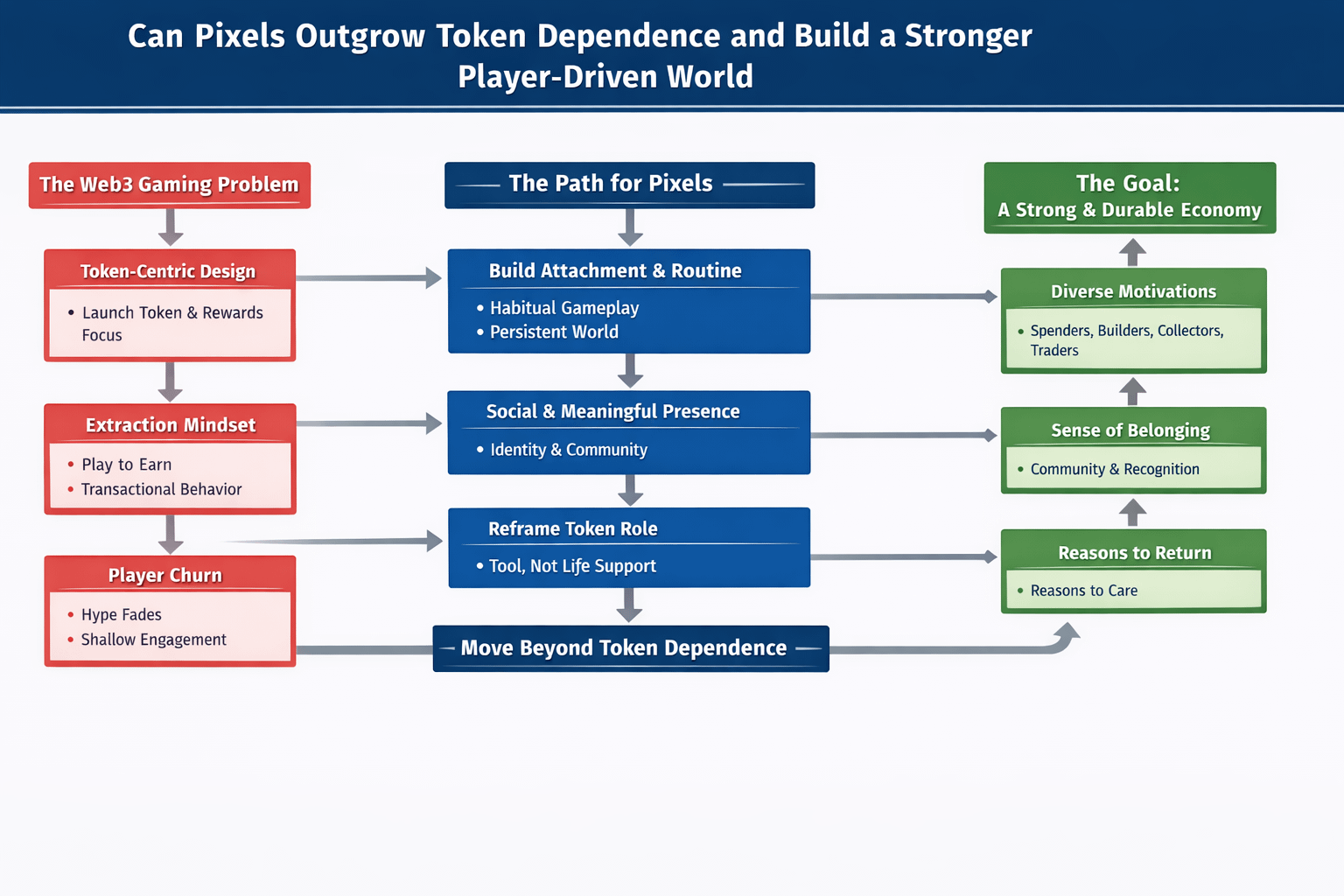
The common mistake in Web3 gaming has always been building the economy around extraction first and gameplay second. The logic is usually simple: launch a token, attach rewards to activity, let users earn, and hope the economy becomes self-sustaining over time. It sounds good on paper, but in practice it often creates the wrong player relationship from the very beginning. Instead of asking, “Why would someone enjoy being here?”, the system asks, “How long can this reward be attractive enough to keep them here?”
Those are two very different foundations.
Once players enter a world primarily to extract value from it, they begin to treat everything inside that world as a resource node. Their time becomes tactical. Their behavior becomes transactional. The game may still look active on the surface, but underneath, the emotional structure is weak. People are not attached. They are positioned.
And the problem with positioned users is that they reposition quickly.
That is why I think Pixels has to be careful about what kind of economy it wants to become. If it keeps training players to see participation mainly through token output, then it risks falling into the same trap as a lot of earlier Web3 games. It may look healthier, softer, and more playable than those projects — and in many ways it is — but no amount of charm fully protects a game if the core user mindset remains extractive.
What gives Pixels a better chance is the nature of the game itself. It is slower. Lighter. More routine-based. It is built around farming, crafting, movement, small progression loops, and everyday presence. That matters. These kinds of mechanics do not always generate dramatic headlines, but they are actually much better at creating habit. And habit is where durable economies begin.
Habit is stronger than hype.
I really believe that.
Hype can create traffic. Habit creates return. And return, over time, is what gives a player-driven economy real shape.
People do not always come back to games because every session is exciting. Sometimes they come back because the game fits into their day. Because it becomes familiar. Because checking on something they built starts to feel normal. Because the world begins to hold a little emotional weight. That is where Web3 gaming often gets the psychology wrong. It overestimates the power of rewards and underestimates the power of routine.
Routine is not flashy, but it is incredibly important.
If Pixels can keep strengthening that feeling of low-pressure, continuous presence, then it has something much more valuable than a temporary incentive loop. It has the beginnings of real attachment. And once attachment starts to form, the economy does not have to rely on constant reward intensity to feel alive.
But that only works if the world becomes socially meaningful too.
A strong player-driven economy is not just about earning and trading. It is about being seen. Being recognized. Having some form of identity inside the space. That could mean land, progression, reputation, crafted items, visual expression, status, or simply a known presence in the community. The point is that participation needs to mean something beyond output.
That is where a lot of digital economies become real: when different people want different things from the same world.
Some players want efficiency. Some want prestige. Some want convenience. Some want collection. Some want expression. Some want to trade. Some want to spend to save time. Some just want to feel embedded in a place they like. That is what a healthy player-driven economy actually looks like. Not a system where everyone earns forever, but a system where value moves because motivations are different.
That part is important, because “player-driven” is often misunderstood in Web3. People hear it and assume it means every player should always be extracting value from the system. But that is not how strong game economies work. In any real game world, there are spenders, builders, optimizers, collectors, flexers, traders, and quiet participants. The economy stays alive because all of those roles coexist.
If everyone is only there to earn, the design eventually collapses under its own expectations.
That is why I think the token in Pixels needs to be repositioned very carefully. Not removed, but reframed.
The token should be a tool. It should help players access things, move through the system more flexibly, unlock deeper forms of participation, trade more easily, or make certain actions more convenient. That is a useful role. A strong role, even. But it should not be the emotional center of the ecosystem. It should not be the main answer to the question, “Why am I still here?”
Because once the token becomes the emotional backbone of the world, the world becomes fragile.
Every shift in incentives starts to feel existential. Every drop in excitement becomes dangerous. Every player slowdown looks like a structural crisis. That is what happens when the token is forced to carry too much meaning. It stops being infrastructure and starts being life support.
The world has to become strong enough that the token no longer has to carry everything.
To me, that is the real challenge in front of Pixels. Not just growing the economy, but maturing it. Building enough social texture, enough identity, enough long-term value in participation that players no longer relate to the world like contractors passing through it. They need reasons to spend, reasons to collect, reasons to care about how they are perceived, reasons to build something that feels like theirs. That is what gives an economy depth.
And to be fair, Pixels seems more capable of getting there than most.
Its style is less aggressive. Its gameplay is more livable. Its environment is better suited to routine than adrenaline. Those qualities are often dismissed as casual, but I think that misses the point. Soft games can create very strong retention when they are designed well, because they leave room for players to form their own relationship with the world. And that kind of relationship is much harder to break than pure reward dependence.
So yes, I think Pixels can sustain a player-driven economy without relying too much on token incentives. But only if it stays disciplined about what kind of world it is building. If it keeps rewarding extraction as the main form of participation, it will eventually weaken its own foundation. But if it keeps building attachment, routine, identity, and socially meaningful presence, then the economy can become much more durable than the usual Web3 cycle.
In the end, the strongest digital economies are not built on the promise that everyone keeps earning forever. They are built on something quieter and much more powerful: reasons to return, reasons to care, and reasons to stay.
That is the difference between a system people use and a world people live in.