
@Pixels For a long time, I moved through free-to-play games without really questioning how they were built. The structure is usually easy to recognize you start off with smooth progress, everything feels open and rewarding, and then gradually something shifts. Either the pace slows down or the rewards start to thin out, and that’s when the paid layer becomes visible. It’s a pattern most players are familiar with now. But Pixels doesn’t quite follow that path, at least not in a way that’s obvious. You can spend hours inside it without ever touching PIXEL, just cycling through farming loops, earning Coins, and staying fully engaged without feeling restricted. It feels complete on the surface, almost like the system is self-sufficient. But after sitting with it for a while, there’s this quiet sense that not everything lines up as neatly as it first appears.
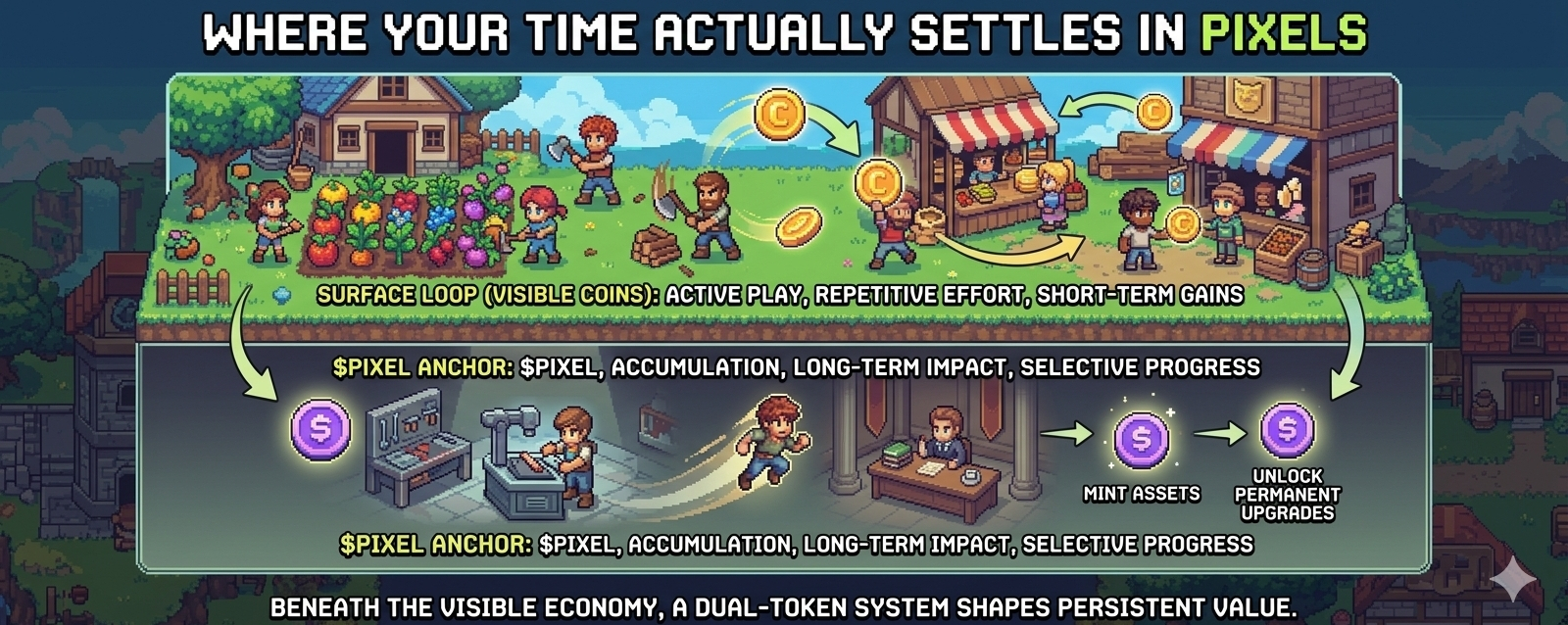
The more time passes, the more that feeling starts to take shape. Coins dominate the visible experience they’re constantly moving, constantly being used, and they keep the entire gameplay loop active. But they don’t really hold onto anything. They feel temporary, tied to the present moment rather than to anything that lasts. You earn them, spend them, and then they’re gone, replaced by the next cycle. Then there’s PIXEL, which doesn’t appear nearly as often and doesn’t try to insert itself into every interaction. Instead, it shows up in specific moments minting assets, unlocking certain upgrades, interacting with guild systems places where something seems to extend beyond the immediate loop. It’s not louder or more aggressive; it’s just positioned differently, almost like it’s waiting in the background rather than competing for attention.
That difference changes the way effort translates into value. It’s not about paying to move faster, and it’s not even about spending more in a traditional sense. It feels more like deciding where your time actually lands. Two players can invest the same number of hours, follow similar routines, and still end up with very different outcomes. One stays fully inside the Coin loop, constantly active but mostly cycling through short-term gains. The other steps into PIXEL occasionally not all the time, just enough to anchor parts of their progress into something that doesn’t reset as easily. The gap between those two paths isn’t immediate or obvious. It builds slowly, almost quietly, until eventually the difference is there whether you noticed it forming or not.
What makes this even more interesting is how little the system pushes you to recognize it. There’s no strong signal telling you to move beyond the surface layer, no early friction that forces you to engage with PIXEL. You can keep playing comfortably without ever thinking about it. And because of that, a lot of players might never cross that boundary in a meaningful way. If the distinction between Coins and PIXEL stays subtle, then most of the activity will remain concentrated in the visible loop, while the deeper layer operates somewhat independently. That’s where things start to feel slightly disconnected not broken, just not fully aligned.
At the same time, the underlying mechanics don’t stop moving. Supply continues, unlocks happen, and the parts of the system tied to PIXEL keep evolving whether players engage with them or not. If those areas don’t expand at the same pace as the rest of the game, the imbalance can grow quietly in the background. It’s something that doesn’t show up immediately in gameplay but can become more noticeable over time, especially as the ecosystem develops.
Still, there’s something genuinely compelling about how it’s all put together. If Pixels continues to grow and starts connecting different systems or experiences, this layered structure could begin to feel more intentional. Coins would remain tied to the moment-to-moment experience, keeping everything active and fluid, while PIXEL could act as a thread that carries certain outcomes forward, linking different parts of the game in a way that isn’t immediately visible but becomes more meaningful over time. At that point, it starts to feel less like a simple in-game currency and more like a foundation that sits beneath everything else.
But there’s also an uneasy side to that idea. If most players stay within the surface layer while value gradually accumulates somewhere deeper, then the system isn’t entirely neutral. It doesn’t block access or create hard barriers, but it does shape which actions leave a lasting impact and which ones fade back into the loop. That kind of selectivity isn’t obvious, and maybe that’s why it works. You’re never forced to confront it. You can keep playing, keep progressing, and everything feels fine. It’s only when you step back and look at how things settle over time that the difference starts to stand out.
In the end, Pixels doesn’t interrupt your experience or demand anything from you in the way many systems do. It lets you move at your own pace, stay within the parts that feel comfortable, and ignore the rest if you want to. But underneath that freedom, there’s a structure quietly deciding what persists and what doesn’t. From the outside, it still looks like a fully open economy. But the longer you stay in it, the more it starts to feel layered—and within those layers, the same effort doesn’t always carry the same weight.