
One of the easiest ways to weaken a game is to make its economy carry too much.
That happens in all kinds of games but in Web3 it happens faster and more visibly. A token starts out as a feature then slowly becomes the center of everything. It is used for rewards, purchases progression access status and speculation all at once. Before long the game is no longer shaping the economy. The economy is shaping the game.
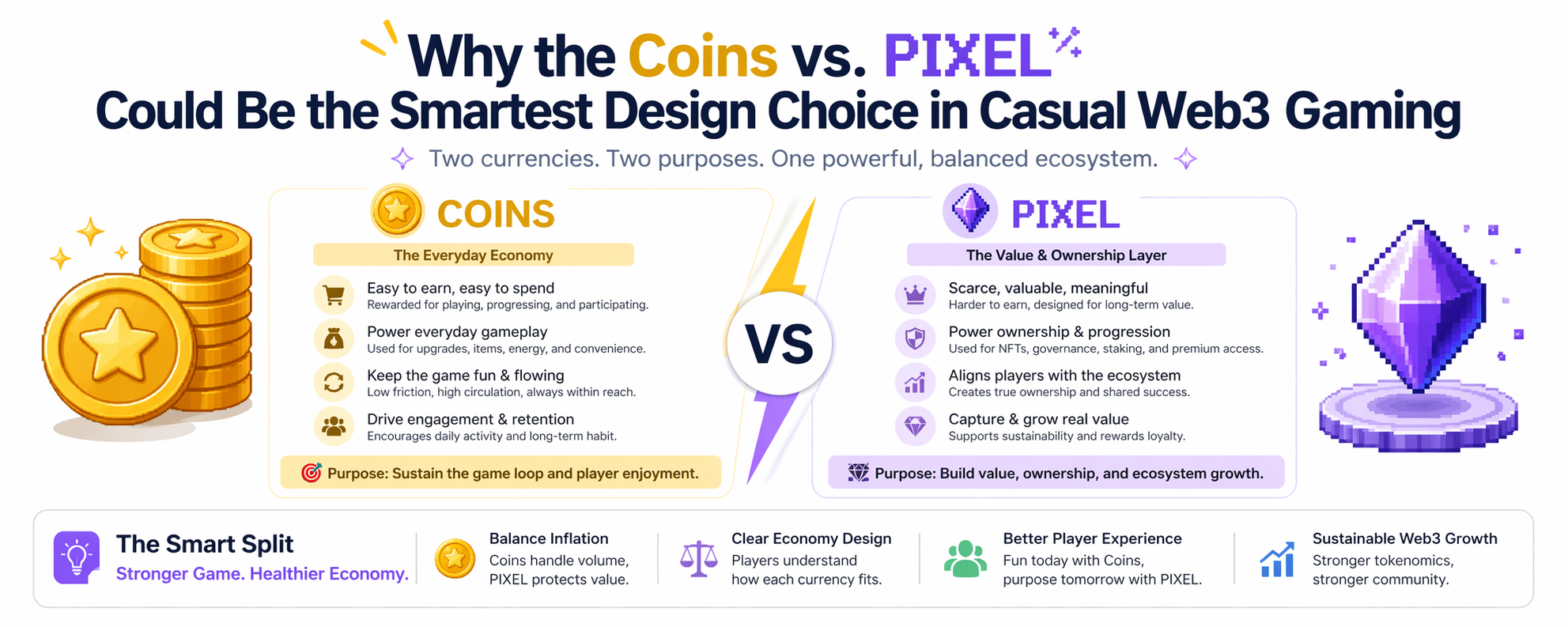
That is why the Coins and PIXEL split in Pixels feels more important than it may seem at first.
On the surface, it looks like a basic two-currency setup. One currency handles ordinary in-game activity while the other sits in a more premium or ecosystem-level role. Plenty of games have done something similar in one form or another. But in Pixels, that separation feels especially well judged because of the kind of game it is trying to be.
Pixels is not built around intensity. It is not a game people open because they want pressure. A lot of its appeal comes from routine. You farm craft explore collect things, complete tasks, and gradually make progress. It works because the world feels easy to settle into. There is a certain lightness to it. You can spend time there without feeling like every decision has to be optimized.
That kind of atmosphere is fragile.
Once a live token starts sitting at the center of everyday play the mood changes. Even if nothing dramatic happens, players begin to feel a different kind of tension. Small decisions no longer feel small. Spending becomes something you second-guess. Progress starts to feel tied to market value instead of game logic. The whole experience becomes a little harder a little louder, a little less natural.
Coins help protect Pixels from that.
They give the game room to feel like a game. That may sound obvious but it matters more than people think. A farming game needs a stable rhythm. Players need to understand what things cost, how rewards work and what progress feels like over time. They do not want the basic loop constantly distorted by the behavior of a public token. They want consistency. They want a world that holds its shape from one session to the next.
That is really what a soft currency does when it is used well. It keeps the everyday layer of the game readable. It lets the developers tune rewards sinks and pacing based on what actually improves the experience instead of forcing every adjustment through the lens of token sensitivity. It also lets players interact with the world more casually, which is important in a game like Pixels, where ease and repetition are part of the charm.
PIXEL on the other hand seems stronger because it is not being asked to do everything.
That is the part I think many Web3 games missed. They treated the token like it had to justify itself by being everywhere. In reality a token often becomes more useful when its role is narrower and more intentional. The more jobs it has, the messier it gets. It becomes harder to balance, harder to understand and harder for players to relate to in a healthy way.
Pixels avoids some of that by giving PIXEL a different place in the system. It is not the currency for every ordinary action. It sits a little higher than that. It is tied more to premium utility upgrades, exclusivity and broader ecosystem value. That makes it feel less like background noise and more like something with a distinct purpose.
And that difference changes the tone of the whole economy.
When one currency handles daily play and another handles premium or higher-level value, the player experience becomes easier to read. You do not need to constantly think about whether you are spending the wrong kind of asset on basic tasks. You are not forced to experience every part of the game through the same financial lens. The world becomes more intuitive.
That matters a lot in casual gaming because casual players are extremely sensitive to friction, even when they do not talk about it in those terms. They notice when a system feels too heavy. They notice when ordinary progression starts to feel stressful. They notice when the game is asking them to think like an investor instead of a player.
Pixels seems to understand that better than many projects in the space.
There is also something quietly smart about what this split says philosophically. It suggests that not all value inside a Web3 game should be treated the same way. Some value belongs to the day-to-day life of the game. It should be flexible manageable, and designed around feel. Other forms of value are better kept rarer, more deliberate, and more connected to ownership or broader utility. When those things are mashed together, the system usually becomes noisier than it needs to be.
Separating them creates breathing room.
It also helps different kinds of players exist in the same world without pulling the economy apart. Not everyone comes to Pixels for the same reason. Some people want a calm routine. Some want to collect. Some want to move faster. Some care about land identity or status. Some are interested in the wider ecosystem around the game. Those are different motivations and they do not all need to be fed through one exposed token.
That is another reason the split works. It gives the game more than one lane.
The players who mostly want the comfort of the loop can stay closer to Coins and everyday progression. The players who want premium utility or deeper ecosystem participation can engage more with PIXEL. Of course the two layers still connect but they are not collapsed into the same thing. That makes the economy feel less cramped. It lowers the chance that every player ends up trapped inside the same incentive structure.
And in Web3 that is a real advantage.
Too many blockchain games ended up attracting behavior that was more extractive than playful partly because the economy made no distinction between playing the game and pulling value out of it. When the same token governs everything, those two impulses start feeding each other. That can create activity but it does not always create a healthy world. Pixels seems to be aiming for something more stable. Not less ambitious just more grounded.
There is also a longer-term benefit that could matter even more over time.
If PIXEL is allowed to function as a broader ecosystem asset rather than just the thing you use for ordinary in-game spending, then it has a better future. It can mean something across experiences. It can carry premium identity access or interoperability in ways that make sense on-chain. Meanwhile the local economy of the game can stay local. That is simply better design. Not because it is flashy but because it respects the difference between a playable world and a networked asset.
That distinction may end up being one of the reasons Pixels lasts.
None of this means the system is perfect. Any live economy can drift. Coins can inflate. Premium utility can become too weak or too aggressive. Balance can always go wrong. But some foundations are better than others and this feels like a better foundation than what many Web3 games started with.
What stands out to me most is that the decision feels disciplined.
It does not try to force blockchain into every part of the experience just because it can. It does not confuse visibility with usefulness. It does not assume the token has to sit at the center of every reward purchase, and piece of progress. Instead, it gives the game one layer for living in the world and another for engaging with the premium and ecosystem side of it.
That is a much calmer approach.
And maybe that is exactly why it works.
The Coins vs. PIXEL split is not some dramatic invention. It is not the kind of idea that makes a lot of noise on first reading. But the more you think about it, the more sensible it becomes. It protects the game from volatility. It gives the token a clearer identity. It makes everyday play feel lighter. And it shows a level of restraint that casual Web3 gaming probably needs more of.
Sometimes the smartest design choices are the ones that remove pressure instead of adding complexity.
This feels like one of those choices.
