
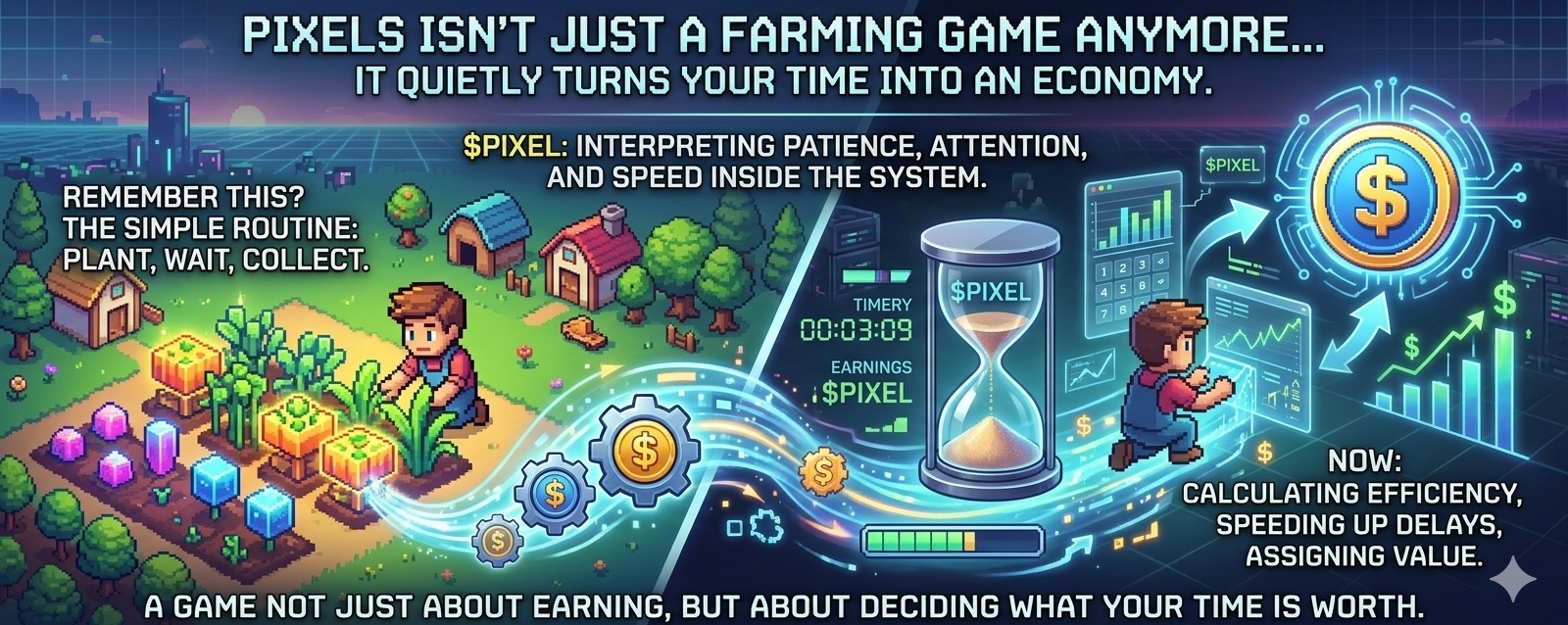
@Pixels For the longest time, I never really thought deeply about time inside games. It always felt casual to me. You log in, finish a few tasks, maybe grind a little, then leave. Nothing about it feels permanent or measurable in the same way real life does. In work, every hour has value. In business, delays cost money. Even in technology, speed matters because time affects efficiency. But games usually feel disconnected from that logic. Time inside them feels light, almost invisible. You spend it without thinking too much about what it’s actually worth.
That was exactly how I looked at Pixels when I first started playing it.
At the beginning, it honestly seemed simple. Just another farming-style game built around routines. Plant crops, wait for timers, collect resources, repeat the cycle. The mechanics felt familiar enough that I didn’t expect much beyond a relaxing grind. But after spending more time in the game, I started noticing something strange. Different activities inside the world slowly began feeling connected in a way I hadn’t paid attention to before. Farming, crafting, upgrading, gathering resources, progression paths they all started feeling less like separate systems and more like different versions of the same decision.
That decision was always tied to time.
And once I noticed that, the entire game started feeling different.
Most games never really solve this problem properly. Every activity exists in its own lane. Crafting rewards one thing, farming rewards another, quests push you somewhere else, and players rarely compare them directly because the systems are disconnected. Pixels feels different because it quietly creates a structure where all these activities begin competing for your attention at the same time. The game never openly says it, but eventually you start evaluating everything through one question: “Is this worth my time right now?”
That’s the moment where PIXEL stops feeling like just another in-game token.
It starts feeling more like a tool that assigns value to your time inside the system.
I realized this without even trying. I’d catch myself making tiny calculations naturally while playing. Should I wait for this process to finish, or should I spend $PIXEL to speed it up? Is this activity worth continuing, or is there another loop that gives a better return for the same amount of effort? Suddenly, decisions weren’t only about gameplay anymore. They became about efficiency. About pacing. About where my time could produce the best outcome.
That shift is subtle, but once you feel it, it changes the entire experience.
What makes Pixels interesting is that the pressure never feels aggressive. The game doesn’t force you into spending or constantly punish you for waiting. The friction is softer than that. Small delays here, tiny slowdowns there, enough waiting to make you aware of time without making the game frustrating. Individually, those moments don’t seem important. But together, they create a constant background feeling where speeding things up starts looking attractive.
You can wait if you want to.
Or you can change the pace.
And that’s exactly where PIXEL becomes important.
In a weird way, the system reminds me less of traditional gaming economies and more of how cloud services or digital infrastructure work. Companies don’t only pay for outcomes anymore — they pay for reduced latency, faster processing, better efficiency, quicker execution. Time itself becomes the product. Pixels feels like a lighter version of that same idea. Instead of machines or infrastructure, though, the system revolves around player behavior. Human decisions become part of the economy.
That creates an interesting effect because two players can spend the exact same number of hours inside the game and still end up in completely different positions. Not because one worked harder, but because one understood how to “price” their time better within the system. The game quietly rewards efficient allocation of attention more than simple activity alone.
And honestly, that’s where things become both fascinating and risky.
Because once players start optimizing, they rarely stop. Every game eventually reaches a point where players search for the best route, the highest return per minute, the least resistance for the most reward. It’s natural. Communities always move toward efficiency. The problem is that when too many people converge on the same optimized paths, the world can start feeling less alive. What originally felt immersive slowly turns into a collection of calculated routines.
Then comes the bigger issue: perception.
Even if the system itself is technically fair, players eventually begin questioning the design behind the friction. Are these delays naturally part of the game, or were they intentionally designed to influence behavior? Is the pacing authentic, or carefully engineered to push certain decisions? Those questions don’t instantly break a game, but they do change how people emotionally connect with it.
I’m not sure Pixels fully avoids that tension.
Maybe it doesn’t even want to.
Because what the game seems to be doing intentionally or not is making time feel measurable across the entire experience. Not perfectly equal, but comparable enough that players constantly think about efficiency no matter what activity they choose. That alone changes how the economy behaves. It changes how progression feels. It changes how players interact with the world.
And honestly, that might be the real idea behind PIXEL.
Not just rewarding effort, but interpreting time itself inside the system.
The more I think about it, the more it feels like the token isn’t mainly connected to what players earn. It’s connected to how the game understands patience, speed, attention, and decision-making. That’s a very different kind of economy compared to most games. Quietly, without making it obvious, Pixels turns time into something structured instead of invisible.
And once you notice that, it becomes hard to unsee.
You stop feeling like you’re simply playing a farming game.
You start realizing you’re constantly deciding what your time is actually worth.