
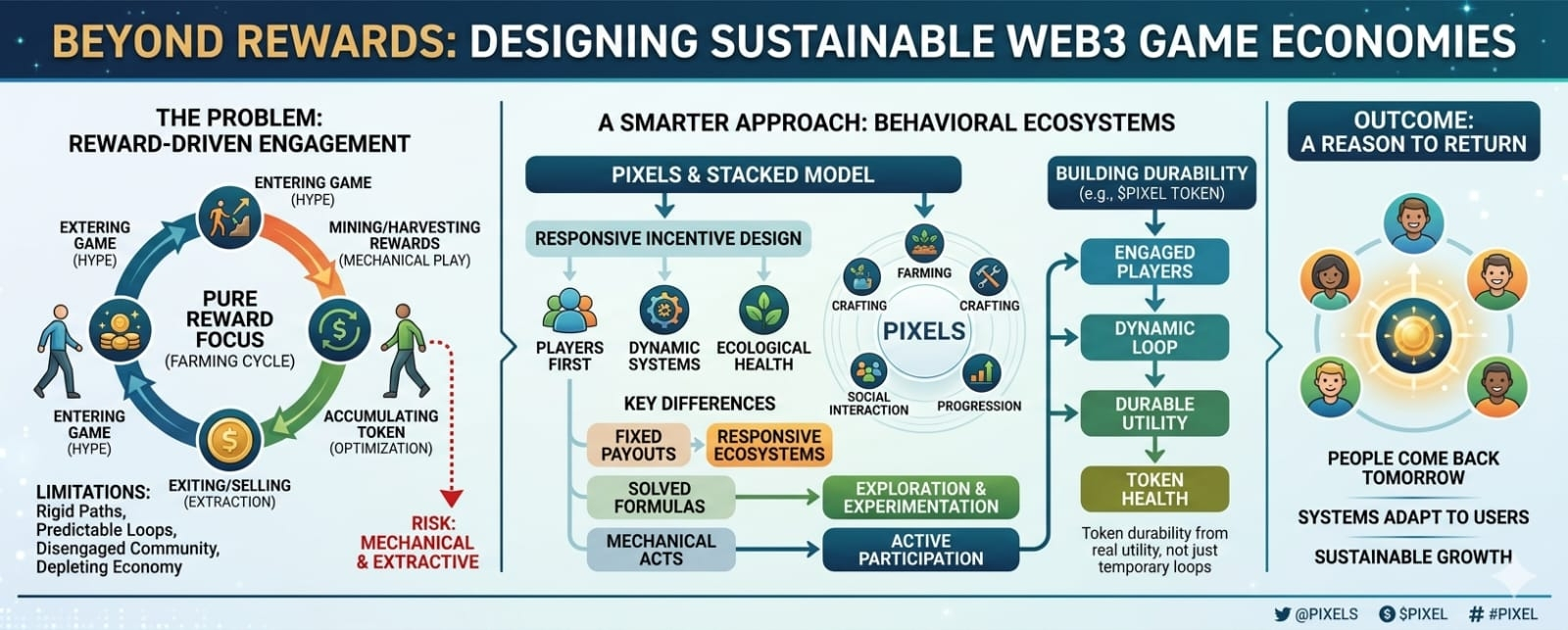
i usually get cautious when a Web3 game starts talking too much about rewards.
Not because rewards are bad. They matter. They bring people in, create activity, and give the economy a pulse. But i have seen too many projects confuse distribution with design. They hand out value, players rush in, the loop looks healthy for a while, and then everything starts narrowing. People stop exploring. Stop experimenting. Stop playing naturally. They begin doing only what pays best. At that point, the game may still be active, but it no longer feels alive.
That is why @Pixels keeps holding my attention.
On the surface, Pixels is easy to explain. Farming, crafting, resource loops, social interaction, progression. It looks familiar enough that you think you already understand where it is going. A calm game with an economy underneath it. But the longer i look at it, the more it feels like the real work is happening below that simple surface.
What interests me is not just the game itself, but the direction of its Stacked ecosystem.
To me, Stacked feels like an attempt to solve one of the hardest problems in Web3 gaming: how do you reward users without training them to destroy the experience? That sounds dramatic, but it is a real design problem. The moment every reward path becomes too fixed and too obvious, players stop engaging with the world and start engaging with the formula. The system gets solved. Once that happens, behavior becomes mechanical and the economy starts getting shaped by extraction more than participation.
That is where Stacked starts to feel important.
Instead of treating incentives like a simple emission schedule, the idea seems closer to making rewards more responsive to how people actually take part in the ecosystem. That is a more interesting direction than pure payout logic. It suggests that the future of game economies may depend less on how much value is distributed and more on how intelligently that value is directed.
And honestly, i think that matters for $PIXEL too.
A token becomes more durable when it is tied to an ecosystem people keep returning to, not just one they know how to farm. If players stay because the system keeps feeling dynamic, social, and worth engaging with, then the token starts sitting inside a real behavioral loop instead of a temporary extraction cycle. That does not remove risk. It just gives the project a stronger foundation than “earn, sell, leave.”
Of course, i am not pretending this solves everything.
Every valuable system eventually attracts optimization. That pressure never disappears. The more attention, utility, or value an ecosystem gains, the more people will try to decode it and push it toward efficiency. That is normal. The real question is whether the design can keep adapting faster than user behavior becomes purely transactional.
That is why i do not see Pixels as just another farming game with a token attached.
i see it as a live experiment in whether Web3 games can create an economy that supports play instead of replacing it. And if Stacked continues developing in that direction, then the bigger story may not be rewards alone. It may be the emergence of a smarter ecosystem where incentives are shaped carefully enough that people keep showing up as players first.
For me, that is what makes @Pixels worth watching.
Not because it promises easy rewards.
But because it seems to understand that in Web3 gaming, the hardest thing to build is not a token loop.
It is a reason to come back tomorrow.