
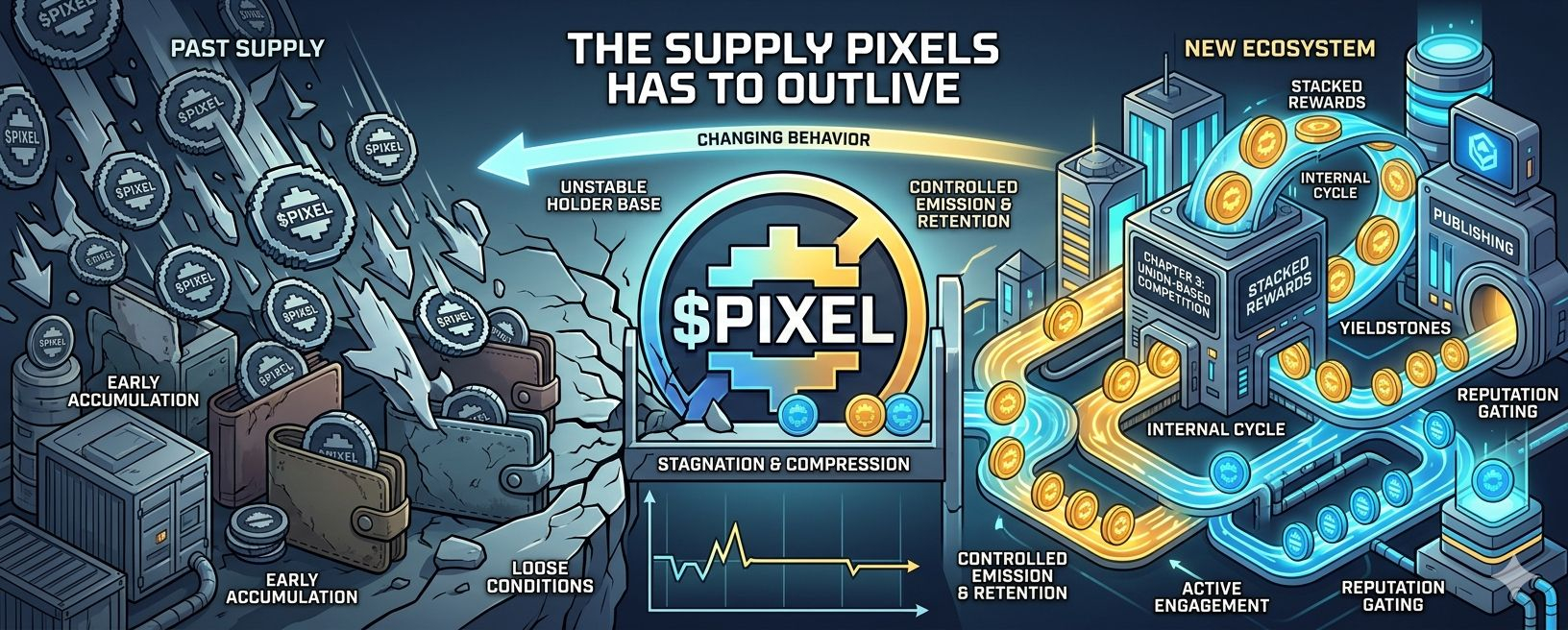
What keeps bothering me is how PIXEL barely reacts anymore. Circulating supply has already pushed past 3 billion, unlocks continue on schedule, Chapter 3 reshaped gameplay, Stacked rerouted rewards and yet the token still trades like it’s digesting something old rather than responding to something new. It doesn’t break down, but it doesn’t reprice either. That kind of flat behavior usually means the market isn’t confused. It means it’s waiting.
What makes this harder to dismiss is that the system itself doesn’t look careless anymore. Chapter 3 forces players into Union-based competition where rewards are tied to participation, not just presence. Yieldstones, Hearth reinforcement, even sabotage these aren’t passive loops. They require engagement that maps to outcomes. Stacked shifting part of the reward flow into USDC instead of pure PIXEL is a direct attempt to reduce immediate sell pressure. Reputation gating adds friction where earlier systems had none. The design is clearly moving toward controlled emission. It’s not trying to attract activity at any cost.
But the part I can’t get past is that none of this rewrites what already exists. Most of the supply that matters is already out there earned under looser conditions, sitting in wallets that don’t need to engage with any of these improvements to exit. And unlocks continue to add to that base without asking whether the system is ready to absorb them. So the structure has improved, but it’s layered on top of an ownership base that hasn’t. The rules changed. The holders didn’t.
If that’s true, then what looks like stagnation is actually a kind of compression. New design is trying to reshape behavior, but it’s colliding with supply that was never conditioned to respond to it. That’s why volume spikes feel disconnected they’re reactions, not transitions. And that’s why price doesn’t move cleanly. It’s not just reflecting demand; it’s filtering through a holder base that still sees the token as something to realize, not something to cycle through.
What feels more important than the mechanics themselves is whether Pixels can change that relationship over time. The Union system, land participation, and the publishing layer all point toward the same idea: keeping tokens inside the system longer. Not by locking them, but by giving them more reasons to move internally before they leave. If the average token turns over inside the ecosystem more times before being sold, then the same emission curve produces a different outcome. Not immediately, but structurally.
I’m not fully convinced that shift has happened yet. The architecture is pointed in that direction, but behavior hasn’t settled enough to confirm it. The reading I keep coming back to is narrower than it sounds: Pixels isn’t trying to fix emission it’s trying to outlast the consequences of it. If future unlocks pass without triggering the same reflex to sell, then something has already changed at the holder level. If they don’t, then the system is still negotiating with a past it hasn’t fully moved beyond.