
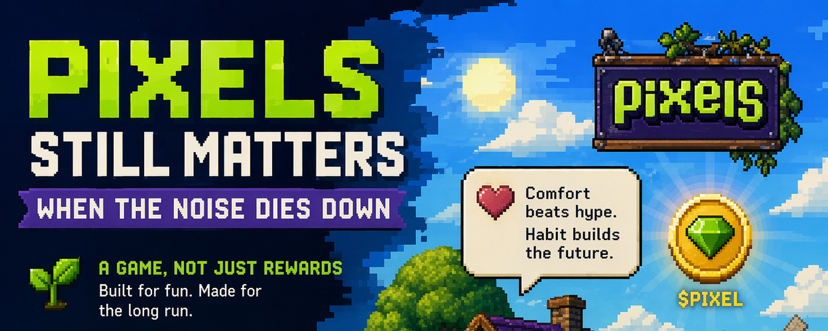

Most Web3 games know how to make a strong first impression.
They launch with energy, push out rewards, get everyone talking, and for a little while it feels like momentum is enough to carry everything forward. The token becomes the center of attention, players rush in, timelines fill up with screenshots, and the whole project starts to look bigger than it really is. But once that first wave slows down, the truth usually becomes easier to see. If the game itself is weak, no amount of excitement can hide it for long 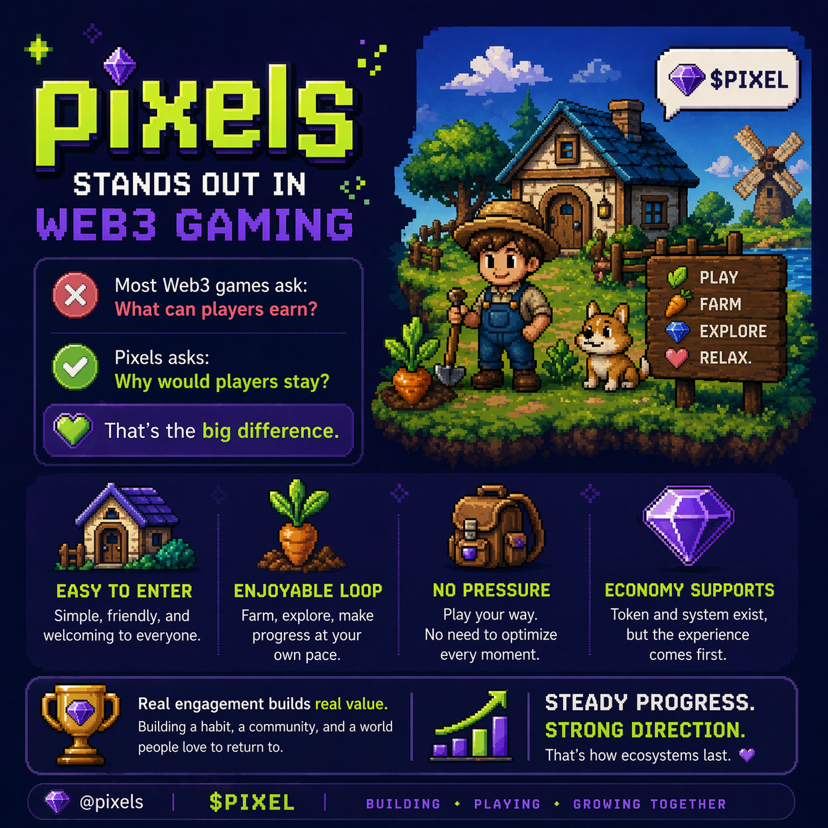
That is where Pixels feels different.
What makes Pixels stand out is not that it tries harder to look important. It is that it feels easier to live with. The game does not demand that every session feel intense or financially meaningful. It gives players a world they can settle into. That difference may sound small at first, but in gaming it changes everything. A project built around pressure can attract attention quickly, but a project built around comfort has a much better chance of keeping people around.
That is one of the reasons Pixels has stayed interesting even after the louder phase of Web3 gaming started cooling down.
A lot of blockchain games were designed like reward machines wearing the costume of a game. They focused so much on incentives that they forgot to build an experience people would enjoy without them. For a while, that model looked powerful because it created activity. But activity is not always loyalty. Many players were not truly attached to those worlds. They were attached to the possibility of extracting something from them. Once that possibility became smaller, their interest disappeared with it.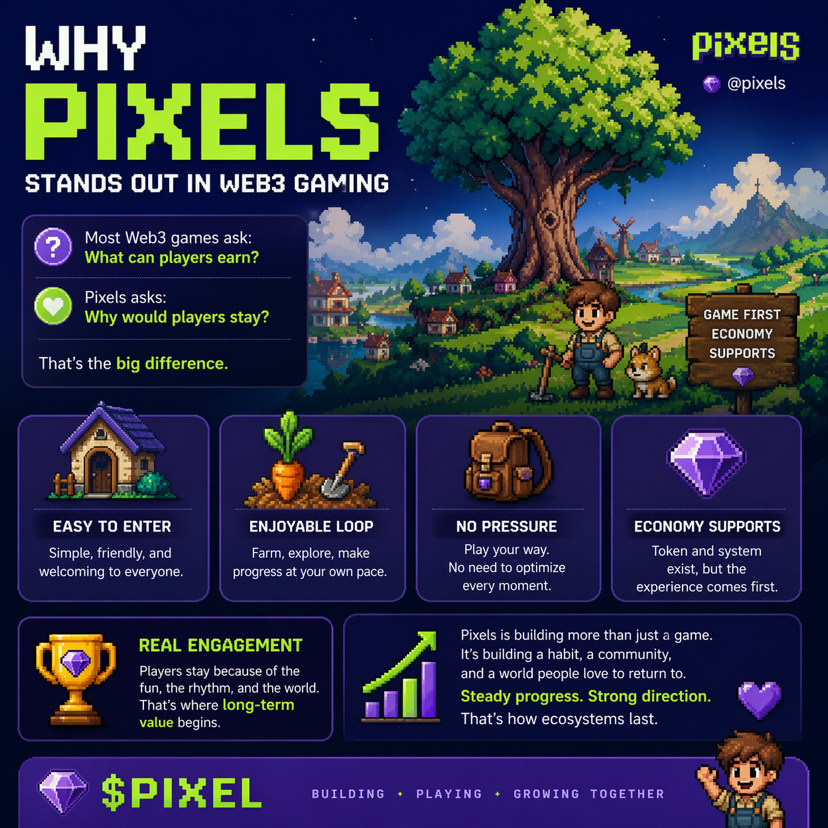
Pixels feels like it learned from that mistake.
When I look at Pixels, I do not see a project forcing value into existence through noise. I see a game that understands routine. The farming loop is simple enough to feel relaxing. The world feels light instead of heavy. The social layer gives the experience more warmth than most Web3 games ever manage to create. You are not constantly being pushed to treat every action like a transaction. You can move through the world at an easier pace, and that makes the experience more believable.
That matters more than people give it credit for.
Games survive because people enjoy returning to them. That has always been true, whether the game is on a console, a phone, or a blockchain. If logging in starts to feel like an obligation, the relationship weakens. If it feels natural, the relationship grows. Pixels seems much closer to the second category. Players do not only come back because they are chasing rewards. Many of them come back because the environment itself has become familiar. In a market obsessed with fast signals, that kind of familiarity is easy to underestimate. But it is often the real foundation of long term retention.
The Ronin ecosystem also helps a lot.
One of the biggest problems in Web3 gaming has always been friction. Even when a game has a decent idea, the onboarding process can ruin the first impression. Wallet steps, network confusion, fees, and unnecessary complexity make too many blockchain games feel heavier than they need to be. Pixels benefits from being in an environment where that burden is lower. The experience feels smoother, and that gives the game more room to succeed on its actual strengths. People can enter the world faster, understand the loop more easily, and start building attachment without fighting through a wall of technical hassle first.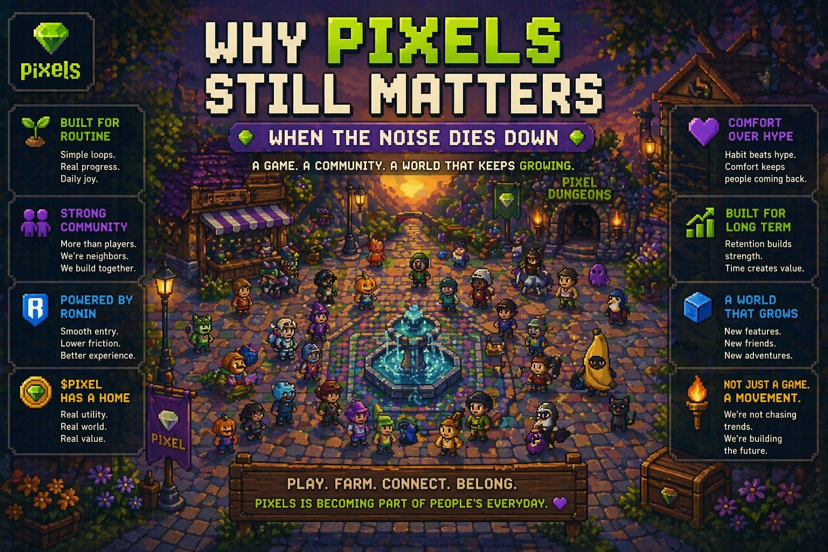
That smoother entry point is not a side detail. It is part of why the whole product feels more playable.
Then there is the role of $PIXEL itself.
This is where a lot of GameFi projects usually start to lose clarity. Their tokens exist, but the connection between the token and the player experience often feels thin. The token becomes something traders talk about rather than something players actually feel inside the structure of the game. That disconnect weakens everything. It turns the economy into a separate conversation instead of something rooted in behavior, progression, and participation.
$PIXEL becomes more interesting precisely because Pixels gives it a world where it can mean something.
A gaming token becomes stronger when it is tied to a place people actually care about. Not just a chart. Not just a campaign. Not just a short cycle of hype. A real place, with routines, social interaction, progression, and reasons to return. In that kind of environment, the token starts to feel less like an extra layer added for speculation and more like infrastructure that belongs to a functioning system. That does not remove risk, but it does improve the quality of the connection.
And that connection is everything.
If the players are weak, the token eventually feels hollow. If the world is forgettable, the economy has nothing stable underneath it. But when the world keeps people engaged, even quietly, the token gains a better foundation. Pixels has a better chance than many projects in this sector because it is not trying to build value on attention alone. It is building around habit, consistency, and player retention. Those things are not as flashy as early hype, but they usually matter much more over time.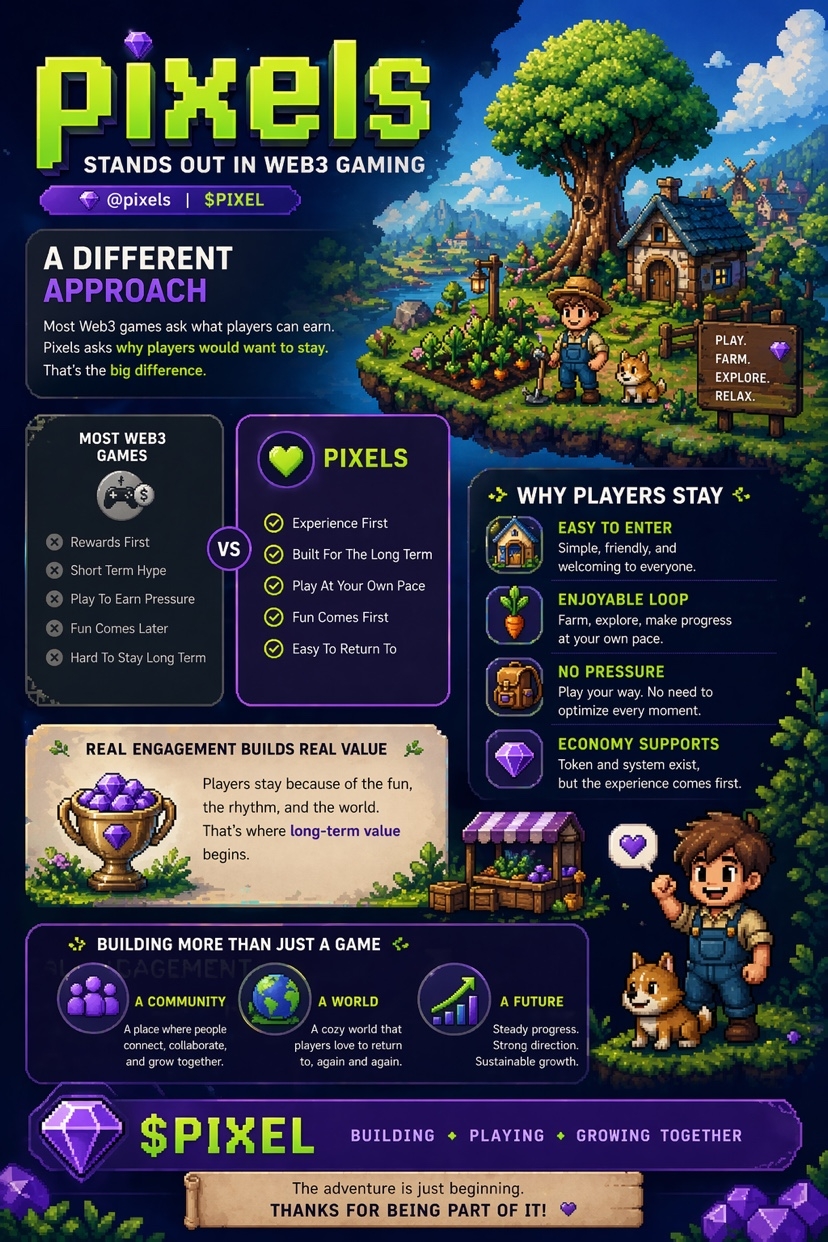
That does not mean Pixels is perfect.
Web3 gaming still carries uncertainty no matter how promising a project looks. Market conditions change. Player behavior changes. Narratives shift fast, and even good products can struggle in bad environments. Anyone pretending otherwise is ignoring reality. But the difference is that Pixels feels like it has something more durable than momentum. It feels like it has formed a real relationship with its players. That relationship may not always produce explosive headlines, but it gives the project a stronger chance of staying relevant when the market becomes quieter.
That is why Pixels still deserves attention.
Not because it is the loudest name in the room. Not because every cycle needs a new gaming token to chase. And not because hype alone can carry it forever. It deserves attention because it feels like one of the few Web3 games that understands a simple truth most projects miss: if the game is not enjoyable, the economy will eventually lose its meaning too.
Pixels feels like it started from the right side of that equation.
It understands that players need a reason to stay before they ever need a reason to speculate. It understands that comfort can be more powerful than noise. It understands that a routine people genuinely enjoy is more valuable than a temporary rush of activity. In a sector where many projects still confuse traffic with loyalty, that understanding gives Pixels a different kind of strength.
Maybe that is the best way to describe it.
Pixels does not feel like a game trying to prove itself through constant shouting. It feels like a world quietly becoming part of people’s habits. And in Web3 gaming, that may be one of the strongest signals a project can have.