

Have been reading the economics of the Pixels dual token system over the last few days and, frankly, the more i contrast it with all the other single currency games that have failed before it the more I believe this design choice to be the most underestimated mechanic in the entire protocol 😂
Today start with very bad tea ad i am reading about this is the issue that killed Axie Infinity, StepN, and all the major play to earn economies preceding this one. They were all based around a single token which was also attempting to be the medium of daily play, the prize of participation, the mode of speculation and store of long term value. Economic needs of those four functions are contradictory. A healthy daily gameplay currency must be plentiful and attainable. A healthy store of value must be rare. You cannot create a token that is not only plentiful enough to be used on a regular basis by a casual player but also a token that is not so common that long term users will be able to amass a large amount of tokens. And as soon as you make an attempt, one of the functions destroys the other. 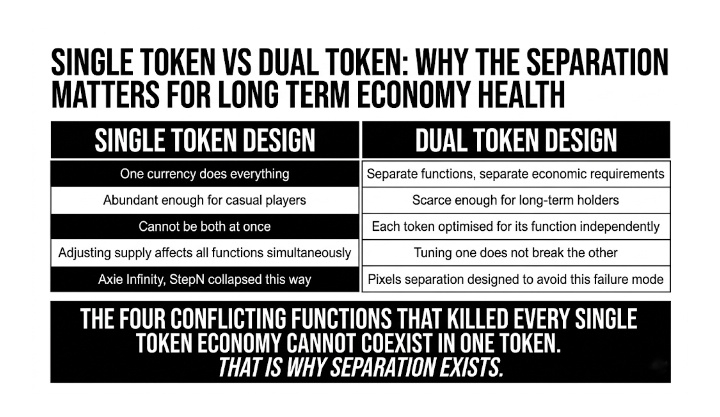
Separating the two functions, pixels separated them entirely. Daily gameplay is performed with the help of the soft currency named Berry. It can be earned by farming, cooking, questing and by the core activity loops. The game requires that it should flow freely. It has various control mechanisms of supply such as replenishment times, input needs, output quantities, and in game store prices. The team has the ability to fine-tune the soft currency economics without any manipulation of the premium layer. In the opposite is the premium token, $PIXEL. Harder to obtain. They are used to upgrade cross games, aesthetics, skills, mint land, and the VIP system which unlocks premium features. Its design is constructed to be scarce.
What irritates me: the separation must remain clean as long as the two currencies remain functionally different in the player experience. The danger that the majority of the dual token designs ultimately experience is that one currency begins to do the job of the other. When Berry is traded at a rate such that the players consider it an investment asset instead of an in-game resource, the soft currency will act like a speculative token and the supply controls will not work. Should Pixel get so cheap that it becomes a part of daily purchases and not a high-end choice, the scarcity that makes it valUable would be eliminated. The dividing line between the two functions must be actively maintained, not merely well designed in the first place. And the documentation does not specify a mechanism that implements that limit dynamically with changing market conditions.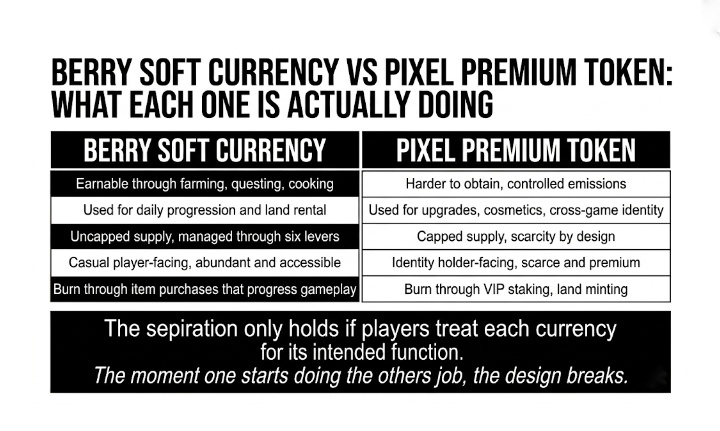
The tokenomics perspective that no one is writing about: the Berry supply controls are even more advanced, as they seem to be on the surface. There are six levers that the team can use to change the amount of soft currency introduced into the economy. The resources can be sluggish in replenishment. It is possible to increase the number of inputs that are needed to produce a given resource. The quantity of output per action can be decreased. The work needed to harvest can be increased. Action costs of energy can be modified. And in game store buy and sell prices can be shifted up and down at the same time. Six independent levers that act on one supply variable. Quite an impressive level of in game economy control. The question to ask is whether any data on the use of those levers since launch by the team has been published and what impact each of the following adjustments had on the behaviour of players. That is the history of calibration that would be one of the most useful datasets that would be available to assess the long term health of the economy.
My worry however:
the Berry token is said to have an unlimited supply with no limit to the overall issuance. The design is effective where the burn mechanisms are vigorous enough to counter the constant emissions. The major burn to Berry is through purchases of in game items which allow the player to continue through the game cycle. It is solely through the players purchasing items instead of saving up on Berry that determines the health of that burn. In any economy that the players anticipate an increase in prices, they will tend to save instead of spending. Provided that Berry ever forms inflationary expectations the spending behaviour which gives rise to the burn mechanism is weakened just at the point when the supply pressure is greatest. The levers that can be used to control this are explained in the whitepaper. It does not specify the conditions under which their use would be triggered.
The philosophy of making the game a real good time first, then focusing on building a token economy is right in its order and is evident in the dual currency architecture. Berry is created to support gameplay. Pixel is created to work in the service of ownership and identity. They are both not created as financial instruments. That philosophy is still uncommon in Web3 games and that is what distinguishes between those projects that will draw real players, and projects that will draw speculators who exit as soon as the yield curve turns the other way.
What bothers me: the dual token split means that players are forced to comprehend two economic systems at the same time. The casual players with traditional gaming experiences are accustomed to one in game currency. A second premium token with a larger cross game ecosystem would cause cognitive load that would likely hinder adoption by precisely the audience Pixels must reach the most. Both currencies are explained in the whitepaper. The product execution question that is not covered in the documentation is whether the in game onboarding experience conveys the difference in a sufficiently non friction way that a non crypto native player can comprehend.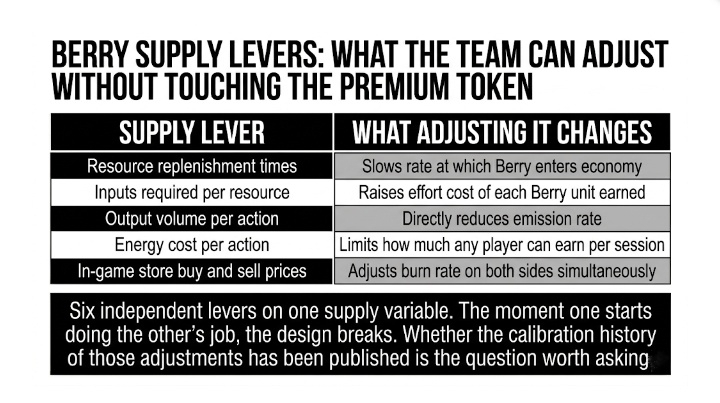
The indicators of interest are any published information on Berry supply growth over time in relation to the Berry burn volume, the ratio of Pixel expended to gameplay upgrades as opposed to speculative holding, and whether the soft currency is starting to trade in any volume on the secondary markets indicating the functional boundary between the two currencies was starting to become blurred.
Frankly do not know whether the dual token separation scales cleanly as the ecosystem grows or whether the demarcation between the two functions begins to blur when enough external studios and casual players come into a system that they were not built to fully comprehend.
What do you think, the dual token architecture which, finally, gets the play to earn economics correct, or an elaborateAted design which, finally, relies on a functional boundary which markets will ultimately test? 🤔