
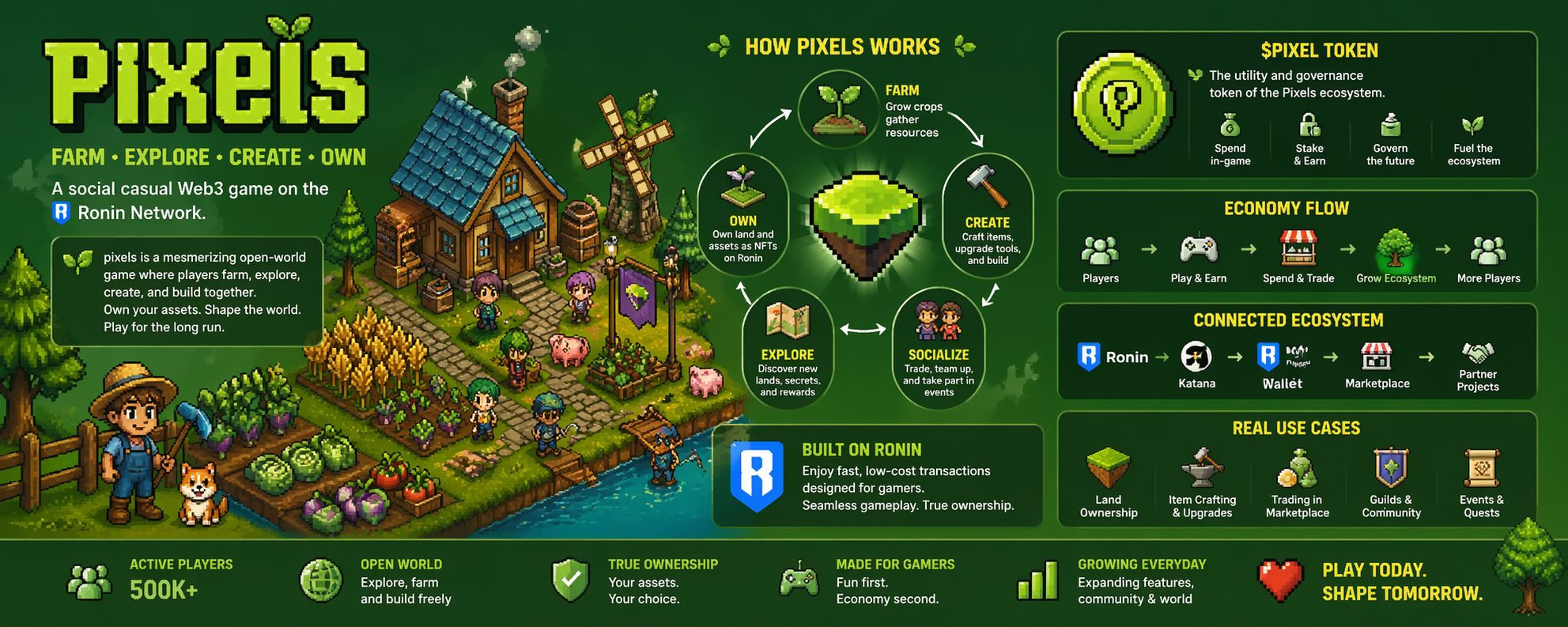

I remember the first time I looked at Web3 games seriously, I didn’t see games at all—I saw dashboards with tokens attached. Everything felt financialized first, fun second. That lens stayed with me for a long time. So when I came across Pixels and saw people actually spending time farming, exploring, and socializing instead of just chasing yields, it forced me to rethink what a Web3 game could look like when it’s built more like a world than a spreadsheet.
Pixels (PIXEL) is essentially a social, open-world farming game built on top of Ronin Network, the same ecosystem that powered Axie Infinity. But Pixels isn’t trying to recreate that earlier play-to-earn loop. It leans more into “play because it’s enjoyable, and earning comes as a byproduct.” That shift might sound subtle, but it’s actually addressing one of the biggest problems in Web3 gaming: sustainability. Most blockchain games collapsed because the only real reason people played was to extract value, not to create or participate in a meaningful in-game economy.
At its core, Pixels is solving a design problem rather than a technical one. Traditional Web3 games struggled because they forced financial incentives too early, without building a reason for players to stay. Pixels flips that. It starts with a familiar loop—farming, crafting, upgrading land, interacting with other players—and only then layers ownership and tokenization on top. The goal isn’t to make players feel like traders; it’s to make them feel like participants in a living world.
Technically, the choice of Ronin matters a lot here. Ronin is a purpose-built blockchain designed for games, meaning transactions are fast, cheap, and don’t interrupt gameplay. From a player’s perspective, most of the blockchain complexity is abstracted away. You’re not constantly signing transactions or worrying about gas fees. Under the hood, assets like land, items, and progress can be tied to blockchain ownership, but the experience feels closer to a traditional online game. That balance—using blockchain where it adds value and hiding it where it doesn’t—is something many projects still struggle to get right.
The architecture itself is relatively straightforward when you strip away the jargon. The game logic and player interactions largely live off-chain for speed and responsiveness, while ownership of key assets and the PIXEL token economy are anchored on-chain. This hybrid approach allows Pixels to scale like a normal game while still offering verifiable ownership and tradable assets. It’s not about putting everything on the blockchain—it’s about putting the right things there.
The PIXEL token sits at the center of the economy, but it’s not the only layer of value. In-game resources, land NFTs, and crafted items all form a multi-layered economy. PIXEL is used for things like upgrades, premium actions, and participation in certain systems, but the real flow of value comes from how players interact with each other. Farmers produce resources, crafters add value, landowners create opportunities for others, and traders move assets across the ecosystem. Ideally, PIXEL becomes a coordination tool rather than just a reward.
Staking and incentives are designed to align long-term participation. Instead of rewarding short-term extraction, the system encourages players to stay engaged, improve their assets, and contribute to the in-game economy. That said, this balance is delicate. If rewards are too high, you attract mercenary capital. If they’re too low, players lose interest. Pixels is still navigating that middle ground, and it’s something worth watching closely.
What makes Pixels more interesting is how it connects to the broader blockchain ecosystem. Being on Ronin means it benefits from an existing user base, infrastructure, and liquidity that came from earlier projects. At the same time, it’s part of a larger shift where gaming is becoming one of the main entry points into crypto. Instead of onboarding users through trading apps or DeFi, games like Pixels onboard them through gameplay. That changes the type of user you attract—and potentially makes the ecosystem more resilient.
In terms of real use, Pixels already shows signs of organic activity. Players are not just logging in for rewards; they’re building farms, trading items, and interacting socially. That might sound basic, but in Web3, it’s a big deal. Real usage means people are spending time, not just capital. Integrations within the Ronin ecosystem also allow assets and users to move more freely, which strengthens network effects over time.
Progress so far has been steady rather than explosive. The game has gone through multiple iterations, refining its economy and gameplay loops. It hasn’t tried to rush into over-promising features or aggressive token emissions. Instead, it’s gradually building a base of active users and testing what actually works. That slower approach might not generate hype cycles, but it’s often how sustainable systems are built.
Of course, there are still open questions. The biggest one is whether Pixels can maintain a balance between fun and financialization as it scales. As more capital enters the system, the pressure to optimize for profit increases. That’s where many projects lose their identity. Another challenge is content depth—farming and crafting are engaging for a while, but long-term retention requires evolving gameplay, new mechanics, and reasons to keep coming back.
There’s also the broader risk tied to Web3 itself. Market cycles, token volatility, and shifting user sentiment can all impact the game’s economy. Even if the game is well-designed, external factors can influence how players behave. And then there’s competition—more studios are entering this space, each trying to find the right formula between fun and ownership.
Looking ahead, the future of Pixels depends on whether it can continue to feel like a game first and an economy second. If it succeeds, it could become a model for how Web3 games evolve—less about hype, more about habit. The strategic direction seems to be leaning toward expanding gameplay, deepening social interactions, and integrating more seamlessly with the Ronin ecosystem.
What changed for me personally is this: I no longer look at projects like Pixels purely through token metrics. I pay more attention to player behavior. Are people staying? Are they interacting? Are they building something that feels alive? Because in the end, if a game can hold attention without constantly paying for it, that’s where real value starts to emerge.