

I have a scar on my back which is plain. I viewed games graffiti splendid dashboards, glistening wallet spaces, blaring local schedules, and endless screenshots of engagement, then I watch them turn into blank maps as soon as bonuses are eliminated. The experience made me change my definition of GameFi. I no longer start to see Pixels with the question whether rewards are good. I start with interrogative questions, whether it is a logic of reward, which teaches the right behavior or it is a logic of renting temporary activity.
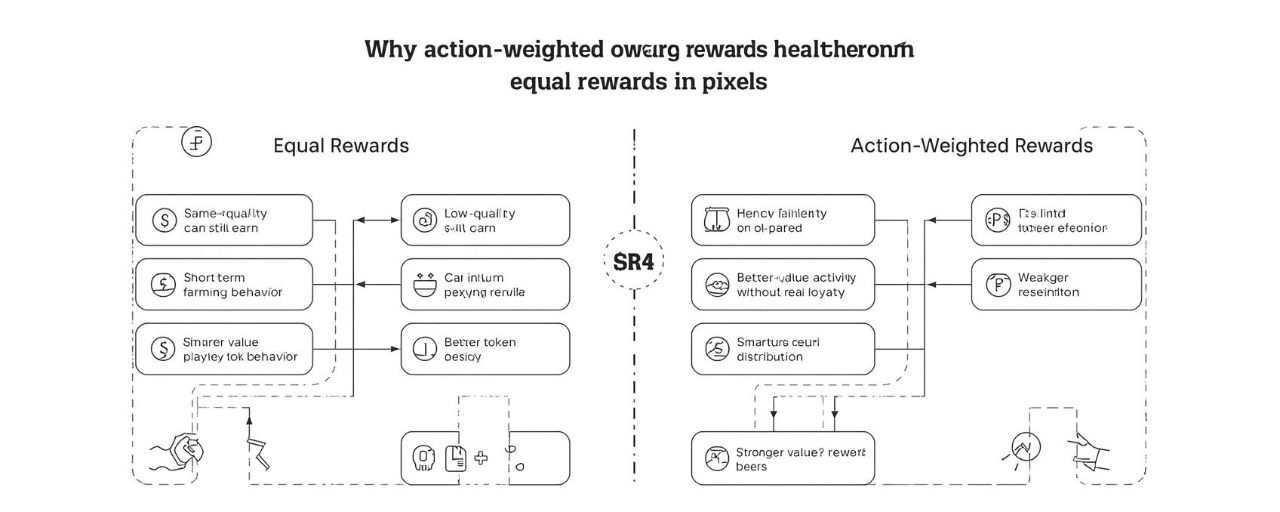
That is why action-weighted rewards appear to be healthier in my opinion, in comparison to equal rewards. Equal rewards will appear to be fair at face value, but they will tend to balance the difference between a tourist, a bot-near grinder, a returning spender, and an actual player who strengthens the economy. Pixels has been moving in this direction since at least its own help documentation mentions a reputation system with different weights on different actions, and in earlier update notes the team mentioned considering on-chain and in-game activity, further segmentation by skill type, and rewarding activities like quests, LiveOps participation, and ecosystem contribution. The Stacked framing which is more current takes that notion a little further. The official communications on Stacked suggest that it is a shared rewards layer, and reporting on Pixels-linked suggests that the AI system is designed to reward actions that have a real impact, such as coming back, progression, spending and contributing to a healthy economy, rather than rewarding every player equally.
And that is significant because, the retention problem in the gaming tokens is rarely solved by giving everybody an equal bowl of emissions. When everything on your side is equal you are more likely to receive more of the worst, instead of the best. With the farming game economy, that can be spending reward leakage to repeated low-quality cycles as the behaviors that are actually rewarded with verifiable use are under-rewarded. A system which is skewed on the frequency of returns, quality of progression, healthier spend or economy-supportive action is more likely to transform rewards into a steering mechanism of subsidy. Not the assurance of success, but it at least positions the token on the road to utility-fashioned demand, as opposed to pure extraction.
The real-time data does not necessarily warrant the move but informs of useful background. On April 23, 2026, CoinMarketCap indicated that the PIXEL had a rough market cap of circa 25.38 million and a volume of circa 8.99 million twenty four hours, circa 3.38 billion in supply and a listing contract page of circa 6.46K holders. Meanwhile the Ronin App page on the PIXEL, with the deprecated label, still showed the numbers of 238,827 holders and 22,365,398 transfers in it. That is the gap which has made me remain skeptical of on-chain action in GameFi headlines. That token can be small, broad, dormant, or widely scattered as the surface you read on a contract, and that alone is that counts of raw holders only can be misleading in trying to determine whether the design of rewards is producing long-lasting behavior.
There are real risks perceived on my part. The latter is self-evident: action-weighted system is likely to over-optimize, and start maximizing the wrong proxy. In cases where the model misreads what it means to be healthy, behaviors that would be good in dashboards would be reinforced without the creation of player value over time. The second hazard is social. Equal rewards are easy to understand but easy to understand and weighted rewards might be opaque or unfair when the players themselves are not informed of the reasons as to why one group of people will be reactivated and not the other. The third risk is economic risk. When the system incentivizes spenders or whales or hyper-efficient cohorts more than it should, it may increase inequality within the system, and erode the social layer on which casual worlds can silently proliferate. The fourth risk is that the reward targeting can lead to an improvement in the short-term monetization but not when the repeat behavior fades out during the quiet weeks.
I do not think that action-weighted rewards will necessarily save PIXEL. It is because they would tend to be healthier as compared to equal rewards because they at least identify the real problem. It is not the problem of giving out tokens. The greatest problem is what should be token invested in in the first place. My slow watch hands have not changed: transaction slowness in all cases after campaigns cool down, it makes sense to pay fees or it sinks during quiet week, players would have reappeared without being bribed on all steps and on-chain activity is starting to resemble more like verifiable use than an incentives-only pulse. In this type of engineering bet, I would never bet on the size of the reward, instead I would always bet on the precision of the reward. The more difficult question is whether Pixels will be able to hold on to that precision when scale, player gaming and model feedback loops start to push back. Will good habits continue in the absence of the incentives? And will $pixel be more of a coordination asset than just an additional non-persistent payout?
@Pixels #pixel $PIXEL
