
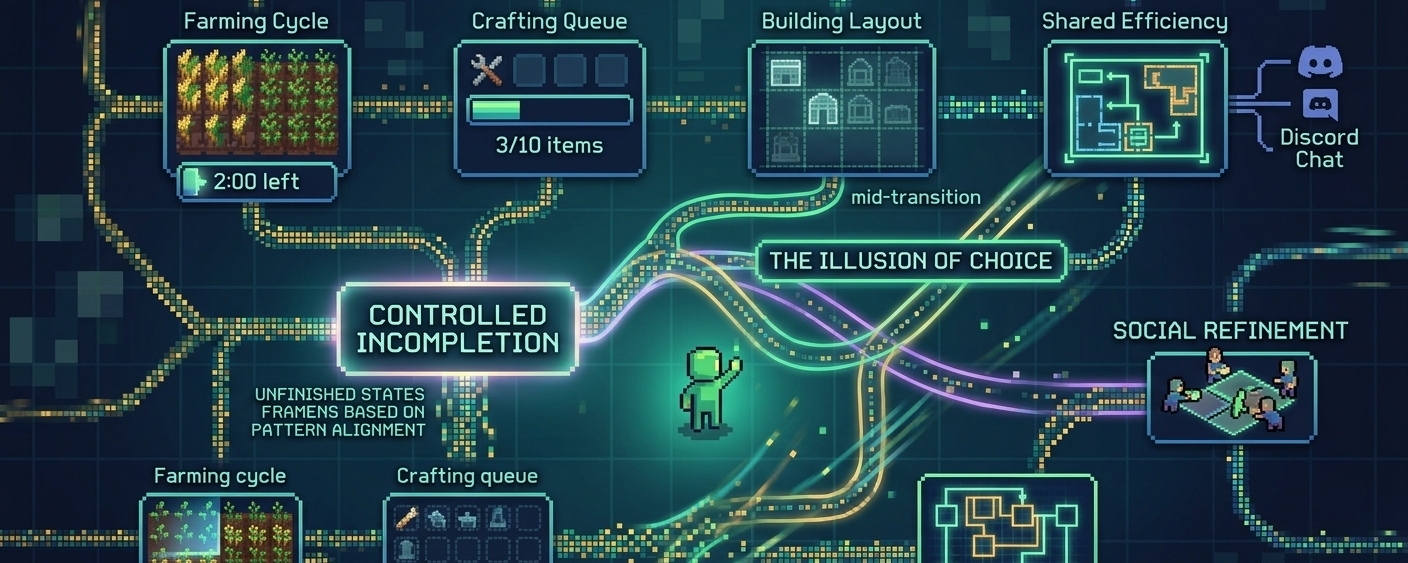
I remember one moment clearly: I logged in just to check a single farm cycle. Nothing serious. One crop was sitting there, almost done—maybe two minutes left. I told myself I’d wait it out properly this time.
Then I clicked something else while waiting. Checked a crafting queue. Adjusted one small thing in my layout.
By the time I looked back, I’d already stayed far longer than I planned.
That’s usually how Pixels works. Not through pressure, but through interruption of closure.
You don’t feel pushed. You just rarely feel “finished.”
At a surface level, the game still looks like a familiar farming loop—grow, craft, upgrade, repeat. But the more you sit with it, the more it becomes clear that the real structure isn’t in the actions themselves. It’s in how those actions are arranged to keep you slightly mid-process at almost all times.
A harvest is almost done. A crafting cycle is nearly complete. A small optimization feels just one adjustment away from being “better.”
Nothing is urgent. But very little is fully resolved either.
And that combination does something subtle to decision-making.
You stop thinking in terms of “what should I do next?” and start thinking in terms of “what’s already in motion that I should not interrupt yet?”
That shift is small, but it changes the entire feel of agency. Choices still exist, but they’re constantly framed by what is already halfway done.
Even simple decisions—like whether to log off or stay a bit longer—start getting shaped by unfinished states rather than explicit goals.
It’s not that the game tells you what to do. It’s that it leaves things open in a way that makes leaving feel slightly untidy.
On the systems side, progression is built around behavior sensitivity rather than flat repetition. You don’t just gain rewards for doing things; the system responds differently depending on how consistently and efficiently you engage.
For example, if you batch farming cycles cleanly and keep production flowing without idle gaps, the whole experience feels like a machine running without resistance. But if you play in scattered bursts, it feels slightly “off,” like a mechanism that never quite reaches full rhythm.
I noticed this directly in a small Discord exchange where someone shared their farm layout. It wasn’t framed as “meta,” just a casual screenshot with a short line like: “this setup stopped my downtime completely.” Within a few hours, others were copying it, not because it was recommended, but because you could feel the difference immediately when you tried it. The system doesn’t announce these optimizations—it just makes them obvious once you’ve seen them work.
So instead of asking “what gives me the most rewards right now?”, players gradually shift into “what rhythm is my setup optimized for?”
That’s a quiet but important transition. It moves decision-making from reward-chasing into pattern alignment.
But it also introduces something more subtle: you start learning the system’s preferred shape of behavior without being explicitly taught it.
You notice it most when you break the rhythm. When you come back after a long gap, everything feels slightly misaligned—like a machine that was running smoothly but now has a faint mechanical drag in it, as if one gear is not fully synced with the rest. Nothing is broken, but the resistance is noticeable.
That “friction difference” becomes a kind of invisible guide.
There’s also a social layer that doesn’t behave like traditional game economies.
Small improvements spread quickly. Not through instruction, but through observation. Someone finds a more efficient crafting path, posts it casually, and suddenly the community starts reorganizing around it. The interesting part is how low-friction this spread is—it doesn’t require persuasion, only proof.
Over time, this creates a kind of distributed learning loop. People aren’t just playing the game—they’re continuously refining how it is being played.
And that refinement becomes content in itself.
A single efficiency discovery can turn into a shared baseline without ever being formally defined as such.
None of that feels like marketing while it’s happening. It feels like conversation. Small corrections. Shared experimentation.
But at scale, it behaves like a distribution engine that doesn’t depend on external push.
What’s interesting is that none of this relies on explicit storytelling or narrative hooks. It emerges purely from how tightly the systems are connected to player behavior loops.
You don’t notice the structure while you’re inside it. You just notice that you keep coming back “for a moment,” and that moment keeps extending itself.
Eventually, the most important shift isn’t about rewards or efficiency anymore.
It’s about perception.
The game stops feeling like a set of tasks you complete and starts feeling like a space where things are always mid-transition. And once that becomes normal, leaving requires more intention than staying does.
That’s the real design layer underneath everything else—not pressure, not reward optimization, but controlled incompletion that quietly redefines what “done” feels like.
