
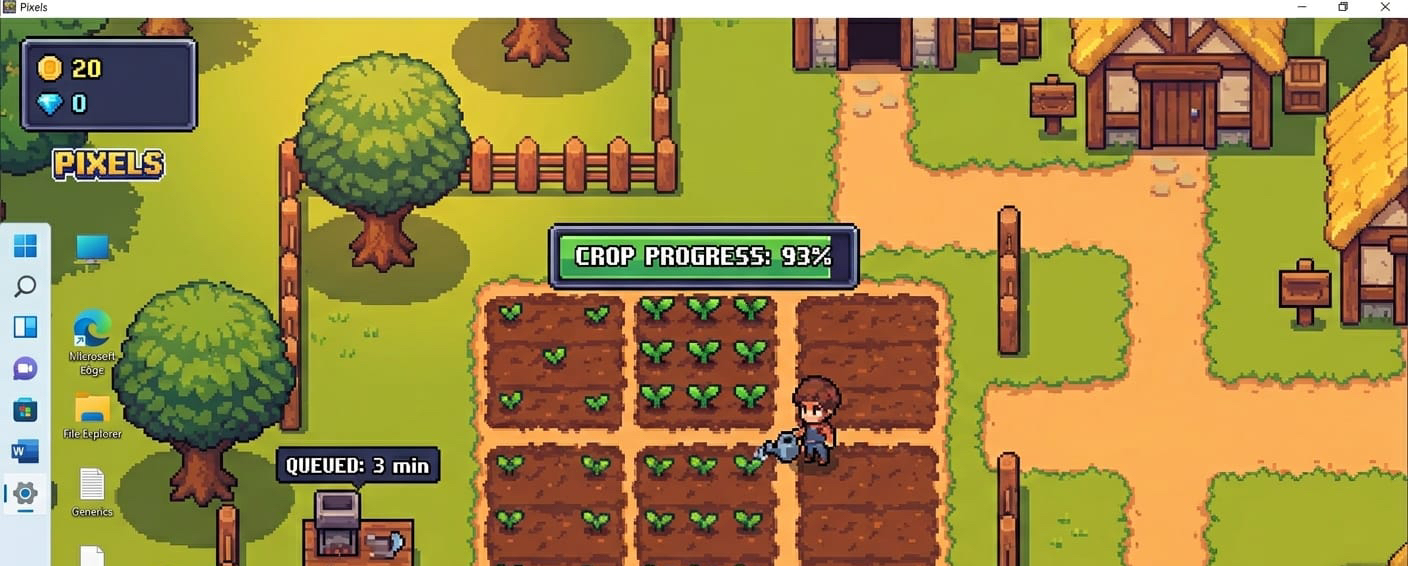

I didn’t really expect Pixels to stick.
At first glance, it looks like a familiar loop—farm, craft, upgrade, repeat. The kind of structure you’ve seen a hundred times in Web3 gaming. You tell yourself you’re just testing it. Ten minutes max.
Then something slightly annoying happens.
Your crops are at 93%. Your crafting queue is almost done. You think about leaving, but it doesn’t feel clean to leave. So you stay a little longer. Not because of rewards exactly. More because things are almost finished.
That “almost” matters more than it should.
Most GameFi systems begin with token logic and then try to retrofit gameplay on top. Pixels flips that order in a quieter way: it assumes the game has to survive even if you remove the financial layer entirely.
That sounds theoretical until you actually play it.
Because the core activities—farming, crafting, upgrading—don’t feel like obligations tied to earnings. They feel like loops that would still exist even if nothing was being paid out. That’s rare. And slightly uncomfortable, because it removes the usual excuse players rely on: “I’m just here for the rewards.”
Here, that excuse doesn’t fully hold.
You’re just… doing things. And coming back. Again.
This is where Pixels quietly diverges from typical GameFi design.
Rewards aren’t evenly sprayed across all actions like a vending machine. They’re shaped around behavior patterns—efficiency, progression, consistency, and timing. In other words, not everything you do is treated as equal just because you did it.
At first, that feels subtle. Almost invisible.
But over time, you start noticing something odd: you stop asking “what gives me the most rewards?” and start asking “what actually improves my setup?”
That shift matters more than it looks.
Because it changes the player from a collector of tokens into a participant in a system that reacts to how they behave.
And once that switch happens, the game stops feeling like extraction. It starts feeling like adjustment.
There’s a specific psychological pattern Pixels leans into—though it never announces it.
Nothing is ever fully “done.”
A harvest is always slightly away. A production cycle is almost complete. An optimization is just one small tweak short of being meaningful.
It creates this low-level mental background noise.
Not stress. Not urgency. Something softer.
Like leaving a tab open in your mind.
You don’t always notice it, but you feel it when you step away. You think you’re done playing, and then you remember: something probably finished by now. Or is about to.
So you check.
Not because you have to. Because it feels incomplete not to.
Most games treat growth as something external. You build the product, then you go and “bring users in” through campaigns, ads, announcements, and cycles of hype that eventually fade.
Pixels feels like it’s leaning into a quieter assumption: if the experience is interesting enough, distribution happens inside the system itself.
It doesn’t look like marketing when you’re playing it. It just looks like people doing things—optimizing farms, sharing progress, talking about small wins that don’t feel designed to be viral, but end up being exactly that.
A player figures out a more efficient setup and mentions it somewhere. Someone else replicates it. A small improvement becomes a shared pattern. Nothing about that moment feels like promotion, but it behaves like it.
And slowly, the game starts to expand through these micro-reports of experience rather than through traditional outreach. Not in a sudden spike. More like a steady leakage of attention outward, driven by people simply interacting with the system long enough for stories to form.
That’s the flywheel—but in practice, it doesn’t feel like a loop diagram. It feels like the game is constantly producing small reasons for people to talk about it without asking them to.
It’s not that the token is gone or reduced or hidden.
It’s that the token stops being the center of interpretation.
You don’t log in thinking “how do I maximize rewards today?” at least not after a while. You log in and realize there’s a rhythm forming. A set of things you check. Adjust. Optimize. Return to.
And that’s the strange part.
It doesn’t feel like being pushed by incentives.
It feels like being gently trained by unfinished work.
Not in a dramatic way. More like background conditioning.
If you strip everything down, Pixels isn’t really about farming tokens.
It’s about what happens when a system is designed tightly enough that you start returning without needing a strong reason every time.
Sometimes it’s efficiency.
Sometimes it’s curiosity.
Sometimes it’s just… “I’ll check real quick.”
And that’s the part most GameFi projects still miss.
Because rewards can bring someone in once.
But only structure—quiet, repetitive, slightly unfinished structure—makes them come back when nothing is being promised at all.
