
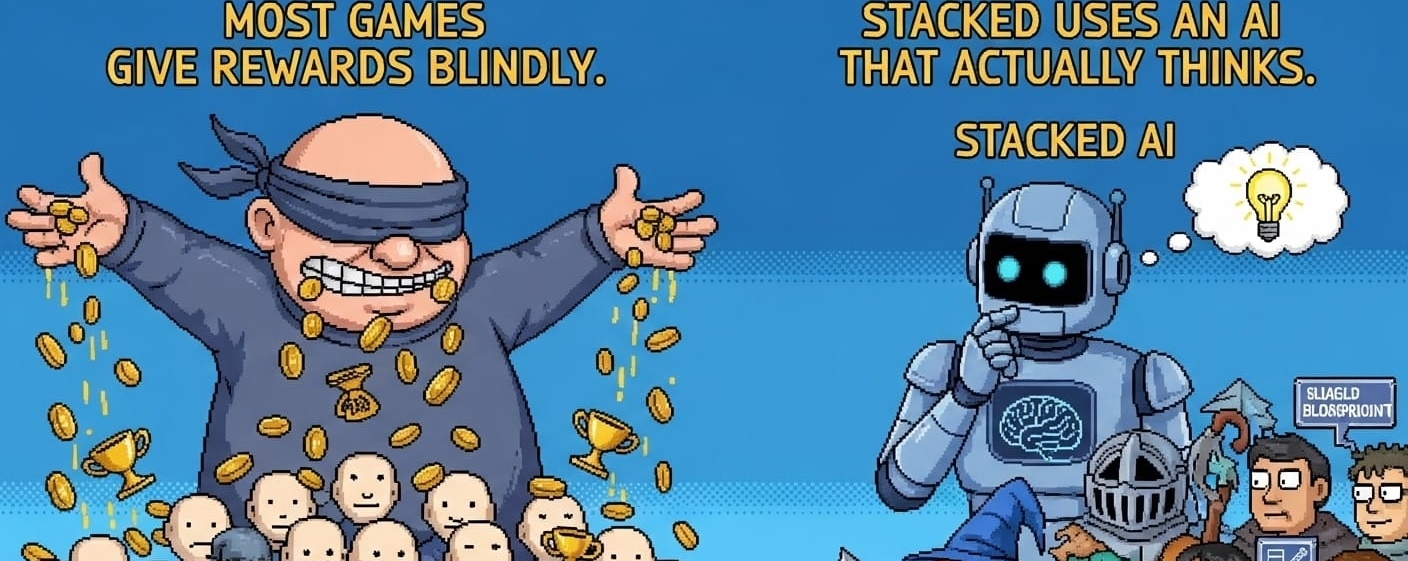
Let me ask you something.
Have you ever played a game that gave you a reward for absolutely nothing? Like, congrats, you logged in. Here's a token. Or hey, you clicked a button. Enjoy your free money.
Feels nice for a second, right?
But here's the problem nobody talks about. When rewards are blind and dumb, they attract the wrong crowd. Bots. Farmers. People who don't care about your game. They show up, collect, and leave. Your economy bleeds out slowly. And by the time you notice? It's too late.
I've seen this happen more times than I can count.
So when I read about @undefined building something called Stacked with an "AI game economist" on top, I rolled my eyes a little. Everyone says AI these days. It's become a buzzword. Slap "AI" on anything and suddenly it's revolutionary.
But then I actually understood what this thing does. And yeah. This one is different.
What Does an AI Game Economist Actually Do?
Simple question. Simple answer.
Most game studios throw rewards at players and hope something sticks. Stacked's AI doesn't hope. It analyzes.
It looks at player behavior across thousands – sometimes millions – of accounts. It finds patterns that humans would never spot. Then it tells the studio exactly what's working, what's breaking, and what to try next.
Here are the kind of questions this AI can answer right now:
Why are our most valuable players quitting between day three and day seven?
What are our most loyal users doing before day thirty that everyone else isn't?
Which in-game mechanics actually lead to long-term retention?
Which rewards are being wasted on players who would have stayed anyway?
These aren't philosophical questions. These are million-dollar questions. And most studios answer them with gut feeling or guesswork.
Stacked answers them with data.
From Insight to Action – No Waiting
Here's the part that actually excites me.
Most analytics tools tell you a problem exists. Great. Your whales are leaving on day five. Now what? You export a CSV. You schedule a meeting. You argue about solutions for two weeks. Maybe you try something next month.
Stacked doesn't do that.
The AI gives you insight inside the same system where you run rewards. You see a problem. You launch an experiment. You measure the result. All in one place.
Insight to action. No waiting. No meetings. No data scientists on retainer.
That's not a small improvement. That's a completely different way of running live games.
Why This Matters for $PIXEL
Okay, let me connect this back to the token because I know that's what many of you actually care about.
$PIXEL used to be just the token for one game – Pixels. Nice game. Solid community. But one game is one game.
Now $PIXEL sits inside Stacked as a cross-ecosystem rewards currency. More games join Stacked. More demand for $PIXEL. And here's the key – because the AI makes reward distribution sustainable, the economy doesn't collapse like every other P2E token.
No hyperinflation. No bots draining the treasury. No death spiral.
The AI protects the economy while rewarding real players. That's the balance everyone has been searching for since Axie Infinity.
This Isn't Theoretical
I keep saying this because it matters.
Stacked isn't a PowerPoint deck. It isn't a promise. It's already live on Pixels, Pixel Dungeons, and Chubkins. Hundreds of millions of rewards processed. Millions of players. Over twenty-five million dollars in revenue generated.
The AI economist isn't coming soon. It's here. It's working. And it's about to open to external studios.
Built in production. Not in a deck.
Say that line out loud. It hits different, doesn't it?
My Honest Take
Look, I'm not saying Stacked is perfect. No system is. But for the first time in a long time, I see a Web3 project that actually learned from everyone else's failures.
Most games reward blindly and hope for the best. Stacked uses AI to reward smartly and measure everything.
Most tokens die when their one game gets boring. $PIXEL becomes infrastructure across many games.
Most projects sell you a dream. Stacked shows you what's already running.
If you're tired of vaporware and empty promises – this one deserves your attention.
And if you're a game studio still using guesswork to manage your economy? Honestly, what are you waiting for.
The AI is ready. The system works. The receipts are public.
