
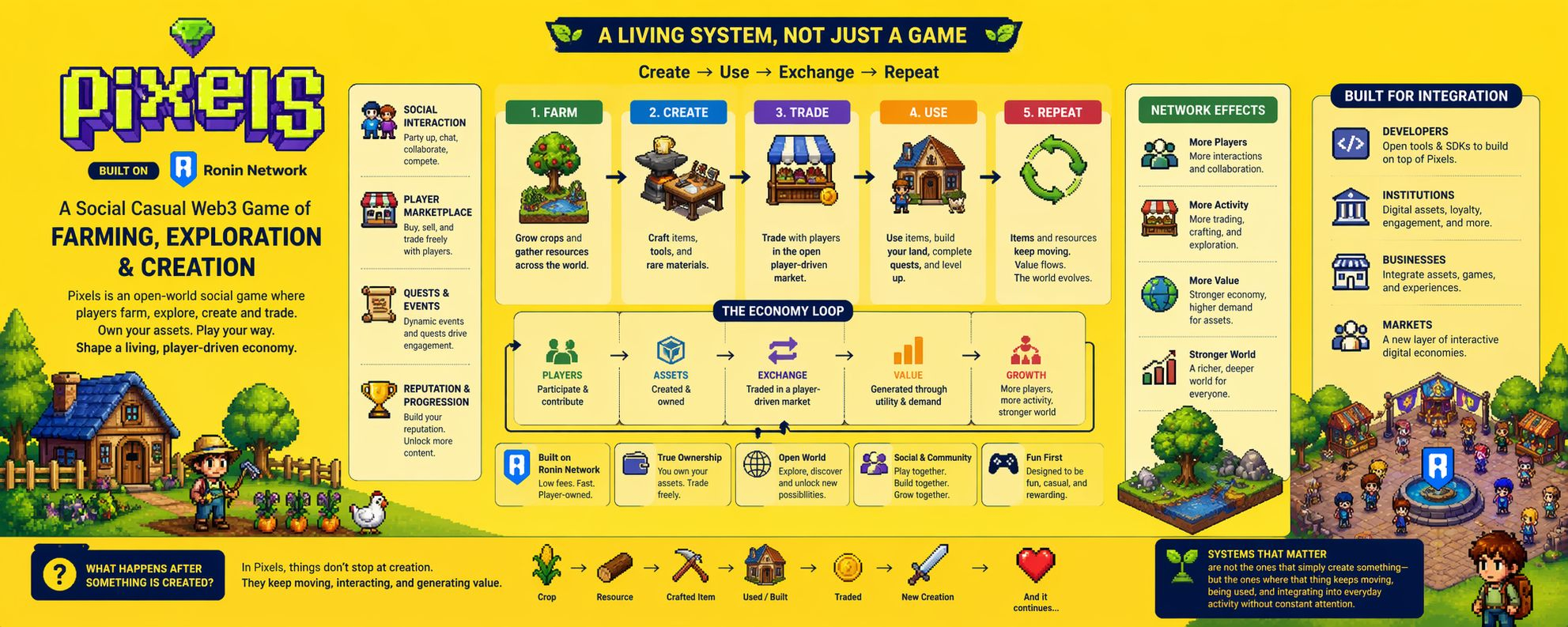

I used to think projects like Pixels were enough on their own—clean concept, strong narrative, and a clear use case. A social, casual Web3 game built on Ronin Network? It sounded complete. Farming, exploration, creation—it checked all the boxes. Back then, I believed that if something was well-designed and engaging at the surface level, adoption would naturally follow. Oh, it felt almost automatic: build something fun, add ownership, and the system sustains itself.
But that perspective was incomplete. Maybe even naive.
What changed wasn’t the idea—it was how I started evaluating what happens after the idea becomes real. Okay, you’ve created assets, economies, interactions… now what? Do they move? Do they circulate? Do they actually matter beyond the moment they’re created?
That’s where the gap started to show.
Creation is the easy part. Usage is where systems either prove themselves or quietly stall.
Think of it like building a marketplace in the middle of a city. You can design the stalls, organize the layout, even bring in vendors. But if people don’t return daily to trade, to exchange, to rely on it—it’s not a market. It’s a setup. And setups don’t generate value unless they turn into routines.
That’s how I started looking at Pixels—not as a game, but as a system. A system where players farm, craft, and create assets. But the real question isn’t what players can create. It’s whether those creations continue to move through the ecosystem. Do they get reused? Do they become inputs for others? Or do they just sit in inventories like unused tools?
Because static output is dead weight. Movement is value.
When I zoom out structurally, I start asking simpler, sharper questions. How do participants actually interact? Not just socially—but economically. Are players dependent on each other in a way that creates ongoing exchange, or can they operate in isolation? Because isolated systems don’t scale—they fragment.
Then I look at outputs. If I create something in Pixels—a resource, an item, a piece of land—does it become part of a larger loop? Can someone else build on it, reference it, rely on it? Or is it just consumed once and forgotten? Systems that matter tend to have memory. Their outputs don’t disappear—they stack, they compound.
And yeah, network effects—everyone talks about them. But they don’t come from users alone. They come from interaction density. It’s not about how many people are present, it’s about how often they need each other. If the system doesn’t force or encourage that dependency, growth becomes shallow. It looks active, but it isn’t deep.
That’s where I started separating narrative from function.
From a market perspective, Pixels sits in an interesting place. The positioning is strong—it taps into gaming, ownership, and community. But maturity is another story. Activity still feels partially event-driven. Spikes happen when incentives align, when attention is pulled in. But the real test is what happens in between those spikes. Does usage hold, or does it fade?
Participation, too, feels somewhat concentrated. Early adopters, Web3-native users—they dominate the flow. The question is whether that circle expands naturally, or if it requires constant external pushes. Because if it needs incentives to stay alive, then it’s not self-sustaining—it’s being subsidized.
And that’s the core risk.
Is this a system people return to because they need it, or because they’re rewarded for it?
Real strength comes from repetition. From habits. From systems becoming part of someone’s routine without needing to be reminded. If Pixels can integrate into that layer—where players log in not for rewards, but because their activity connects to something larger—then it starts to look like infrastructure. Not just a game, but a functioning micro-economy.
But if usage drops the moment incentives fade, then it was never truly integrated. It was temporary engagement.
So now, when I think about it, I don’t ask whether Pixels is innovative. That’s obvious. I ask whether real entities—players, developers, even external systems—have a reason to keep using it over time. Not once, not occasionally, but consistently.
What would increase my confidence? Steady, organic activity that doesn’t rely on campaigns. More interdependence between players—where outputs clearly feed into others’ actions. Signs that assets are circulating, not just accumulating. And especially, developers building on top of it in ways that extend its lifecycle.
What would make me cautious? Sharp spikes followed by quiet periods. Over-reliance on rewards to drive engagement. A system where most outputs don’t get reused. And a user base that doesn’t meaningfully expand beyond its initial core.
Because at the end of the day, oh yeah, I’ve realized something simple.
The systems that matter aren’t the ones that create things.
They’re the ones where those things don’t stop moving.