
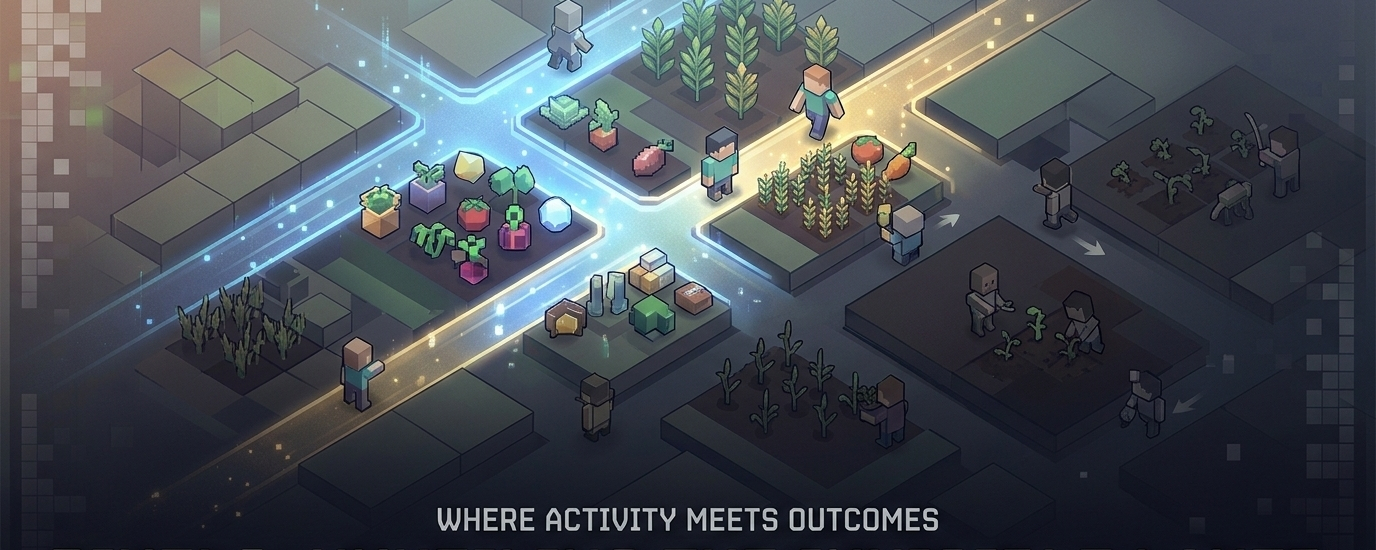
Pixels looks like a normal game economy at first.
You log in and everything feels active. Farms are running, items are moving, trades are happening. People are clearly spending time inside the system. It gives off that familiar sense of momentum — like effort is constantly being converted into progress.
And for a while, that explanation holds up.
You do more, you earn more. You optimize your loop, you get slightly better results. It feels fair enough. Not perfect, but functional in the way most game economies are.
But the longer you sit with it, the harder it is to ignore a small inconsistency.
The outcomes don’t always match the effort.
You start noticing players who aren’t doing anything dramatically different, yet somehow move ahead faster. At the same time, there are others who stay active, keep repeating the same loops, but don’t really break out of their position.
It’s not obvious. Nothing feels broken. There’s no clear point where the system fails.
It just feels… uneven.
That’s usually where the first assumption starts to fall apart. The idea that Pixels is simply rewarding activity begins to feel incomplete.
Because if effort alone isn’t explaining outcomes, then something else is quietly doing the sorting.
And it doesn’t take long to realize that most of what’s happening on the surface might not be the full picture. The farming, crafting, trading — all of that looks like the core system. But it might actually be more like the visible layer of something deeper.
A layer where not all actions are treated equally.
If you shift perspective a bit, Pixels starts to look less like a pure game economy and more like a flow system. Value isn’t just created by doing things. It moves through the system, and only certain actions intersect with that movement in a meaningful way.
Everything else still happens. It just doesn’t carry the same weight.
That’s the subtle part.
The system doesn’t block participation. It doesn’t stop you from playing. Instead, it filters which actions actually connect to value, and which ones remain in the background.
So two players can be doing similar things, but only one of them is positioned where value is actively flowing. The other is effectively maintaining activity without capturing much of it.
From the outside, both look equally engaged.
Underneath, they’re not.
One way to think about it is like a market with limited attention. Everyone can show up, everyone can trade, everyone can produce something. But attention — and by extension value — only passes through certain points at certain times.
If your actions align with those points, you benefit. If they don’t, you’re still participating, but you’re not really advancing in the same way.
That’s where the idea of access starts to matter more than effort.
Access doesn’t necessarily mean something obvious like paywalls or restrictions. It can be softer than that. Being early to a loop, being in the right network, understanding which actions the system amplifies, or simply being present where liquidity is moving.
These are small differences on the surface.
But over time, they compound into very different outcomes.
And this is probably intentional.
If every action was rewarded equally, the system would inflate quickly. Value would spread too thin, and nothing would really stand out. By filtering activity instead of rewarding it blindly, the system creates hierarchy. Some actions matter more. Some positions matter more.
It gives structure to the economy.
But it also introduces a quiet tension.
Because once players begin to notice that not all activity is equal, behavior starts to change. People stop focusing on what looks like the game, and start focusing on what actually works.
They optimize for recognition, not effort.
And when that happens, the system can slowly drift. The visible layer stays the same — farming, trading, crafting — but underneath, participation becomes more strategic, more selective. Fewer actions carry most of the value, while the rest turn into background noise that keeps the system looking active.
That’s where the unevenness becomes more visible.
Newer or casual players might keep feeding into the system, assuming their effort will translate over time. Meanwhile, more experienced players position themselves closer to the flows that actually matter.
The gap isn’t enforced directly. It just emerges.
And once that gap becomes clear, it can change how the entire system is perceived.
Right now, it’s still subtle. Easy to overlook if you’re not paying close attention.
But the idea that Pixels is quietly deciding which actions count — rather than simply rewarding everything — might matter more than it seems.
I’m not sure the market is fully seeing this yet.
But if the invisible layer is where outcomes are really determined, then understanding it could end up being more important than anything happening on the surface.@Pixels #pixel $PIXEL