
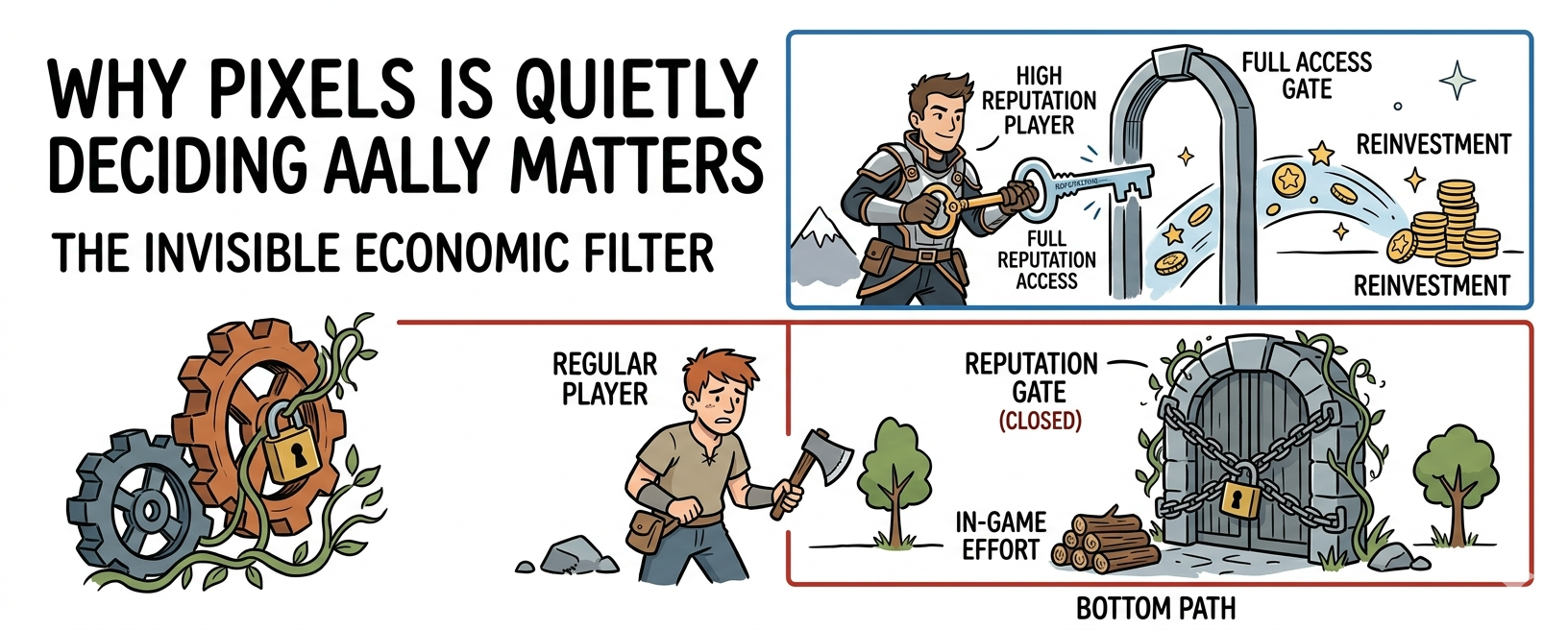
I noticed something while watching Union contributions during Bountyfall that I couldn't stop thinking about.
Two players. Similar effort. Similar time spent. Similar loops. But when rewards started moving, they ended up in completely different positions. One was compounding. The other was stuck. And it didn't feel random at all it felt like the system had already made a decision about them.
That bothered me because Pixels presents itself as open. You can log in casually, generate Coins, join a Union, and feel fully involved without hitting any obvious wall. Nothing blocks you. Nothing tells you that you're playing at the wrong level. But the more I looked, the more I realized the system isn't actually designed to treat all participation equally it just doesn't announce that upfront.
The real filter is invisible until you try to move.
Chapter 3 made this clearer without ever saying it directly. Union mechanics, Yieldstones, Hearth contributions these reward structured participation. But those rewards don't fully belong to you until you clear another layer. Reputation, withdrawal limits, marketplace access these decide whether your effort becomes something you can actually use, extract, or build on.
So two players can generate the same output inside the game. Only one can fully realize it outside the loop.
The other stays active. But structurally capped.
That's the moment it stops feeling like a game mechanic and starts feeling like an economic filter.
Reputation isn't a trust score. It's a gate on economic freedom.
It controls how much you can withdraw, how efficiently you can trade, how easily you can move value out or cycle it back in. The game never stops you from playing. It just quietly decides what your participation is worth.
You don't feel that while you're playing. You feel it the moment you try to move forward and realize you can't, not at the same speed, not with the same access.
Some players move freely. Others don't. And the gap between them isn't effort. It's accumulated position.
What this means at the system level is harder to ignore.
Pixels is doing something most GameFi projects never figure out: filtering who can actually convert activity into economic consequence, without making the game feel closed. It limits outflows without restricting participation. From the outside, it looks busy and open. From the inside, not all of that activity carries the same weight.
And over time, that difference compounds quietly. Players who pass through the filter gain more ability to extract, reinvest, and scale. Players who don't remain part of the system contributing, participating, showing up but at a level where their presence doesn't shift much.
I'm not fully convinced the market is seeing this yet. Most people still read Pixels through surface signals user counts, update cadence, activity metrics. But activity and economic depth are two different things, and right now they're being treated as the same signal.
If most players stay in the lower layer, growth can look strong while the system stays structurally shallow. If more players cross into the higher layer building reputation, gaining access, reinvesting then the picture changes entirely.
So the question I'd actually be watching isn't how many players Pixels has.
It's how many of them the system has decided actually matter.
