Sometimes a game starts spreading before people even explain it clearly.
That is what I notice around Pixels right now. The game itself is still built on small things. Farming. Moving around. Gathering resources. Checking tasks. Seeing other players nearby. But the recent Binance CreatorPad campaign made me think about something slightly different: how a game like this starts living outside the game too.
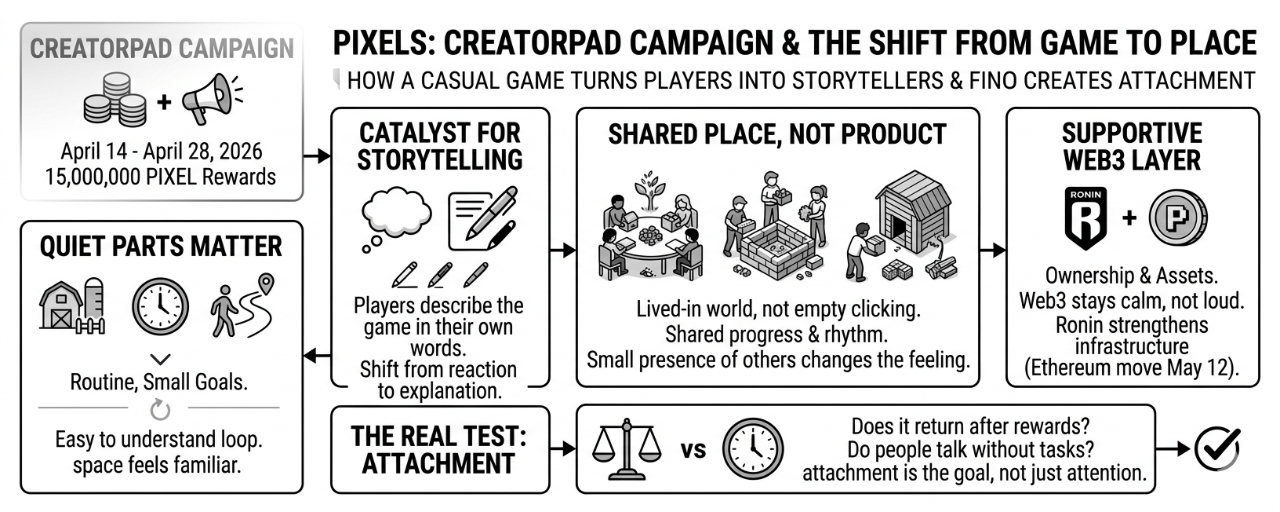
Binance Square announced a Pixels CreatorPad campaign running from April 14 to April 28, 2026, with 15,000,000 PIXEL in rewards for verified users who complete the required tasks. I do not see that only as a reward campaign. I see it as a sign that Pixels is becoming something people are asked to describe in their own words.
That matters more than it first seems.
Pixels is a social casual Web3 game powered by the Ronin Network. On the surface, it feels like an open-world farming game, with exploration, creation, land, resources, and daily routines. The official Pixels site describes it as a world where players can build and play around digital ownership. But when people start writing about it, posting about it, and explaining what they notice, the game becomes less like a product and more like a shared place.
For me, that is the interesting part.
A creator campaign can easily feel noisy. It can become full of repeated phrases, rushed posts, and people trying to say the biggest thing in the shortest time. But Pixels does not really need that kind of voice. The game works better when people talk about the quiet parts. The routine. The small goals. The way the world feels when you enter it for a few minutes and see other players already doing their own things.
That is what I think fits Pixels best.
At first, it looks simple. You farm. You collect. You finish tasks. You move through the world. But after a while, you start noticing the pattern around the gameplay. People return because the loop is easy to understand. They return because the space feels familiar. They return because there is always a small thing to do, and sometimes that is enough.
This is where the CreatorPad campaign becomes more than a campaign to me. It creates a moment where players and creators are not only reacting to a token or an event. They are trying to explain why this game has stayed in their daily view. Some will focus on rewards. Some will focus on Ronin. Some will focus on farming. Some will focus on community. But underneath all of that, there is one simple question.
Why does this place keep pulling people back?
I do not think every answer needs to be polished. In fact, the more natural answers are probably the better ones. Pixels feels like the kind of game where a person can say, “I logged in, did a few tasks, saw what others were doing, and somehow stayed longer than I planned.” That says a lot.
The social side is easy to overlook because the game does not always need big social moments. Sometimes it is enough to see movement around you. Another player near a task area. Someone trading. Someone working on resources. Someone following the same routine you are following. That small presence changes the feeling of the world.
A farming game alone can be peaceful. A social farming game can feel lived in.
Pixels sits in that middle space. It is not only about private progress. It is also about being near other people who are slowly building their own progress too. That makes even simple actions feel less empty. You are not just clicking through a list. You are part of a shared rhythm.
The Web3 side adds another layer, but I think it works best when it stays calm. Ownership can matter. Digital assets can matter. The PIXEL token can matter. Ronin can matter. But if those things become the whole story, the game loses some of its softer appeal. Pixels feels more interesting when the Web3 layer supports the world instead of swallowing it.
Ronin also plays a quiet role here. The official Ronin team recently confirmed that Ronin is moving to Ethereum on May 12, with changes meant to strengthen security and adjust the network’s economy. That is important for the ecosystem around Pixels, but I still think the best version of this experience is one where the chain does not interrupt the feeling of play.
In a game, good infrastructure should almost disappear. It should make the world easier to use, not harder to enjoy. That is something many Web3 games are still learning.
Pixels seems closer to understanding it.
Still, I do not think every player will connect with Pixels immediately. Some people may open it and only see chores. Some may only care about rewards. Some may not feel attached to farming loops or social spaces. That is fair. A game like this grows slowly on people, and not everyone wants a slow game.
The CreatorPad campaign may bring more attention, but attention by itself does not create attachment. The real test is what happens after the campaign ends. Do people still return? Do they still talk about the game when there is no task pushing them to post? Do they still care about the world when the reward moment passes?
That is where things become clearer over time.
For me, Pixels is most interesting when I stop looking at it as a quick Web3 story. It feels better as a daily world. A place where farming, exploration, creation, and social habits sit together. A place where small actions repeat until they become familiar.
And maybe that is why creator stories matter here. They show what different people actually notice.
Not every post will be deep. Not every article will say something new. But when enough people describe the same game from different angles, you start to see the shape of the community around it.
That is what I am watching now.
Not only the campaign itself.
But the way Pixels gives people something simple enough to explain, and familiar enough to keep thinking about after they leave.
Still watching the quiet stories forming around $PIXEL #pixel @Pixels

ဆောင်းပါး
Pixels CreatorPad campaign and the quiet way players turn into storytellers
ရှင်းလင်းချက်- ပြင်ပအဖွဲ့အစည်း၏ ထင်မြင်ယူဆချက်များ ပါဝင်သည်။ ဘဏ္ဍာရေးဆိုင်ရာ အကြံပေးခြင်း မဟုတ်ပါ။ စပွန်ဆာပေးထားသော အကြောင်းအရာများ ပါဝင်နိုင်ပါသည်။ See T&Cs.