
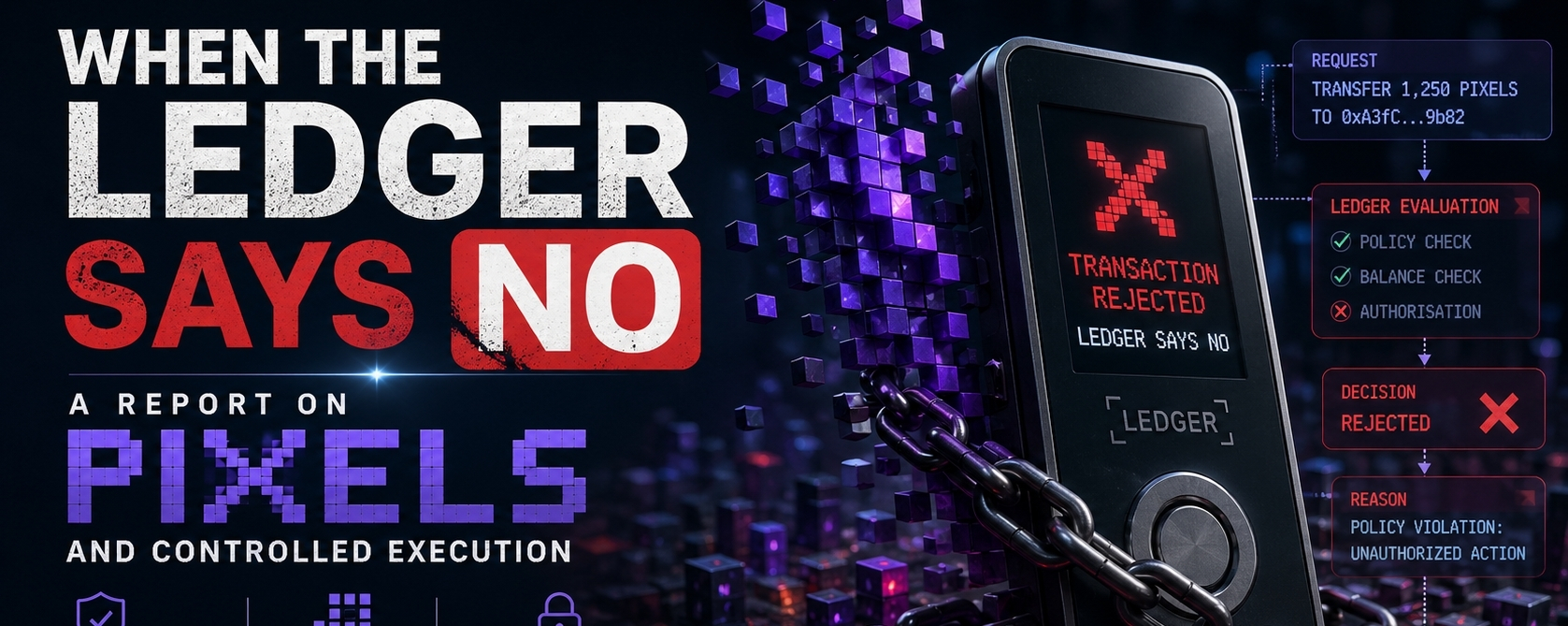
I write this the way internal reports are usually written when something almost broke but didn’t, and everyone agrees afterward that “almost” is the most expensive state in distributed systems.
The incident logs start quietly. Not with collapse, but with drift. A few delayed confirmations. A spike in wallet approvals at an hour when no one should be awake. 2 a.m. alerts that don’t scream, just persist. The kind that make risk committees stop using the word “unlikely” and start asking what, exactly, we mean by “acceptable exposure.”
PIXELS sits in those logs as a strange kind of system—an open-world social game, yes, but also a live economic environment running on a high-performance SVM-based L1 with guardrails that behave less like walls and more like reflexes. Farming, exploration, creation—these are the user-facing verbs. Underneath them, execution is modular, segmented, and deliberately constrained above a conservative settlement layer that refuses to be impressed by speed alone.
Somewhere in the architecture reviews, someone always raises TPS as if it is a moral metric. It never is. The real failures we see don’t come from slow blocks. They come from permissions that were too broad, keys that were too reusable, signatures that were treated like casual confirmations instead of irreversible authority grants. Speed, in those moments, is just how quickly you propagate an error.
We learned this the usual way: through audit notes that read like understatement, through postmortems that avoid the word “exploit” until paragraph four, through wallet approval debates that stretch longer than product launches. Every discussion eventually collapses into the same uncomfortable truth—most systems don’t fail because they are slow. They fail because they trusted the wrong thing for too long.
PIXELS Sessions emerged from that discomfort. Time-bound, scope-bound delegation that doesn’t pretend users want infinite permission just because they asked for convenience once. Scoped delegation + fewer signatures is the next wave of on-chain UX. That line appears in design docs, but also in arguments that happen between engineers who have all seen what “temporary approval” becomes in practice: permanent liability.
EVM compatibility exists here, but not as ideology. It is tooling friction reduction, nothing more. A bridge to familiarity, not a statement of architectural identity. And even bridges are treated with suspicion. Every cross-domain flow carries the same annotation in reviews: “assume adversarial degradation.” Because trust doesn’t degrade politely—it snaps.
The native token exists in this system less as an instrument of excitement and more as security fuel, staked into behavior rather than belief. Staking, in internal language, is not passive yield logic. It is responsibility allocation. A way of saying: if you participate in execution, you also participate in consequence.
There are nights when bridge risk dashboards glow more than gameplay metrics. Those nights are not unusual anymore. They are expected. The language of incident response has become more fluent than the language of marketing. And in those moments, the philosophical shift becomes hard to ignore: decentralization does not remove failure modes; it redistributes them into more interesting places.
i have seen enough systems to notice the pattern. The ones that scale safely are not the ones that move fastest. They are the ones that can refuse cleanly. That can interrupt execution without apologizing for it. That can say no without turning it into a consensus failure.
PIXELS, in its best interpretation, is an attempt to encode that refusal into infrastructure. Not just a game layer, not just a liquidity environment, but a system that treats constraint as a feature rather than a limitation.
There is a moment in every post-incident review where someone asks what we would have done differently if we could go back. The honest answer is almost never “we would have been faster.” It is usually “we would have required less trust per action.”
And that is where the architecture quietly converges: modular execution above conservative settlement, guarded sessions instead of permanent keys, scoped authority instead of ambient permission. Not because it is elegant, but because it survives.
If there is a conclusion in the logs, it is this: a fast ledger that can say “no” prevents predictable failure.
