I always think the first few days inside a game say more than people admit.
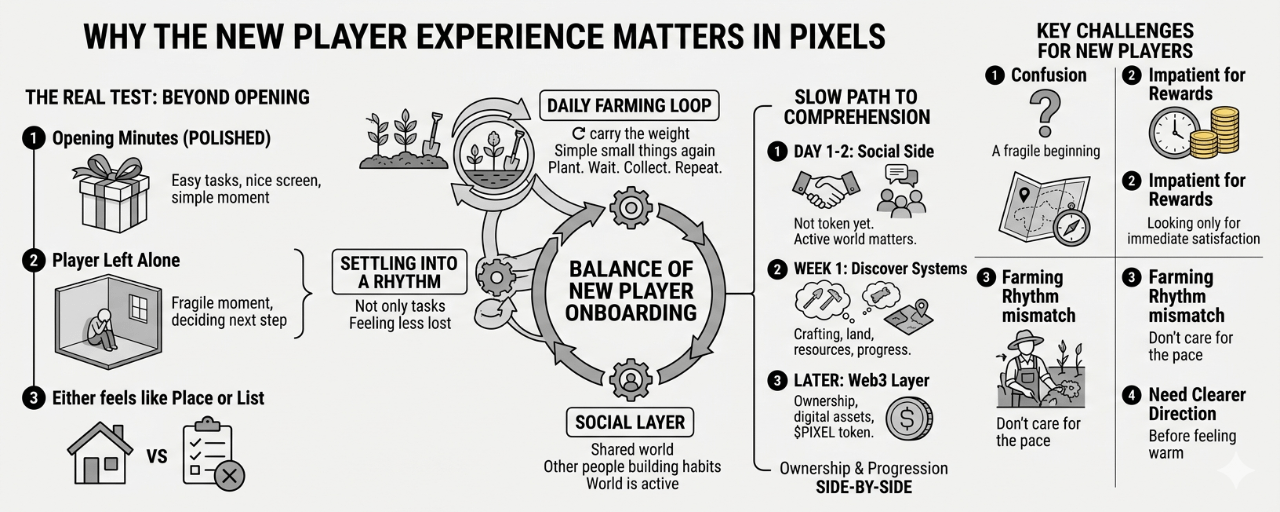
Not the first five minutes. Those can be polished. A game can make the opening look clean, give a few easy tasks, show a nice screen, and make everything feel simple for a moment. But the real test comes after that, when the player is left alone with the world. That is when the game either starts feeling like a place or starts feeling like a list.
That is what I was thinking about with Pixels today.
Pixels is a social casual Web3 game powered by the Ronin Network. It has farming, exploration, crafting, creation, and open-world movement at the center of it. The official Pixels site describes it as a place where communities come to life and where people can build experiences around digital collectibles.
On the surface, it looks easy to understand. You farm. You gather. You move through Terra Villa. You follow tasks. You see other players around you. It has the shape of a familiar farming game, but with Web3 systems sitting underneath it. And because of that, the first experience matters even more.
A recent Pixels AMA recap mentioned something that stayed with me. It said Stacked was already integrated into Pixels through the offer wall, and that players who only want to play Pixels do not have to interact with the Stacked app directly. It also connected Stacked to the idea of rewarding loyal users while making the experience less punishing for new players, especially compared with older anti-bot systems that made the new-user experience difficult.
That made me think about how fragile the beginning of a game can be.
A new player does not enter Pixels with years of context. They may not know what land means yet. They may not understand resources, tasks, crafting paths, or why some players care so much about certain systems. They may not even know how much of the game is social until they stand in the same space with everyone else and start noticing the movement.
At first, it can just look like crops and errands.
But after a while, you start noticing something else.
You notice that the game is not only asking you to complete tasks. It is asking you to settle into a rhythm. You check what needs doing. You learn where things are. You see familiar places. You understand that other players are not just decoration. They are part of the feeling of the world.
For me, that is where a new player experience becomes important. It is not only about explaining buttons. It is about helping someone feel less lost while still letting the world feel open.
Pixels has a lot of small systems. Farming is simple by itself, but farming inside a live Web3 world can become more layered. There are tasks, resources, crafting, land, social spaces, ownership, rewards, and player behavior all mixing together. If too much is thrown at someone too quickly, the game can stop feeling cozy and start feeling like homework.
But if the game hides too much, a new player may never understand why people stay.
That balance is hard.
I think casual games often live or die in that middle space. They need to be easy enough to enter, but deep enough to keep returning to. Pixels seems to understand that the daily loop has to carry the weight. A player should be able to log in and do something without needing a long explanation every time. The world should slowly teach itself through repetition.
That is one of the reasons farming games work in the first place.
There is comfort in doing small things again. Planting. Waiting. Collecting. Moving. Making. Upgrading. Even when the action is simple, it gives the player a small sense of order. Pixels adds the social layer on top of that. You are not only doing those things in a private little box. You are doing them inside a shared world where other people are also building their own habits.
That changes the feeling.
When I see Pixels as a new player might see it, I imagine the social side matters before the Web3 side fully makes sense. A person may not care about ownership on day one. They may not care about deeper systems yet. But they may notice that the world is active. They may notice people moving around. They may notice that the game feels less empty than many browser-based or crypto games they have tried before.
That first feeling can matter more than a long explanation.
The Web3 part should come in gently. Ownership, identity, assets, and tokens can give Pixels another layer, but they are not always the first thing a player needs to feel. If the first impression is only about rewards, then the game becomes easy to misunderstand. If the first impression is about a world with routines and people in it, then the Web3 layer has more room to feel natural later.
Ronin also sits in the background here. The Ronin marketplace describes Pixels as an open-ended world of farming and exploration where players gather resources, advance skills, build relationships, and connect blockchain ownership with progression. That description feels important because it puts relationships and progression beside ownership, not underneath it.
That is how I think Web3 works better in games.
Not as the whole personality.
More as the structure behind what players already care about.
A new player does not need to understand everything at once. Maybe they start with a task. Maybe they get curious about crafting. Maybe they notice another player’s land. Maybe they slowly understand why resources matter. Maybe later they start thinking about digital assets or PIXEL. That slow path feels healthier than forcing every concept into the first session.
Still, Pixels is not simple in every way.
Some players may enter and feel confused. Some may not care for the farming rhythm. Some may only be looking for rewards and leave if the loop does not immediately satisfy them. Some may need a clearer sense of direction before the world starts feeling warm. That is normal. A social casual Web3 game has to welcome different kinds of people, and not all of them arrive with patience.
That is why the early experience matters so much.
If Pixels can make the first days feel smoother without removing the slower discovery, it gives more people a chance to understand the game on its own terms. Not as a token page. Not as a campaign. Not as a loud Web3 pitch. Just as a place where farming, exploring, creating, and returning can slowly become familiar.
I keep coming back to that idea.
A game does not always need to explain everything loudly. Sometimes it only needs to help people stay long enough to notice why others are already there.
That is where Pixels feels interesting to me today. Not only in the advanced systems, not only in the updates, and not only in the Web3 layer. More in that early moment where a new player is still deciding whether this is just another game to try or a small world worth returning to tomorrow.
Still watching how new players find their rhythm around $PIXEL #pixel @Pixels

ဆောင်းပါး
Why the new player experience matters quietly inside Pixels’ daily farming world
ရှင်းလင်းချက်- ပြင်ပအဖွဲ့အစည်း၏ ထင်မြင်ယူဆချက်များ ပါဝင်သည်။ ဘဏ္ဍာရေးဆိုင်ရာ အကြံပေးခြင်း မဟုတ်ပါ။ စပွန်ဆာပေးထားသော အကြောင်းအရာများ ပါဝင်နိုင်ပါသည်။ See T&Cs.