

Pixels is the kind of project I don’t trust quickly, because I’ve seen this movie too many times.
A farming world. A token. A soft design language. A community that wants to believe the economy will behave better than the last hundred economies that came before it. On the surface, it looks calm. Almost harmless. But that is usually where the trouble starts in crypto gaming. The quiet projects can still bleed. The cute ones can still overpay. The simple loops can still turn into factories.
I’m not looking at Pixels as a farming game first.
I’m looking at it as a pressure system.
Every crypto game eventually has to answer one ugly question: how much player activity should become money? Too much, and the game starts rotting from the reward layer. Too little, and people stop caring because the token feels like decoration. Pixels sits right in that uncomfortable middle, and honestly, that is the only reason it is still interesting to me.
Most of the gameplay does not rush straight into payment.
Good.
That sounds boring to the impatient crowd. They want a clean path. Click, grind, earn, sell, repeat. I have seen what that path does. It brings noise first. Then farming groups. Then inflation. Then complaints. Then reward cuts. Then the same people who begged for easy earning start calling the economy broken.
Pixels seems to be trying to avoid that old loop by keeping a lot of value inside the game before it touches the token. You farm, collect, craft, move, upgrade, and repeat. Some of that work matters. Some of it is just grind. That is gaming. But not every piece of effort becomes something the market can instantly chew on.
That friction matters.
People hate friction until they see what happens without it. A game with no friction becomes a drain. Everyone moves toward the exit at the same time. The token turns into a bucket under a leaking roof. At first, the volume looks exciting. Then you realize most of the activity is not belief. It is extraction wearing a player skin.
Pixels has one thing right: not every moment should be sellable.
I don’t say that as praise with fireworks. I say it because the alternative has already failed enough times to become boring. When every crop, every task, every click, and every small reward can be pushed toward the market, the game stops feeling like a place. It becomes a workplace with colors.
And nobody stays loyal to a workplace that pays less next month.
That is the part people keep pretending not to understand. Crypto gamers are not always gamers. Some are workers. Some are traders. Some are bots with better grammar. Some are just tired people hoping this one finally gives them something back. Pixels has to serve real players without letting the extractors design the economy by force.
That is hard.
The project uses internal progress as a kind of buffer. You do things inside the world, and much of that effort stays there. It becomes usefulness. Access. Better positioning. Better movement through the game. It does not always become a direct token event.
That makes the game slower.
Maybe slower is necessary.
A farming game that pays too quickly stops being a farming game. The whole emotional logic of farming is delay. Plant now. Wait. Prepare. Come back. Do the dull thing again because the dull thing leads somewhere. If everything ripens instantly, the farm loses its meaning. It turns into a vending machine.
Pixels is trying not to become that.
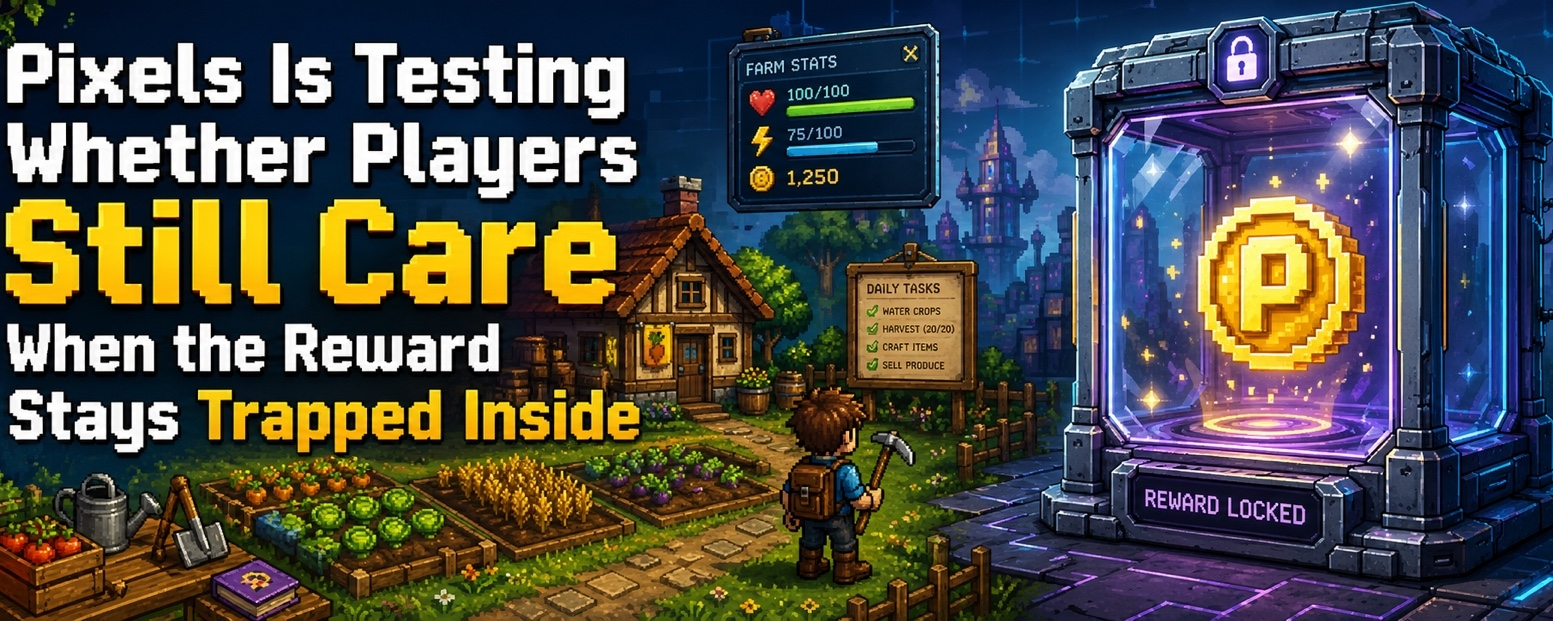
I’m watching the split between the in-game economy and the token layer more than I’m watching the visuals. The visuals are fine. Pleasant. Familiar. Not the point. The important thing is whether Pixels can keep its internal economy useful enough that players do not feel like they are trapped in a fake room before reaching the “real” reward.
That is where this can break.
If the internal rewards feel meaningful, Pixels has a chance to build habit. If they feel like padding, players will notice. They always do. Crypto users are impatient, suspicious, and often brutally practical. They may tolerate friction if the world feels alive. They will not tolerate friction if it feels like a locked door with a cute background.
I’m looking for that moment.
The moment players stop saying, “I’m progressing,” and start saying, “Why am I doing all this?”
Every game has that moment. Good games survive it. Weak economies collapse into excuses.
Pixels has already had to learn from economic pressure. That matters. The project did not stay married to a reward model just because it was familiar. It adjusted. It moved toward a cleaner structure where the main token does not have to carry every ordinary action on its back. That is not glamorous. It is maintenance work. But crypto gaming needs more maintenance work and less theater.
Still, discipline can look like distance if the game is not strong enough.
That is my worry.
A token can be protected so much that players stop feeling connected to it. A game can slow extraction so much that honest users feel punished along with the farmers. A project can build walls to protect itself, then discover the walls also kept out excitement.
There is no neat answer here.
Pixels has to keep the token important without making it spill everywhere. It has to make the game rewarding without turning every reward into sell pressure. It has to make grinding feel like progress, not unpaid labor. It has to make social systems matter, because without people, farming loops become lonely machines.
And yes, the world needs people.
Not just wallets. Not just accounts. Not just active users on a chart. Real people who remember what they were building yesterday. People who care about their land, their upgrades, their group, their routine. That sounds soft, but it is not. In a game economy, attachment is infrastructure.
Without attachment, everything becomes temporary.
The extractor does not care about the world. The extractor cares about the route. Once the route weakens, he leaves. Then the project discovers that yesterday’s activity was not community. It was traffic.
I have seen that too many times.
Pixels needs to make empty activity expensive. Not impossible. Nothing is impossible when rewards exist. But expensive enough that the easiest way to benefit is to actually stay, learn the systems, move with the world, and become harder to replace than a script.
That is a serious design problem.
Daily activity alone is not enough. A bot can be active. A farm group can be active. A bored player can be active while already mentally gone. The project has to figure out how to reward presence, not just motion. That is where most games fail. They count movement and mistake it for life.
Pixels cannot afford that mistake.
The farming theme helps, at least emotionally. It gives the project a natural reason for repetition. People expect farming to involve waiting, cycles, small tasks, and slow improvement. That buys Pixels some patience. Not unlimited patience, but some.
The real test, though, is whether tomorrow feels different enough from today.
If every session becomes the same little grind with a token somewhere in the distance, fatigue will build. Slowly first. Then loudly. Crypto communities are good at turning fatigue into blame. They blame emissions. They blame whales. They blame bots. They blame the team. Sometimes they are right. Sometimes they are just tired.
Usually both.
I don’t think Pixels should be judged only by token price, but pretending price does not matter is childish. Price affects mood. Mood affects retention. Retention affects the economy. The chart becomes weather. Even players who claim they are here for the game feel the cold when the token keeps sliding.
That is the curse.
A normal game can be fun without every player checking the market. A crypto game has to entertain people who are also watching liquidity. Pixels has to build charm under financial surveillance. That is not easy. It is probably unfair. But this is the category it chose.
The better version of Pixels is not a game where everyone asks how much they made today.
The better version is a game where people still log in when the answer is not impressive.
That is what I’m looking for.
Not hype. Not recycled promises. Not another loud campaign where the economy looks alive because people are rushing to drain it. I want to see whether Pixels can create the slower kind of value. The kind that sits inside the world for a while. The kind that does not immediately run to the exit.
Because value needs somewhere to rest.
If it never rests, the whole project becomes a hallway. People enter, collect, leave, and call it adoption. That word has been abused enough. Real adoption would mean players care about what remains after the reward is claimed.
Pixels is still unfinished. That is not an insult. Every live game is unfinished. The question is whether it is unfinished in a healthy way or unfinished because the economy keeps needing another patch to survive the next wave of pressure.
I don’t know yet.
I like that Pixels does not let every action become payment. I like that more than I expected. It shows some restraint, and restraint is rare in a market addicted to noise. But restraint only works if the world behind it is worth staying in.