
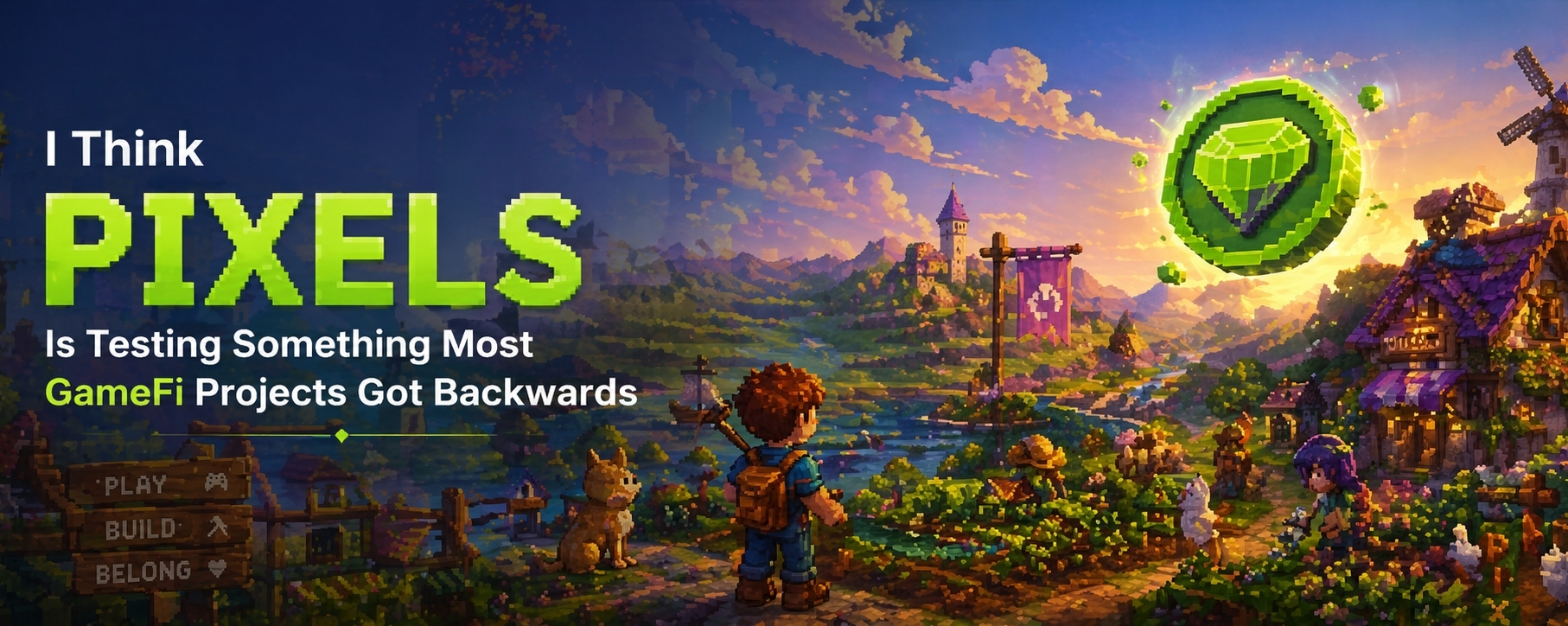
I've been circling $PIXEL for a while now, mostly because I kept seeing it survive while everything around it collapsed. That felt worth paying attention to.
Here's what I couldn't stop thinking about lately: most GameFi projects weren't actually games. They were economic loops disguised as games. People showed up to earn, not to play. And that worked fine — until token prices dropped. Then motivation vanished overnight. No fun meant no loyalty. The whole thing just emptied out.
I saw this happen with a project I was in last year. Entered because the APY looked insane, stayed maybe three weeks, left the moment rewards slowed down. Never once cared about the gameplay. That's the pattern that killed 93% of these projects, apparently. Even with $12 billion spent across the industry, most games were just… honestly not fun. Quality got sacrificed for tokenomics.
Pixels feels different because it seems to be doing the opposite. It built a game first — actual gameplay, farming loops, world-building — then added the blockchain layer after. Crypto became a feature, not the foundation. That sounds simple, but it's rare in this space.
I picked up a small $PIXEL position about a month ago, not because of any breakthrough fundamentals, just because the user behavior looked sticky in a way most GameFi doesn't. Held it through some volatility, took partial profit last week. Nothing dramatic, but the logic felt more sound than betting on earn-first projects I've touched before.
What's interesting is Pixels keeps the pressure low. They're not screaming "earn money playing games" everywhere. Instead, they're just creating an environment where people actually stay. That's subtle, and honestly, it might be powerful.
But here's my doubt — and it's a real one. Right now, Pixels is working at a relatively small scale. Balance is easy to maintain when the system is controlled. The real test comes when it scales. Can this game-first approach handle massive user growth without defaulting back to heavy incentives? Or will the earn pressure creep back in once expectations rise?
History in this space gives a pretty pessimistic answer to that question.
So I'm not calling Pixels a guaranteed success. I'm calling it an ongoing experiment. Some things are clearly working — the game-first approach, slower economy design, organic engagement patterns. But other questions remain unanswered. Revenue sustainability. Long-term retention without aggressive rewards. Scaling without breaking the balance.
What I do think is becoming clear: projects that only promised quick money didn't survive. The ones that tried to build an actual experience are still standing.
Maybe @Pixels finds that balance. Maybe it's just a small-scale illusion that breaks under pressure. Either way, it's testing something most of this industry got completely backwards.