
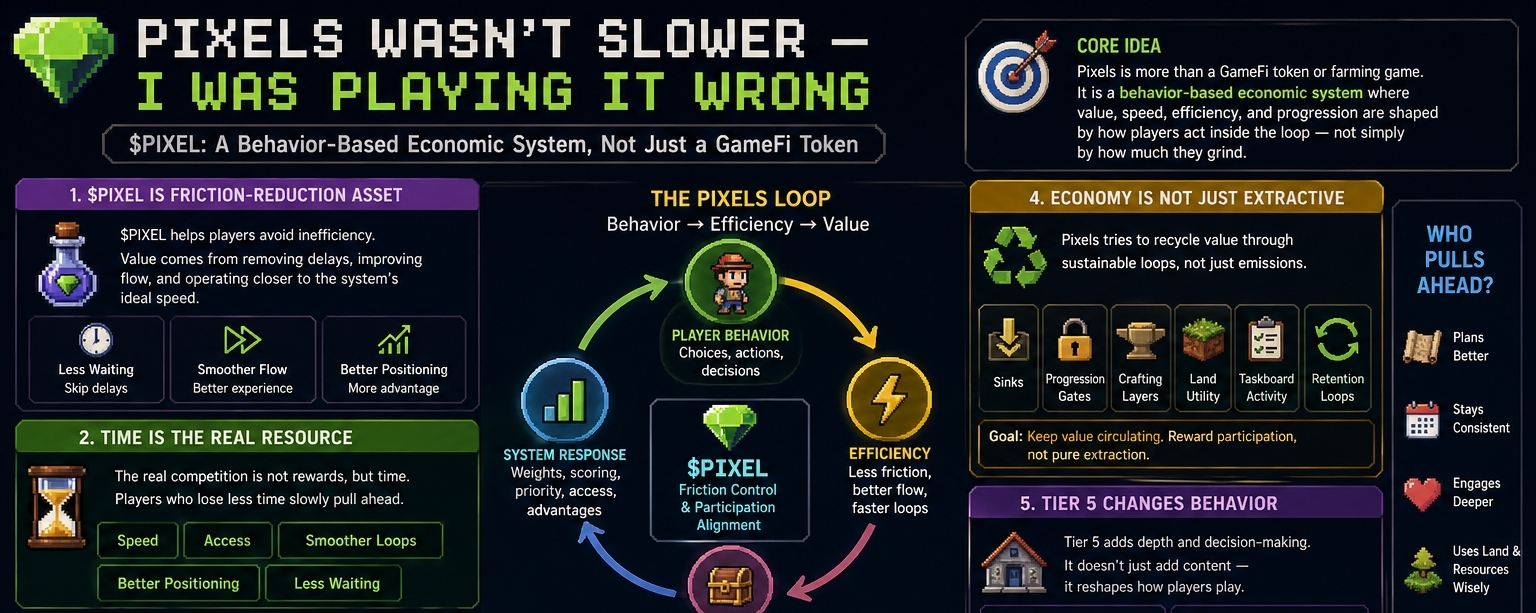
At first, I thought Pixels had a pacing problem. Things felt delayed, loops felt heavier, and progress didn’t always match the effort I was putting in. But the more I stayed inside the system, the more I realized something uncomfortable:
The game wasn’t slow it was selective.
And not everyone is moving through it at the same speed.
What changed my perspective was noticing how differently players progress despite doing “similar” things. That’s when it clicked for me: Pixels isn’t just a farming game or a GameFi loop. It feels more like a behavior-driven economy where efficiency isn’t given it’s earned through how you interact with the system.
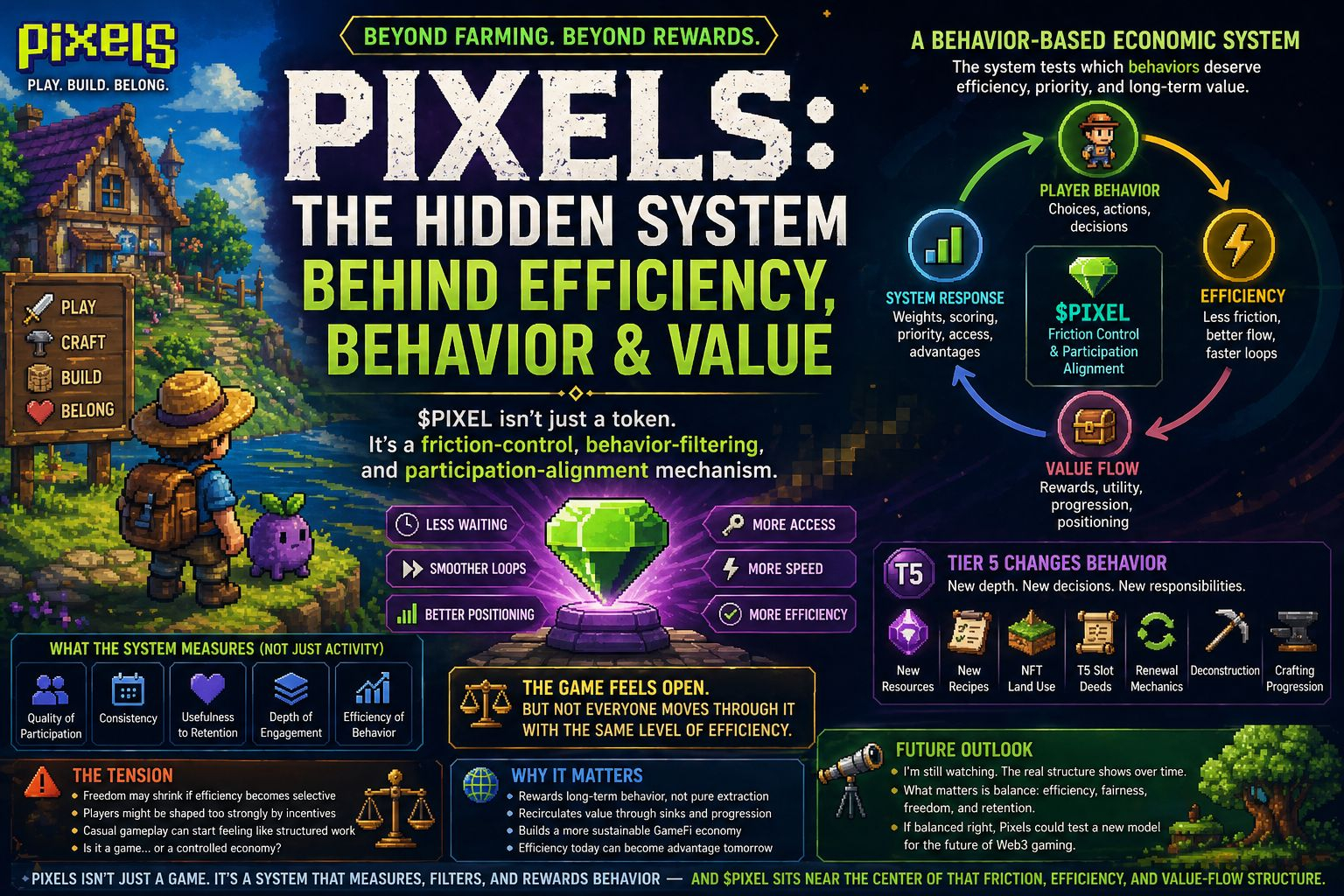
PIXEL started to make more sense through that lens.
Not as a simple reward token, but as something closer to a friction-control layer. It doesn’t just represent value it helps you move closer to the system’s ideal flow. Less waiting, smoother actions, better positioning. The advantage isn’t loud, but it’s there. And over time, it compounds.
In Pixels, time feels like the real currency.
Not how much you grind but how much time you waste while grinding. Players who reduce friction, plan better, and stay consistent slowly pull ahead. It’s subtle, but it reshapes the entire experience. Efficiency becomes the edge.
That’s where things get interesting.
Because the system doesn’t seem to treat all behavior equally. Some actions feel more “aligned” than others. It’s like Pixels is quietly scoring participation not just by activity, but by quality, consistency, and usefulness to the ecosystem.
And that shifts the game away from pure extraction.
Instead of just earning and leaving, the design pushes toward staying, building, and recycling value. You see it in crafting layers, land utility, sinks, and taskboard loops. The system feels like it wants players to circulate within it not drain it.
Tier 5 made this even clearer to me.
It didn’t just add content it changed decisions. New resources, deeper crafting, land interactions, slot mechanics suddenly, progression wasn’t just about doing more, but thinking differently. It raised the seriousness of participation.
And that’s where I started feeling a bit of tension.
Because while the game feels open, it also feels guided. Efficiency isn’t evenly distributed. Some players naturally align with the system and move faster. Others lag, even with effort. It raises a quiet question:
Is this still freedom or a system shaping behavior toward a preferred path?
I don’t think that’s necessarily a bad thing. In fact, it might be what makes the economy more sustainable. Most GameFi models fail because they reward extraction over participation. Pixels seems to be testing the opposite rewarding those who stay, adapt, and engage deeper.
But it does change the feel of the game.
It becomes less about playing however you want, and more about understanding how the system wants to be played.
And I’m still watching that balance.
Because if efficiency becomes too selective, it risks turning casual play into structured work. But if balanced well, it could become something much bigger than a typical Web3 game a system where behavior, time, and value are tightly connected.
That’s why I don’t really see PIXEL as just a token anymore.
It sits at the center of something quieter a loop that filters participation, reduces friction, and rewards alignment over noise.
And the real question isn’t where the token goes.
It’s whether this model holds up when the incentives settle, and only behavior remains.
