
Where Land Quietly Becomes Power
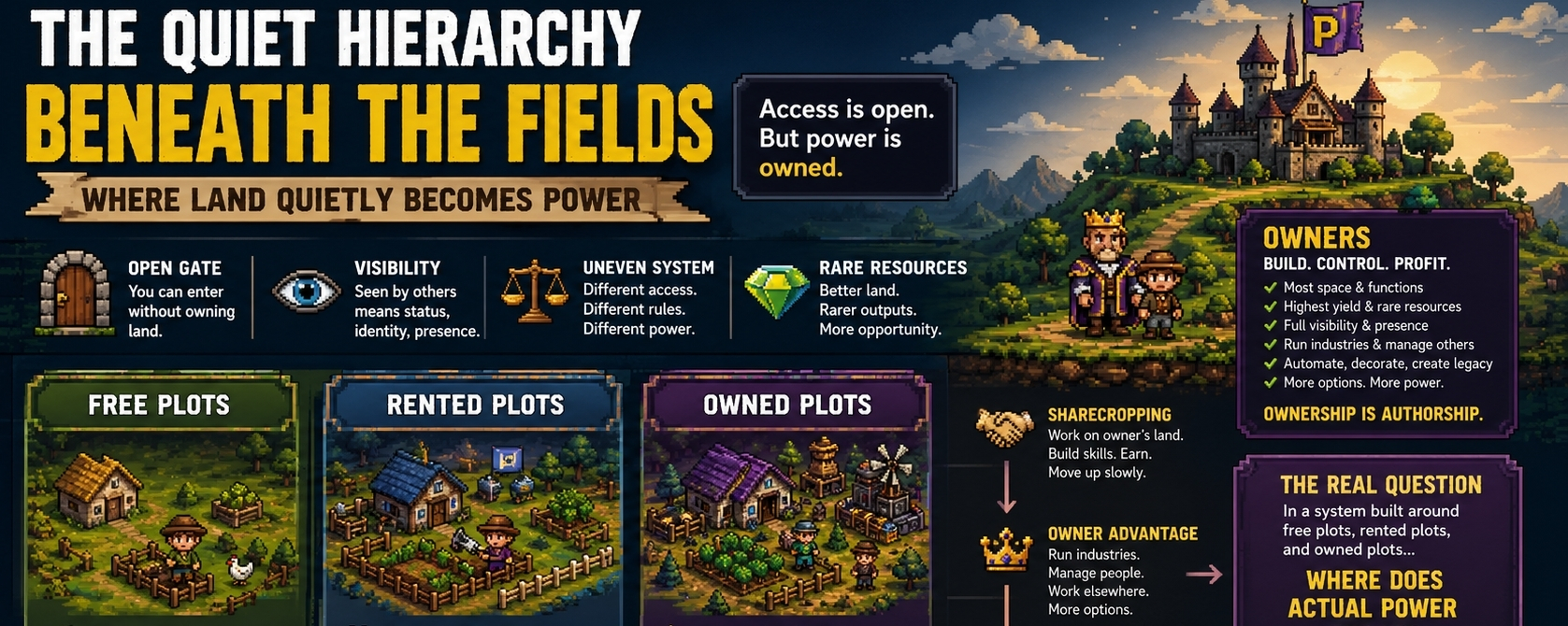
The thing that stuck with me was not simply that Pixels has land. A lot of games have land. What stayed with me was the way Pixels organizes people around it. The project says you do not need to own land to use the game’s features, and at first that sounds open, even generous. But once you look a little closer, the differences between each kind of access start to feel important. Free plots give basic farming, but with lower functionality and lower yield. Rented plots give players more room, more flexibility, and better yield, but a big share of what they earn is taken as rent. Owned plots offer the most space, the most functions, and the highest yield. That is not just a gameplay choice. It is a way of arranging power.
Once I saw that, I could not stop thinking about the real question underneath it: in a system built around free plots, rented plots, and owned plots, where does actual power end up?
On the surface, Pixels makes a real effort to keep the gate open. You can enter the world without owning land. You can still farm, still participate, still move through the game. Free and rented plots exist for a reason. They make the world feel less closed, less restricted to owners only. That is worth noticing, because it means the project is not building the most obvious kind of ownership barrier.
But being allowed in is not the same thing as standing on equal ground once you are inside.
What caught my attention was how different these spaces feel in terms of presence and visibility. Free and rented plots are mainly single-player spaces, and other players cannot really see your farm. That may sound like a small design detail, but it changes the meaning of the space. In online worlds, being seen matters. Visibility is part of status, part of identity, part of how a world feels shared. If your farm exists mostly out of sight, your role in that world becomes quieter, less permanent, and less socially grounded. Owned land feels different. It is where all industries are available, where some industries are unique, and where owners can keep improving, automating, and decorating over time. So ownership is not only giving better output. It is giving a deeper kind of authorship inside the world.
That is where the politics of land starts to feel real to me. The owner is not just somebody with a bigger plot. The owner is closer to the game’s underlying structure.
The sharecropping system makes that even clearer. Pixels openly says this is how free-to-play users will play. Rented land is leased, not owned, and players can move up to larger plots as they gather more in-game resources. Sharecroppers can also build skills by working industries on NFT farms. On one level, that sounds practical and inclusive. But the relationship is still uneven. Multiple sharecroppers can work around one landowner’s setup. The landowner can run their own industries, manage people using their land, and even go work as a sharecropper somewhere else. The owner gets more than access. The owner gets options.
And that matters, because options are a form of power. Ownership here is not only a reward for commitment. It is a position from which other activity can be organized.
The resource system pushes that point further. Pixels says that some resources and rarities only appear on certain land types, and that better land can produce rarer outputs. The moment that becomes true, land stops being a decorative feature. It becomes a filter. Opportunity may still look open from a distance, but the most valuable possibilities are clustered around certain forms of land, which means they are clustered around certain players.
Even renting has its own quiet instability. The help center explains that land rentals happen through LootRush, and that VIP status depends on the oldest land ID in a wallet. If the rental ends, that benefit can disappear until another land has been held for long enough. So renting gives access, but not the same kind of security. It lets players participate, but it does not give them the same footing.
I do not think Pixels is pretending otherwise. The project is fairly direct about linking ownership, rewards, and the wider token economy. What you build is yours to own, and what you own can generate blockchain-backed rewards. That is a clear promise. But it also means the land system is doing more than sorting farms by size or function. It is quietly sorting influence. And the more I sit with it, the more it seems that in Pixels, access may be open to many people, but control still gathers around the people who own the ground everyone else is trying to grow on.
