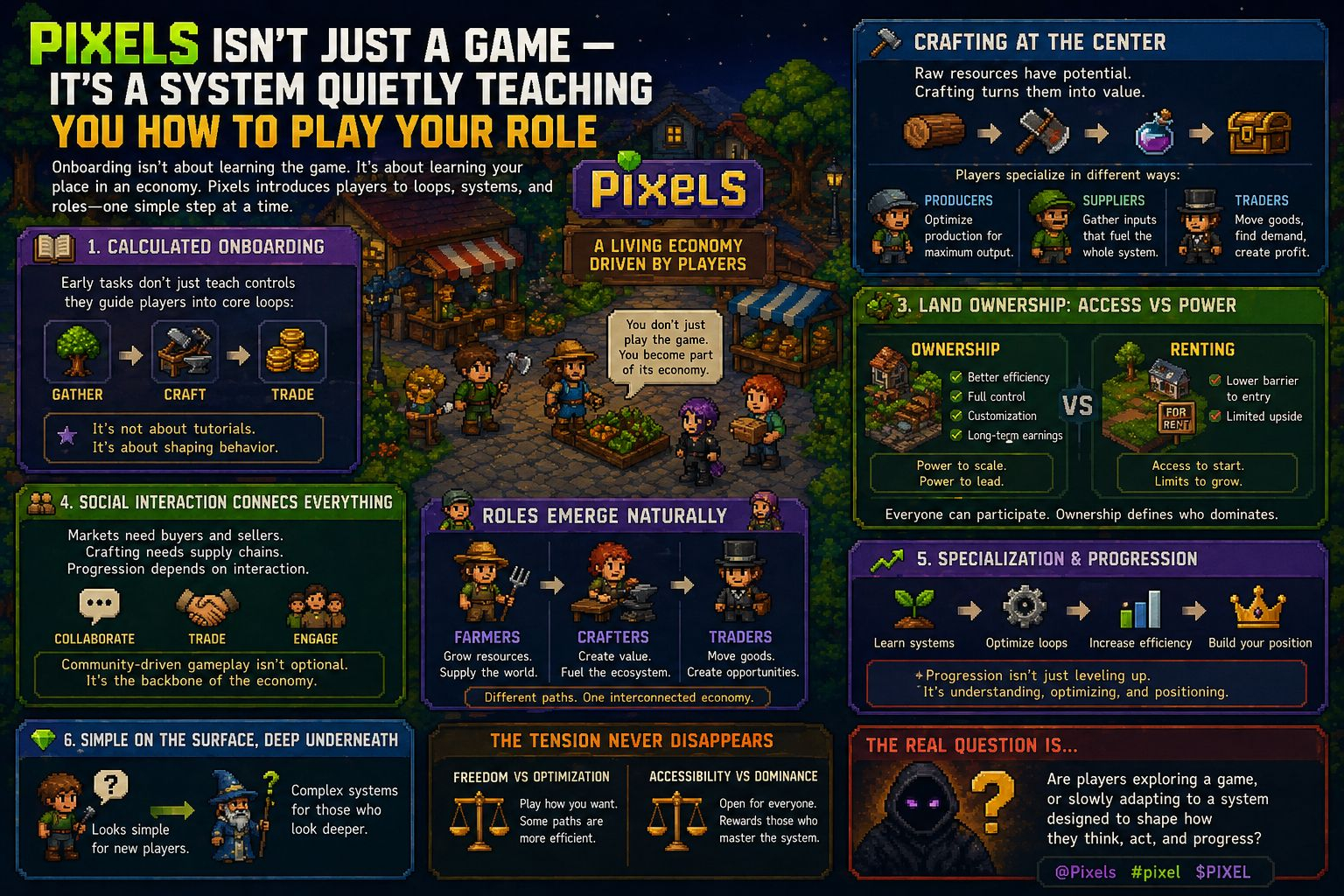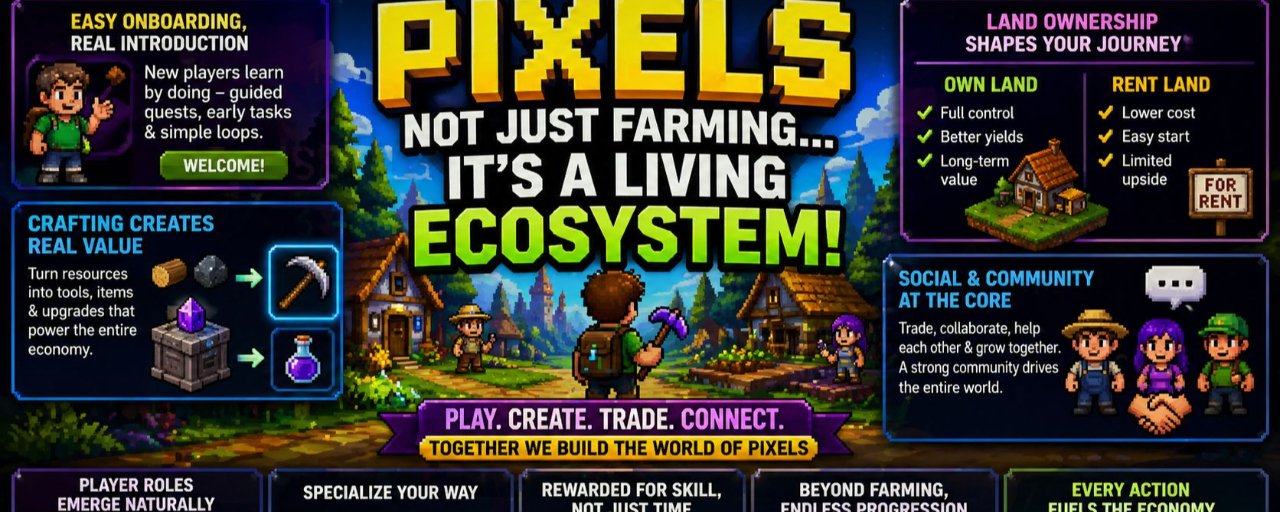
Honestly? The more time I’ve spent thinking about how @Pixels introduces new players into its world, the more it feels intentionally designed rather than just “good onboarding” 😂. At first glance, it looks like any other game—simple tutorials, easy quests, basic instructions. But underneath that surface, something more calculated is happening. It’s not just teaching players how to move, farm, or craft. It’s slowly easing them into an entire economic system without ever making it feel overwhelming.
Most players assume onboarding is just about learning mechanics. Click here, gather this, craft that. But in reality, those early steps are shaping behavior. They’re quietly guiding players into repeating loops—gathering resources, converting them into items, and eventually trading them. It doesn’t feel forced, and that’s the key. Instead of overwhelming new players with complexity, Pixels introduces structure through action. You don’t study the system—you naturally fall into it.
What stands out is that onboarding in Pixels isn’t really about understanding the game. It’s about understanding your place within it. From the very beginning, players are nudged into roles, even if they don’t realize it yet. Some lean toward farming, others toward crafting, and some start noticing opportunities in trading. These paths aren’t assigned—they emerge through interaction.
Crafting, in particular, sits at the heart of everything. It’s not just another feature added for depth—it’s the engine that drives value creation across the entire ecosystem. Raw materials on their own don’t carry much weight, but once processed, they become tools, upgrades, or consumables that other players depend on. This transformation is where the real economy begins to take shape.
But here’s where it gets more interesting—players don’t engage with crafting in the same way. Some focus on efficiency, optimizing their production to maximize output with minimal input. Others specialize in gathering the resources needed for crafting, becoming suppliers in the chain. Then there are players who skip production altogether and position themselves as traders, moving goods where demand exists. Without any strict rules, a natural division of roles begins to form.
Land ownership adds another strategic layer to the system. Owning land isn’t just about status—it directly impacts production capabilities. It allows for better efficiency, more control, and stronger long-term growth potential. On the flip side, renting land lowers the barrier for new players to enter the system. It gives access without full commitment, but also limits how far someone can scale. This creates a constant tension between accessibility and control. Anyone can participate, but not everyone can dominate.
Social interaction is where everything connects and becomes truly alive. Pixels doesn’t force multiplayer dependency in an obvious way, but it quietly makes it essential. Crafting requires inputs, trading requires markets, and progression often depends on cooperation. Over time, players start interacting more—not because they have to, but because it becomes the most efficient way to grow. Communities form, trade networks develop, and the economy becomes driven by player relationships as much as game mechanics.
One of the most fascinating parts is how specialization evolves. Players don’t just “level up”—they refine their approach. Efficiency becomes a skill in itself. Understanding supply and demand, optimizing production loops, and positioning yourself within the economy becomes more important than simply grinding tasks. The deeper you go, the more layers you uncover. And yet, none of this is immediately obvious when you start.
What Pixels does exceptionally well is maintaining simplicity on the surface while running a complex system underneath. New players see a casual farming and crafting game. Experienced players begin to recognize patterns, opportunities, and economic strategies. This duality is what keeps the experience engaging across different levels of understanding.
But that underlying tension never really disappears. There’s always a balance between freedom and optimization. You can play however you want—but some approaches are clearly more efficient than others. There’s also a balance between accessibility and dominance. The system allows entry for everyone, but rewards those who learn how to navigate it deeply.
And that leads to a bigger question that keeps coming back…
Are players truly exploring a game at their own pace, or are they gradually adapting to a system that’s quietly shaping how they think, act, and progress?