
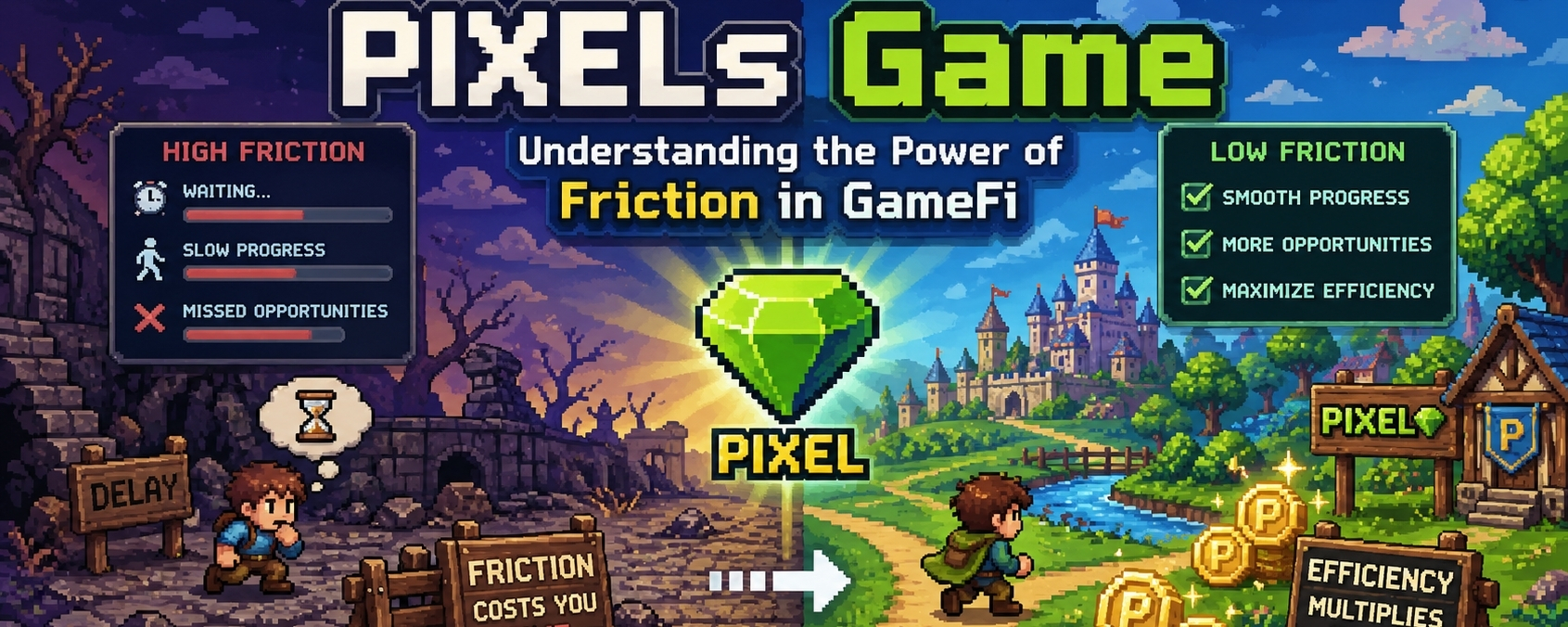

I Will Be Honest.........$PIXEL
I Used to think “Open systems” meant equal systems. If everyone can participate, then everyone should move at the same pace, Right? But the longer I spend inside digital economies, the more I notice something subtle. Access is usually equal. Efficiency is not.
Yeah..That difference is easy to miss at first. Everything works. You can play, earn, and interact without obvious restrictions. But after some time, a strange feeling appears. Not that you are blocked, but that you are slightly behind. Like the system is moving at a rhythm you didn’t fully choose.
I have seen this before in crypto markets. Two traders look at the same setup, At the same time. One Gets filled. The other watches price move without them. It is rarely about skill in that exact moment. It is about positioning, timing, and sometimes invisible advantages in execution.
GameFi was supposed to simplify this. Play, earn, repeat. A clean loop where effort leads to rewards. But over time, Most of these systems face the same hidden problem. They reward activity, But they don’t manage efficiency. And when efficiency is ignored, systems either get exploited or slowly lose balance.
That is where things start to get interesting.
The deeper issue is Not about rewards being too low or too high. It is about how predictable those rewards are. In most play-to-earn systems, repetition guarantees output. If you follow the loop long enough, you extract value. This creates a mechanical relationship between action and reward.
But mechanical systems are easy to drain.
People learn the pattern, optimize it, and push it to the limit. Eventually, the system either inflates or collapses because it cannot differentiate between meaningful participation and simple repetition.
This is where I started seeing a different pattern inside Pixels.
At first, it looks like a soft and simple GameFi loop. Farming, collecting, waiting, Repeating. Nothing aggressive. Nothing forcing you to optimize. You can play casually without thinking too much, and that is probably intentional.
But after spending more time observing player behavior, I noticed something small but important. Players are not really chasing rewards. They are chasing smoothness.
Less waiting. Fewer interruptions. Fewer points where the system slows them down.
And this is where $PIXEL begins to feel different.
It does not act like a typical reward token that pushes you to earn more. Instead, it quietly sits in the background, shaping how friction behaves. You can ignore it, Nbut ignoring it means you experience the system at its default speed. And default speed is fine, just not optimal.
That changes how you think about value.
Instead of asking “how much can I earn?”, the question becomes “how much inefficiency can I remove?” Because over time, . small delays are not small anymore. They compound. A few seconds here, a pause there, repeated across hundreds of cycles, starts to create a visible gap between players.
Two people can produce similar output, but one does it with less friction. That player slowly pulls ahead, not because they work harder, but because they lose less time.
Time becomes the real resource. PIXEL just sits next to it.
What makes this more interesting is that the system does not explicitly tell you this. There is no moment where it says, “now you need this token.” Instead, you feel it indirectly. You start noticing where your flow breaks. You begin adjusting your behavior to stay smooth.
That is where demand naturally forms. Not from big decisions, but from small repeated ones.
Over time, I also noticed another layer. The system does not feel completely static. The same actions do not always produce the same weight of outcome. Some patterns seem to stay effective longer, while others slowly lose impact, even if nothing changes on your side.
This creates the feeling that behavior itself is being evaluated, not just executed.
Instead of “this action gives reward,” it starts to feel like “this type of behavior is currently being valued.” That is a very different dynamic. It introduces a form of selection without making it obvious.
From a design perspective, this makes sense. Purely open reward systems get drained quickly. But systems that quietly prioritize certain behaviors can sustain themselves longer by guiding participation instead of just rewarding it.
PIXEL, in this context, does more than reduce friction. It connects players to deeper participation loops. Staking, . longer engagement cycles, and smoother progression paths start to feel less like yield mechanics and more like filters. They separate surface-level interaction from consistent presence.
And that separation matters.
Because it changes what value means inside the ecosystem. It is no longer just about extracting rewards. It is about whether your activity continues to fit into a loop that the system wants to sustain.
There is also a broader implication here.
If systems like this become more common, GameFi could shift away from pure “play-to-earn” into something closer to “play-to-participate efficiently.” Where rewards are not just outputs, but reflections of how well your behavior aligns with the system’s long-term balance.
But this also introduces a quiet tension.
The more a system adapts to behavior, the more it starts shaping behavior. Over time, Some play styles get reinforced while others slowly fade. Not because they are removed, But because they stop being effective.
So the system remains open, but outcomes are no longer neutral.
I think Pixels is still in an early stage of figuring this balance out. It does not feel like a finished model. More like a system that is adjusting itself, testing what kind of participation actually keeps it alive.
And that is what I find most interesting.
Not what PIXEL gives you directly, but what it allows you to avoid. Not what you earn, But how you move through the system while earning.
Because in most digital economies, the biggest advantage is not always more rewards. It is less friction.
So the real question becomes:
Are systems like this necessary for GameFi to survive long term?
Or do they slowly create invisible layers that separate players over time?
And if efficiency becomes the main advantage, does that improve fairness… or redefine it?
From what I have seen so far, PIXEL is not just a token. It is a way to price time inside a system.
And pricing time has always been where things get interesting.