
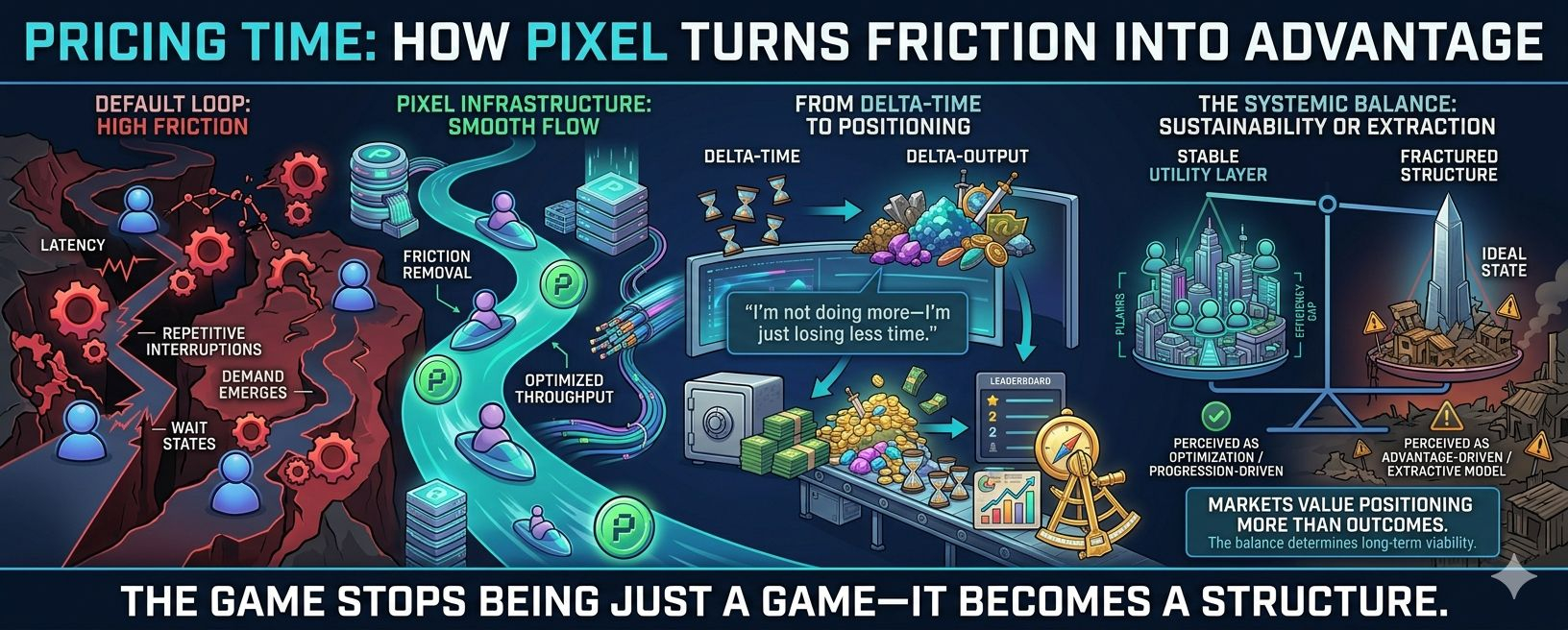
What I wrote goes far beyond the usual “is a good token?” conversation. I don’t see it purely as an asset—I see it as a friction instrument, a system that quietly controls how resistance behaves. And that lens, to me, is where things start to become meaningful.
The strongest part of my analysis is the distinction between earning rewards and reducing friction. Most GameFi systems make demand obvious: play more, earn more, stake more, receive more. The token is directly tied to output. But in Pixels, what I’ve observed is different. The token behaves more like infrastructure. It doesn’t aggressively push rewards to the surface—it subtly reshapes the speed and flow of the experience. And psychologically, that matters, because people tend to respond more strongly to the removal of discomfort than to the addition of gain.
I’ve noticed that people can tolerate the absence of extra rewards for a while. But once they become aware of repeated interruptions, their tolerance drops quickly.
That’s why the comparison to market execution feels accurate to me.
Two traders can see the same setup, yet one executes while the other watches the move happen. In that moment, the difference isn’t skill—it’s latency, routing, positioning. The edge lives in the system, not in the decision. In the same way, within Pixels, time stops being passive and becomes an economic resource.
To me, that suggests that functions less like a traditional reward token and more like a throughput priority layer—something that determines how smoothly and continuously I can move through the system.
That’s a deeper structural role.
The compounding effect I noticed is critical. Skipping a single delay feels trivial, but systems are shaped by repetition. If I save even a small amount of time per cycle, that difference accumulates. Over time, delta-time turns into delta-output, then into delta-capital, and eventually into better positioning within the system itself.
This is why one line keeps coming back to me: “I’m not doing more—I’m just losing less time.”
That line captures the model clearly.
In many digital systems, the truly scarce resource isn’t the visible currency—it’s uninterrupted flow.
When I step back, this pattern isn’t new. Modern systems rarely sell outcomes directly—they sell smoother access to them.
Cloud platforms reduce latency.
Exchanges reduce execution delay.
Blockchains prioritize transactions.
And increasingly, games optimize loop efficiency.
Pixels feels like a direct translation of that logic into gameplay.
That’s why demand emerges quietly but persistently. I don’t necessarily think, I need this token to profit. Instead, I think, I don’t want this delay anymore. That’s a much more organic form of demand, because it comes from lived experience rather than abstract incentives.
There is, however, a subtle discomfort in this structure.
It’s not traditional pay-to-win, but it can still create functional stratification.
The system remains open in principle—anyone can participate—but in practice, layers begin to form. Some players operate closer to the system’s “ideal state,” where everything flows smoothly. Others remain in the default loop, where small inefficiencies continue to accumulate.
From my perspective, that difference is subtle enough to go unnoticed at first, but over time it can become visible.
And that’s usually where systems either stabilize or begin to fracture.
If the efficiency gap stays moderate, players tend to accept it as optimization. But if it becomes too pronounced, perception shifts, and the system starts to feel advantage-driven rather than progression-driven.
In the long run, I think this balance will determine whether evolves into a sustainable utility layer or drifts into something more extractive.
The most accurate way I can describe it is this: the system isn’t really selling rewards—it’s selling positioning.
And markets have always valued positioning more than outcomes, because outcomes are uncertain, while positioning improves the probability of better outcomes.
That’s exactly what’s happening here.
I’m not just describing a token. I’m describing a system that quietly turns time into an economic gradient.
And once time itself becomes priced, the game stops being just a game—it becomes a structure.
