

The market felt unusually empty frim last night. Low volume. Mixed sentiment. No clear structure to act on. Nothing really worth forcing a trade on.
So I did what I usually end up doing in moments like this, I drifted.
Clicked through unrelated charts. Opened tabs I normally ignore. Let curiosity lead instead of intention.
That’s how I landed on @Pixels
At first, it wasn’t serious. Just another scroll. Something I’d seen mentioned a few times this cycle; mostly in passing. Play-to-earn, but actually fun. That kind of narrative. Easy to dismiss.
I told myself I’d spend maybe twenty minutes on it.
Then I didn’t.
The First Signal: Real Users, Real Scale
What immediately stands out around Pixels is the user activity.
People keep pointing to daily active users. And unusually, those numbers are not small. At its peak, Pixels reportedly reached hundreds of thousands of players. For a blockchain-based game, that’s not normal; that’s significant.
Most crypto projects struggle to get even a fraction of that engagement. Many never move beyond wallets interacting once or twice.
So on surface level, something is clearly working here.
But the interpretation problem starts right after that.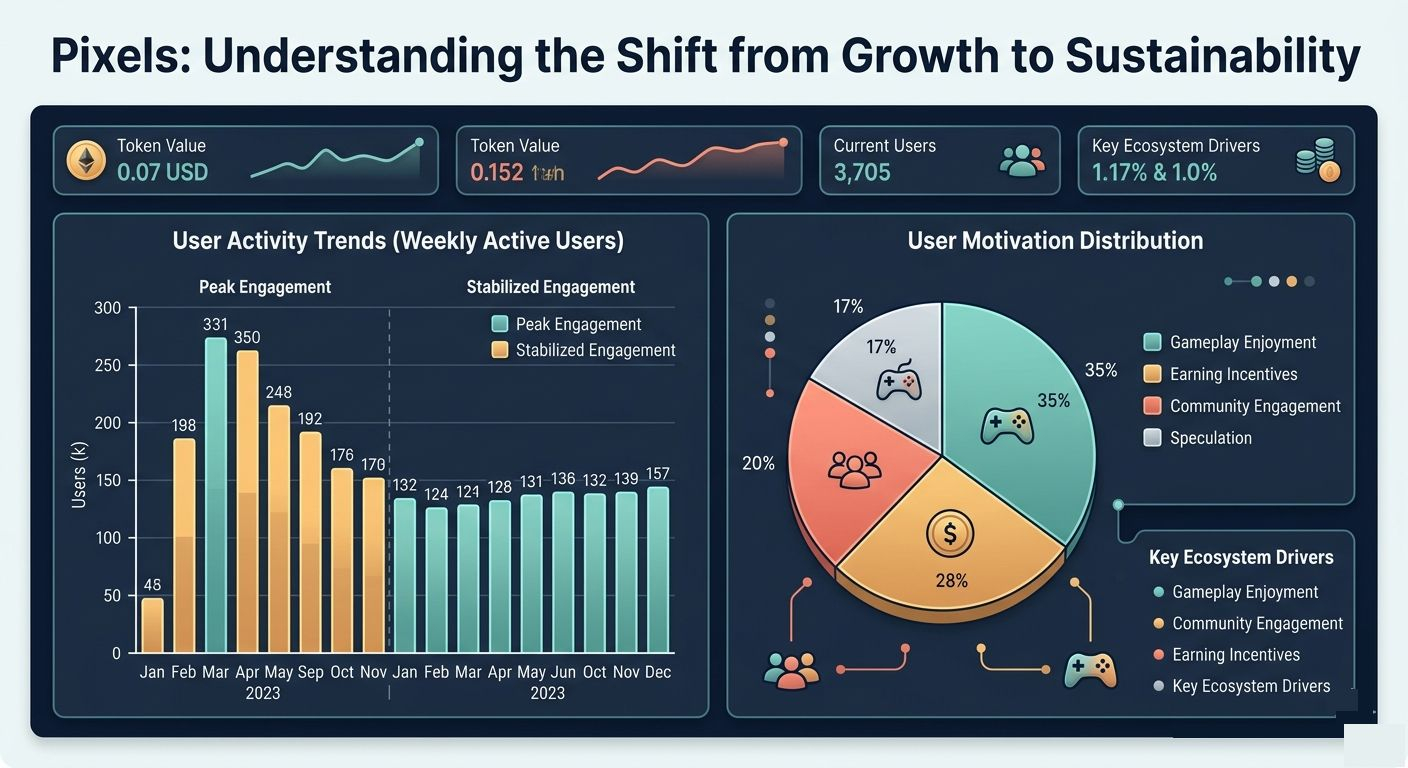
Misreading the Metrics
The way most people analyze PIXEL feels slightly misplaced.
They treat it like a DeFi protocol.
Price charts. Liquidity depth. TVL-like comparisons. Short-term token movement.
And when those metrics pulled back, as they inevitably did, the narrative formed quickly:
The hype faded.
Retention dropped.
Another GameFi cycle cooling off.
But that framing might be too narrow.
Because Pixels doesn’t behave like a financial protocol first.
Not Just a Game, But a Social Layer
The more I looked at it, the more it stopped resembling typical GameFi structures.
It feels closer to a social ecosystem than a yield-driven product.
Think less Axie Infinity, and more:
Habbo Hotel energy.
Stardew Valley pacing.
With a wallet quietly embedded underneath.
And that distinction matters more than it seems at first.
Because financial systems and social systems decay in completely different ways.
Financial games break when yields compress. It’s mechanical. Predictable. Almost immediate.
Social systems break slowly. Quietly. Through erosion instead of collapse.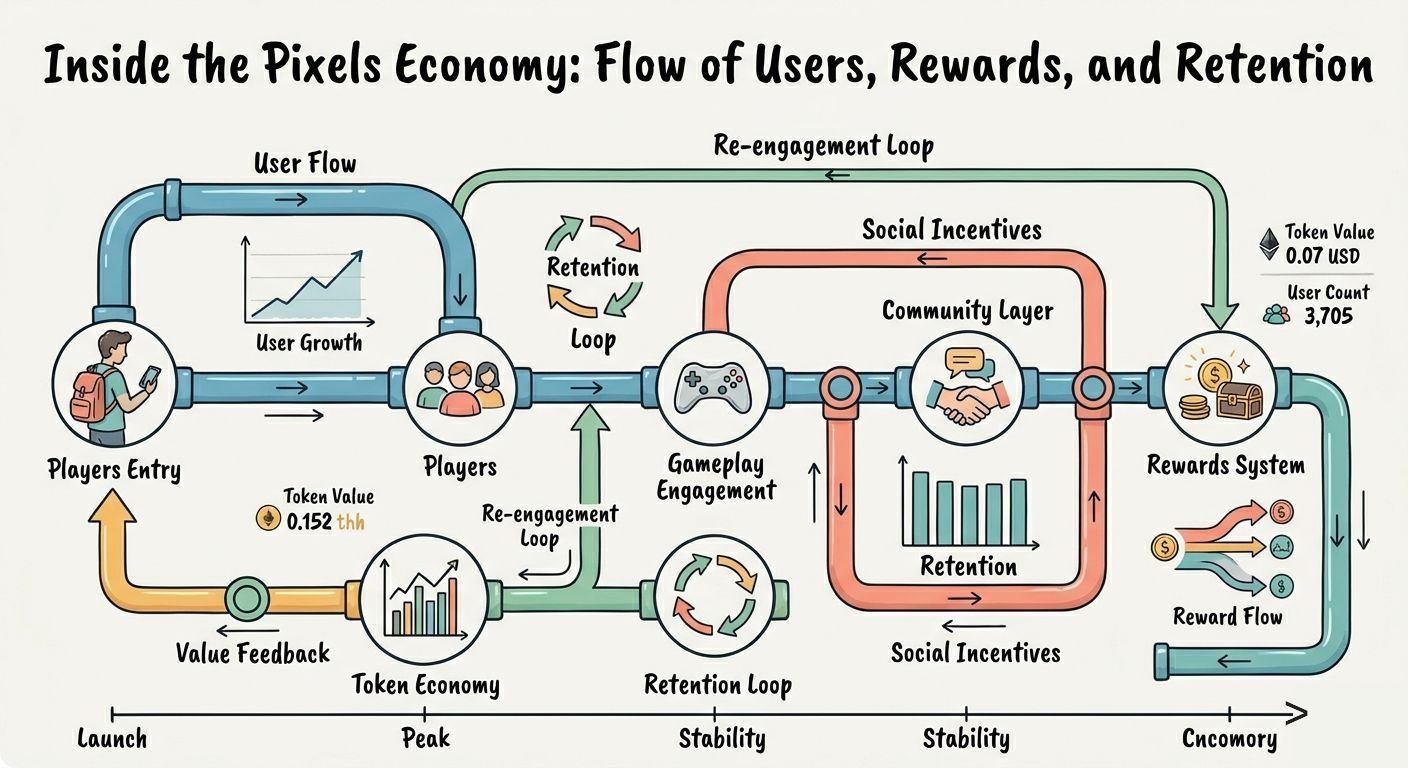
What I Noticed Inside the Ecosystem
Spending time observing Pixels, one thing stood out.
The community didn’t disappear.
It just stabilized.
Not explosive hype anymore. Not peak-cycle noise. But still active. Still present. Still playing.
And more importantly, many of them are no longer there for extraction.
They’re there because the game is enjoyable in itself.
That creates a different kind of baseline.
A quieter floor. But a potentially more durable one.
The Concern Beneath the Surface
Still, there’s a problem I can’t ignore.
And it sits at the core of nearly every blockchain game ever built.
Economics.
Pixels has clearly put more thought into its systems than most GameFi projects. Token design. Farming loops. Resource distribution. All of it looks more structured than average.
But there’s a difference between designing an economy carefully… and making it survive long-term real user behavior.
History isn’t kind here.
Almost every play-to-earn system eventually runs into the same wall: inflation inside the game loop. Rewards dilute. Progress starts feeling repetitive. The system turns into a treadmill instead of a world.
And when that happens, users slowly exit.
Not all at once. But steadily.
The Question: Can Social Stickiness Survive Economic Resets?
This is where the real uncertainty sits.
Even if Pixels has a stronger social layer than most, the question remains:
Can a community stay intact if the economic structure shifts multiple times?
Because at some point, something usually has to give.
Either the token model changes.
Or player incentives break.
Or engagement shifts elsewhere.
And when that happens, you find out what people were actually there for.
The world, or the yield.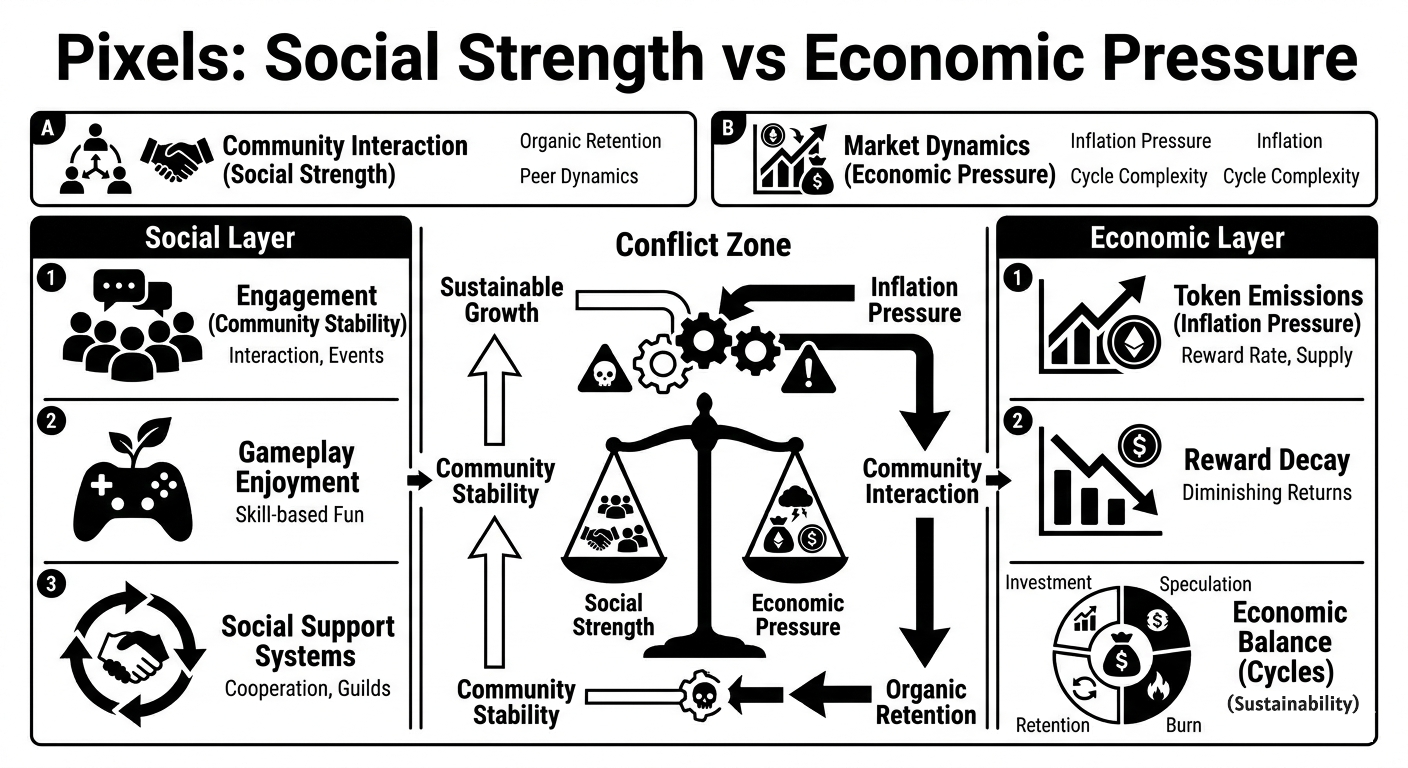
Timing Might Be the Real Edge
There’s another angle worth considering.
Timing.
If this cycle behaves like previous ones, the next phase of crypto adoption won’t be purely financial or institutional. It will likely lean more toward casual onboarding and social engagement.
Not everyone wants dashboards and trading interfaces.
Some users just want interactive systems that don’t feel like financial terminals.
And in that context, Pixels feels oddly positioned.
Not perfect. Not solved. But closer than most in its category.
That alone might be its strongest argument right now.
Final Thought
Still, I keep returning to the same concern.
The economic loop.
It doesn’t fully resolve in my head. It just sits there; persistent, unresolved.
Maybe it holds. Maybe it doesn’t. Maybe it evolves into something more stable over time.
For now, there’s no clean conclusion.
Just observation.
Charts are still uncertain. Sentiment still uneven.
So this isn’t conviction.
It’s closer to awareness.
Not this is the answer.
More like:
I’m watching this because I genuinely don’t know how it ends yet.
And in markets like this, that uncertainty is often where the real interest begins.
@Pixels #pixel $PIXEL #Pixel #PIXEL $币安人生 $ORCA