
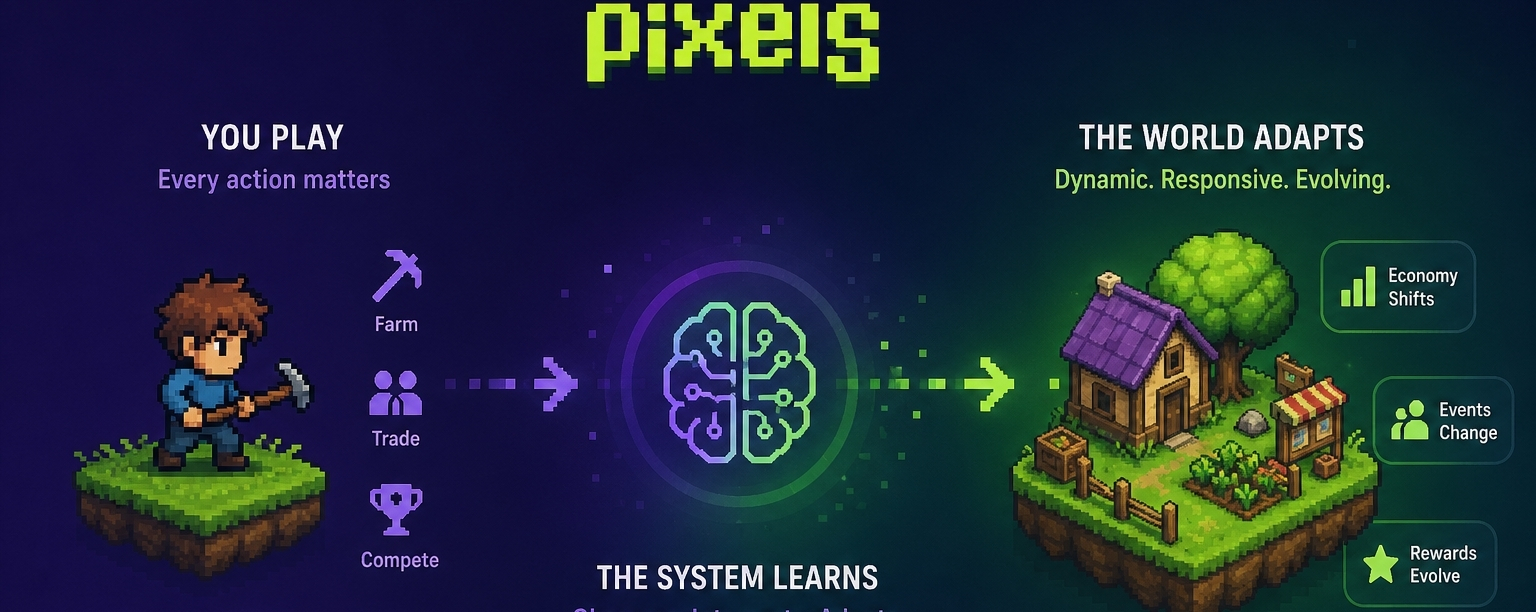
At first glance, Pixels looks familiar.
It has all the expected layers: a game loop, progression systems, and a token economy sitting somewhere in the background. Nothing about it immediately signals that it’s fundamentally different from everything else in the space.
But the longer you spend with it, the harder it becomes to define that way.
That’s the part that keeps pulling my attention back.
Because Pixels doesn’t fully behave like a typical game. And it’s not just because of the economy. It’s something deeper—something in how the system reacts to players.
It doesn’t feel static.
It doesn’t just sit there waiting for input.
It adjusts—quietly.
Once you start noticing that, the experience shifts. You’re still playing, still moving through familiar loops, optimizing, adapting. But underneath it all, there’s a subtle sense that something else is happening at the same time.
The system seems to be watching.
Not in an obvious or intrusive way, but in how it absorbs patterns—how it interprets behavior and feeds that back into outcomes. Things don’t feel entirely fixed. The edges aren’t rigid.
And that’s where it stops feeling like a traditional game—and starts feeling more like an experiment.
Not an unfinished one, but a live one.
Something that isn’t just designed once and left alone, but continuously shaped by how people interact with it.
From that perspective, the role of the player changes.
You’re not just participating in the system—you’re contributing to how that system evolves.
Every action becomes part of a larger feedback loop. Patterns form, get interpreted, and eventually influence how the environment responds. Even if you never see that process directly, you’re inside it.
And it doesn’t really stop.
Most players probably don’t think about it this way. They just play. They adjust to what works, optimize their path, and move forward.
But beneath that surface, the system is constantly learning from those choices—reshaping itself in response.
So where does Pixels land?
I’m not entirely sure yet.
Maybe it stabilizes into something more predictable—a system that balances behavior, incentives, and outcomes more cleanly.
Or maybe it continues evolving into something harder to categorize.
Either way, it’s not just a game you play.
It’s a system that’s quietly learning how to play you back.