
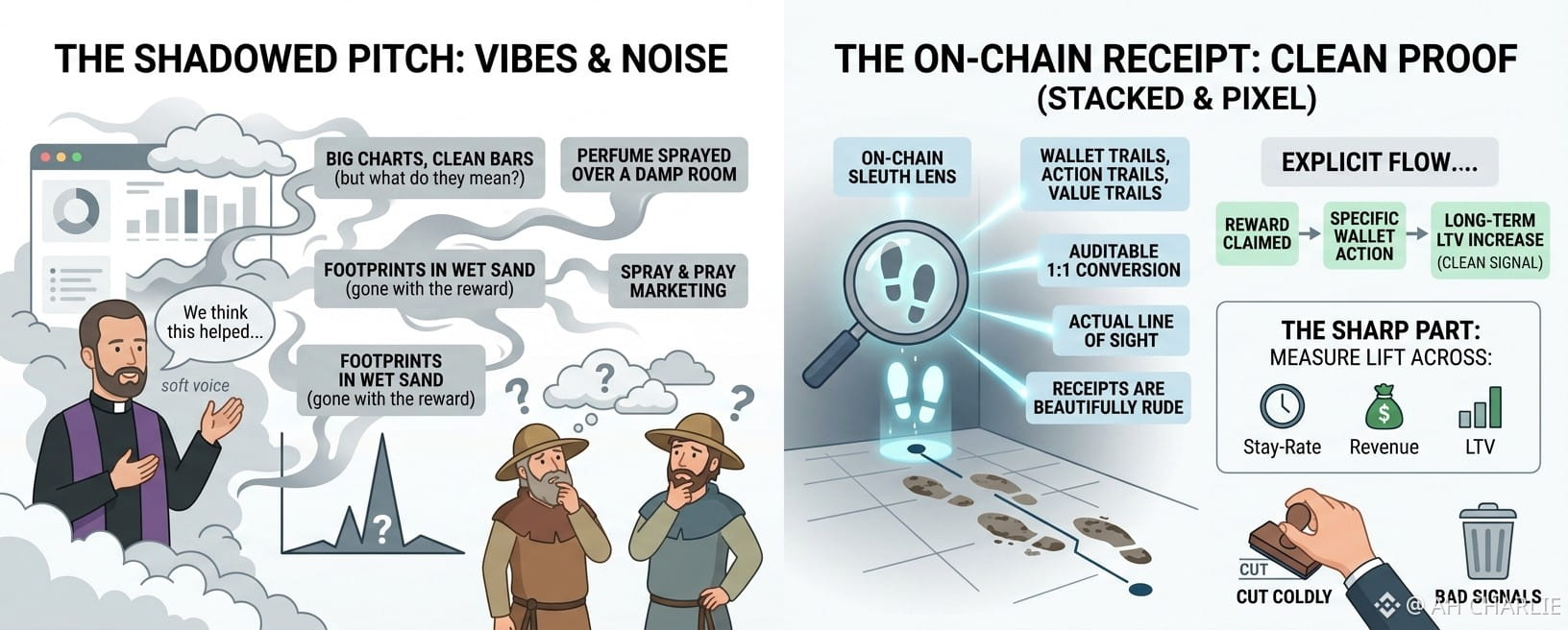
I’ve seen too many game pitches where the whole pitch deck smells like perfume sprayed over a damp room.
Big charts. Clean bars. Smooth claims. A soft voice saying, “This campaign performed well.”
Well… based on what?
That is where I start getting cold.
Because in gaming, spending is easy. Proving what the spend did is the ugly part. Most teams can show a spike. Few can show why that spike happened, who caused it, and whether the same user came back after the reward was gone. That is the real question. Not noise. Not vibes. Not some dashboard dressed like a priest.
For PIXEL, this is where Stacked starts to matter in a way that feels less cute and more serious.
Not because it makes rewards sound fun. Everyone can do that. A vending machine can do that if you give it enough tokens and low self-respect.
The sharp part is traceability.
Stacked gives studios a way to see lift across stay-rate, revenue, and LTV. Simple version: did the reward make the user stay longer, spend more, or become more worth serving over time?
That sounds basic. It is not.
Most game teams work with fog. They push a campaign, see numbers move, then argue in Slack like medieval farmers reading clouds. Was it the reward? Was it the update? Was it market mood? Was it whales farming clicks? Was it pure luck wearing sunglasses?
Stacked changes the question.
Instead of asking, “Did numbers go up?” the studio can ask, “Which wallet took which reward, did what after that, and did that action lead to value?”
That is a very different room.
It moves the talk from story to receipt.
And receipts are rude. Beautifully rude.
Because once you can follow wallet action, you can stop worshiping surface stats. A user showing up one time is not the same as a user coming back, doing real tasks, joining the loop, spending time, and adding value. One is a footprint in wet sand. The other is a path.
That is the part most people miss with PIXEL.
They keep staring at token talk like it is the whole book. It is not. The deeper game is whether PIXEL can sit inside a system where rewards are not blind candy. They are tracked. Checked. Linked back to action.
Okay, let’s be plain.
A studio does not need another pretty claim. It needs proof that the reward created a real result. If a wallet claims something, sells, leaves, and never comes back, that is not success. That is a small hole in the roof. If another wallet claims something, plays longer, spends inside the world, and keeps showing up, that is different. That is signal.
Stacked, at least in theory and in product design, is trying to separate those two cases.
That is why the “on-chain sleuth” lens fits PIXEL so well.
You are not just looking at a chart. You are looking at trails. Wallet trails. Action trails. Value trails. It is like following muddy boots through a house after someone swears they never came inside. Cute story. Floor says otherwise.
For game studios, this matters because ROI without proof is just theater with better fonts.
A lot of teams burn resources chasing broad attention. They shout into the market, pay for reach, then hope some of it sticks. Spray and pray. Classic human genius. Throw grain into the wind, then call birds a strategy.
But gaming is too costly for that now.
Studios need to know which reward worked, which group cared, which action led to more time in-game, and which users only came for the fast take. Not moral judgment. Just survival. Bad signals waste design time. Good signals help teams build better loops.
PIXEL’s edge here is not that it has a reward token. That part alone is not rare. The edge is whether Stacked can turn rewards into clean proof.
Because if a studio can audit the exact wallet action that led to a reward, it can judge real 1:1 conversion.
Not “we think this helped.”
Not “our model suggests.”
Not “the chart looked green for twelve minutes and everyone clapped like trained seals.”
Actual line of sight.
Reward given. Wallet acted. Result tracked.
That makes the whole system more serious.
It also forces better discipline. If a reward does not improve stay-time, spend depth, or LTV, then it should be cut. Coldly. No romance. No sacred cows. Games already have enough fantasy inside them. The business side does not need more.
This is where I respect PIXEL’s angle more than the usual Web3 gaming noise.
It is not asking me to believe in magic. It is asking me to inspect cause and effect.
That is the only kind of story I still trust.
My personal Opinion is simple, marketing is usually spray and pray with a nicer suit. If I cannot follow the money on-chain and see whether a user stayed, spent, or vanished after taking the reward, I do not trust the spend.
Attention can be rented.
Proof has to be earned.
And for PIXEL, Stacked’s real value may be this boring, brutal thing: helping studios stop guessing where value came from.
Not flashy.
Just useful.
Markets love fireworks. Operators need receipts.
