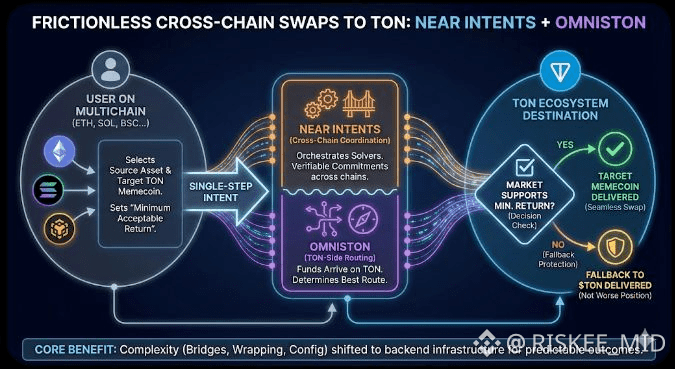
In the messy, fast-moving world of multichain DeFi, opportunity often arrives before your tooling catches up. New memecoins, sudden yield windows, and short-lived arbitrage slices demand speed — and speed usually runs headfirst into a tangle of bridges, token wrapping, and wallet reconfiguration. A recent integration between NEAR Intents and STON.fi’s liquidity aggregation protocol Omniston (explored in STON.fi’s MemeRepublic breakdown) demonstrates a different pattern: move the complexity behind the scenes, keep the UI simple, and make cross-chain execution predictable.
Below I unpack what that flow does, why it’s notable, and how it could reshape expectations for multichain UX — especially on TON.
The problem: multichain opportunities are time-sensitive and painful
Imagine you spot a promising TON memecoin drop while you hold assets on Ethereum, BSC, or Solana. Historically, turning that signal into a position required a sequence of manual steps: bridge funds, wait for confirmations, wrap or unwrap tokens, switch wallet networks, find the best on-chain route on TON, and — if anything fails — accept uncertain outcomes. Each step adds latency and points of failure. For traders and liquidity-seekers, that friction kills many good opportunities.
The idea: declarative intents + on-chain routing = frictionless access
The integration combines two complementary pieces of infrastructure:
NEAR Intents — a declarative layer where users express what they want (source asset, minimum acceptable return, target token), rather than how to execute it. Intents are matched to off-chain or on-chain “solvers” that commit to delivering the requested outcome.
STON.fi’s Omniston — a TON-side liquidity aggregator and routing engine that finds the best path for swaps once liquidity arrives on TON.
Put simply: a user declares the desired swap and acceptable parameters. NEAR Intents coordinates parties who promise to deliver cross-chain liquidity. When those commitments exist and the market condition is met, Omniston executes the optimal TON-side route — and the user receives the target token (or a TON-denominated fallback if the minimum output can’t be satisfied).
How it worked during MemeRepublic (practical flow)
The MemeRepublic campaign provided a real-world test:
1. A user on any supported chain selects a source asset (e.g., ETH, BSC token, SOL), specifies a minimum acceptable return, and picks a $TON memecoin as the target.
2. NEAR Intents broadcasts the request and solvers bid or commit to delivering the required liquidity across chains.
3. Those solvers move funds into TON or lock commitments tied to verifiable conditions.
4. Once funds are on TON, Omniston computes and executes the best on-chain routing to convert the delivered liquidity into the target memecoin.
5. If the market condition (the user’s minimum output) cannot be met, the system falls back to returning $TON rather than delivering a worse position — preserving value predictability for users.
The crucial innovation is that the user never needs to personally coordinate bridging or wallet switching; the orchestration happens as part of the intent-solver-routing stack.
Why this is meaningful (not just another hack)
A few aspects make the setup more than a one-off trick:
Separation of concerns, independent evolution. NEAR Intents handles cross-chain orchestration; Omniston optimizes TON-side routing. Each can improve or iterate without forcing simultaneous upgrades across the stack. That modularity is powerful for long-term resilience and innovation velocity.
Predictability through verifiable commitments. Instead of optimistic “try and see” flows, solvers explicitly commit to delivering liquidity under stated conditions. Execution happens only when those commitments are verifiable — reducing edge-case failures that usually plague cross-ecosystem flows.
User-centric UX model. Users declare goals, not mechanics. For most multichain participants this is a huge UX win: fewer steps, lower cognitive load, and less manual risk.
Safer fallback semantics. Returning value in $TON (a native asset on the target chain) rather than an arbitrary low-quality token avoids delivering worse-than-expected outcomes — another user-protecting design choice.
Risks and limitations (what to watch)
No architecture is risk-free. Some considerations:
Solver reliability and incentives. The whole model depends on solver capacity, honest behaviour, and aligned economics. Poorly designed incentive structures or insufficient solver liquidity could degrade the UX.
Latency and front-running surface. Cross-chain orchestration can still introduce delays; sophisticated MEV strategies might try to exploit predictable flows. Execution ordering and privacy-preserving mechanisms will matter.
Liquidity fragmentation and fees. Even with aggregation, the path chosen may incur multiple fees across chains; solvency and fee transparency are important for user trust.
Operational complexity under the hood. While users see declartive intents, the backplane executes complex sequences. Bugs or oracle failures in those sequences would have outsized impact.
What this implies for TON and multichain DeFi
As TON’s DeFi stack matures, flows like NEAR Intents + Omniston point toward a new expectation: multichain participation should feel single-click and predictable. If proven robust, these patterns can bootstrap liquidity flows into TON by lowering the entry cost for external capital — and make TON-native routing protocols a standard destination for cross-chain settlement.
More broadly, the combination is an example of a powerful design pattern for multichain DeFi:
Declarative intent layers reduce user friction.
Solver markets provide execution elasticity and capture arbitrage / service value.
Chain-native aggregators ensure optimal on-chain outcomes.
Together, they make complex cross-chain actions composable and more user-friendly — and that’s exactly the kind of UX shift needed if multichain finance is to scale beyond specialized traders.
Conclusion
The NEAR Intents + Omniston integration is a small but telling step toward hiding multichain complexity behind robust infrastructure while preserving predictable outcomes. During MemeRepublic it showed up as a practical mechanism that let demand flow from many chains into TON memecoins with far less friction than the old manual approach. If architects keep focusing on verifiable commitments, clear fallback semantics, and modular evolution of layers, these hybrid flows could move from clever experiments to foundational primitives for multichain DeFi.
$ETH