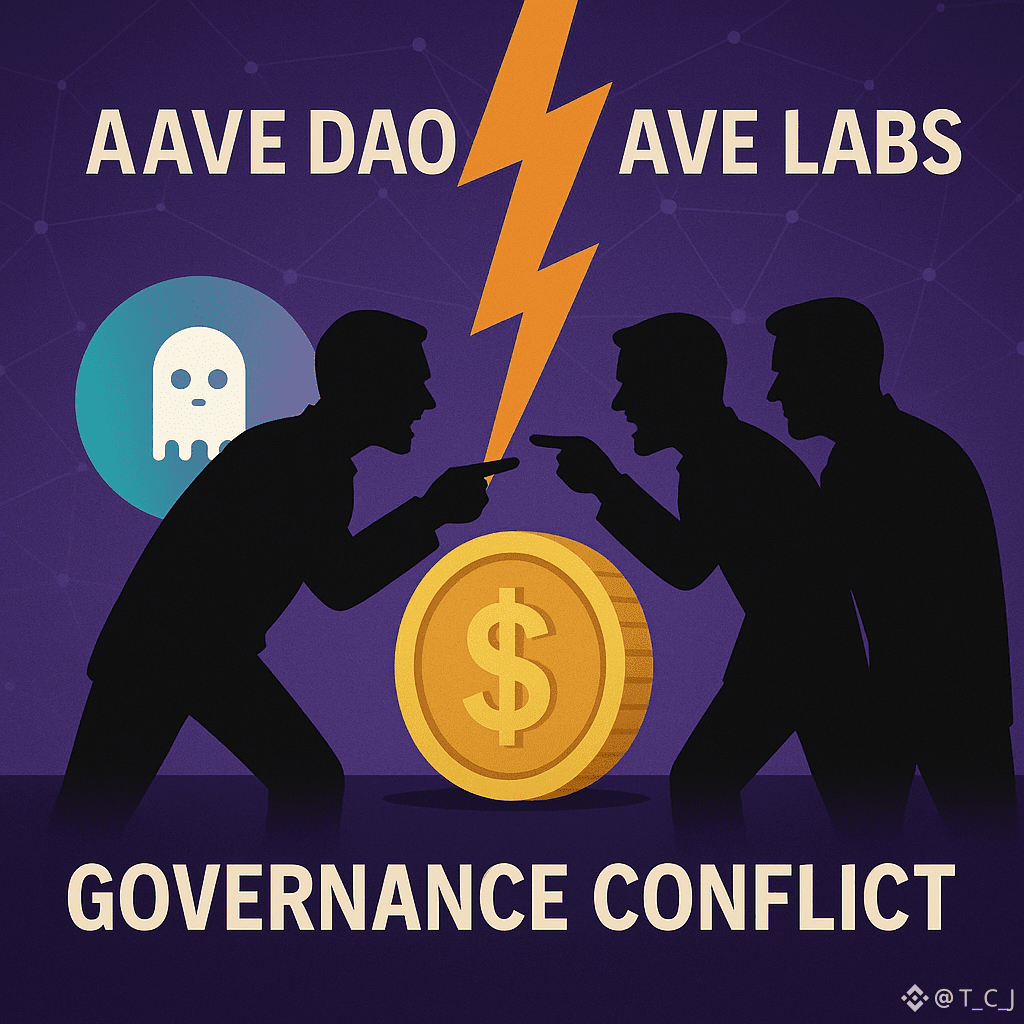
The real risk in DeFi isn’t always smart contracts—it’s governance.
When Aave DAO and Aave Labs began clashing over roughly $10 million in protocol revenue, it exposed a tension most traders underestimate: who truly controls a decentralized protocol once real money is on the table?
I’ve traded and invested through enough DAO dramas to know this isn’t just noise. It’s a signal.
What’s actually happening?
At a high level, Aave DAO—the token-holder governed body—controls the protocol.
Aave Labs—the original development company—builds, maintains, and steers much of its technical direction.
That model works… until meaningful revenue accumulates.
The current dispute centers on:
Who has authority over protocol-generated revenue
How much autonomy Aave Labs should retain
Whether DAO governance is being respected—or bypassed
$10 million isn’t just a number. It’s a line in the sand.
Why this matters beyond Aave
I don’t look at this as an “Aave problem.” I see it as a DeFi governance stress test.
Many protocols are built the same way:
A DAO on paper
A core team in practice
Token holders voting, but not executing
When revenues are small, alignment is easy.
When revenues grow, incentives diverge.
That’s when governance stops being theoretical.
The core tension: decentralization vs efficiency
Let’s be honest—DAOs are slow.
From a builder’s perspective:
Shipping upgrades requires coordination
DAO votes can delay execution
Token holders may not understand technical tradeoffs
From a token holder’s perspective:
Revenue belongs to the protocol
Control without enforcement is meaningless
“Trust us” defeats decentralization
Neither side is entirely wrong.
But unresolved tension here creates risk.
What traders and investors should pay attention to
When I evaluate governance disputes, I focus less on headlines and more on structure.
Here are the questions that matter:
Who controls the treasury, in practice—not theory?
Can the DAO enforce decisions without relying on the core team?
Are incentives aligned long-term, or only culturally aligned?
What precedent does this set for future revenue?
Governance risk doesn’t show up in charts—until it does.
Lessons this conflict reinforces
I’ve seen similar patterns across DeFi, and the outcomes are predictable.
1. Token value is governance value
If token holders can’t influence revenue, the token’s role weakens over time.
2. “Decentralized” is a spectrum, not a switch
Protocols evolve. Early-stage control often lingers longer than expected.
3. Revenue changes everything
Disputes rarely happen when protocols are struggling. They happen when success raises stakes.
4. Governance clarity is a competitive advantage
Protocols with clean, enforceable governance attract more institutional confidence.
What this could mean for Aave going forward
Best-case scenario:
Clear revenue frameworks
Defined boundaries between DAO and Labs
Stronger long-term legitimacy
Worst-case scenario:
Governance gridlock
Loss of trust from token holders
A slow erosion of decentralization credibility
Markets don’t price these outcomes immediately—but they remember them.
My takeaway as a trader
I don’t panic over governance disputes—but I don’t ignore them either.
When capital, control, and credibility collide, the outcome shapes:
Token narrative
Institutional participation
Long-term protocol valuation
Aave remains one of DeFi’s most important protocols.
But this moment will define whether it matures into a truly DAO-led system—or settles into something more corporate than advertised.
And in DeFi, what you promise matters almost as much as what you build.
Curious to hear how others are thinking about DAO power versus builder control—because this won’t be the last protocol to face this test.
#AAVE #defi #DAOs #CryptoGovernance #CryptoInvesting #ProtocolRisk #Web3